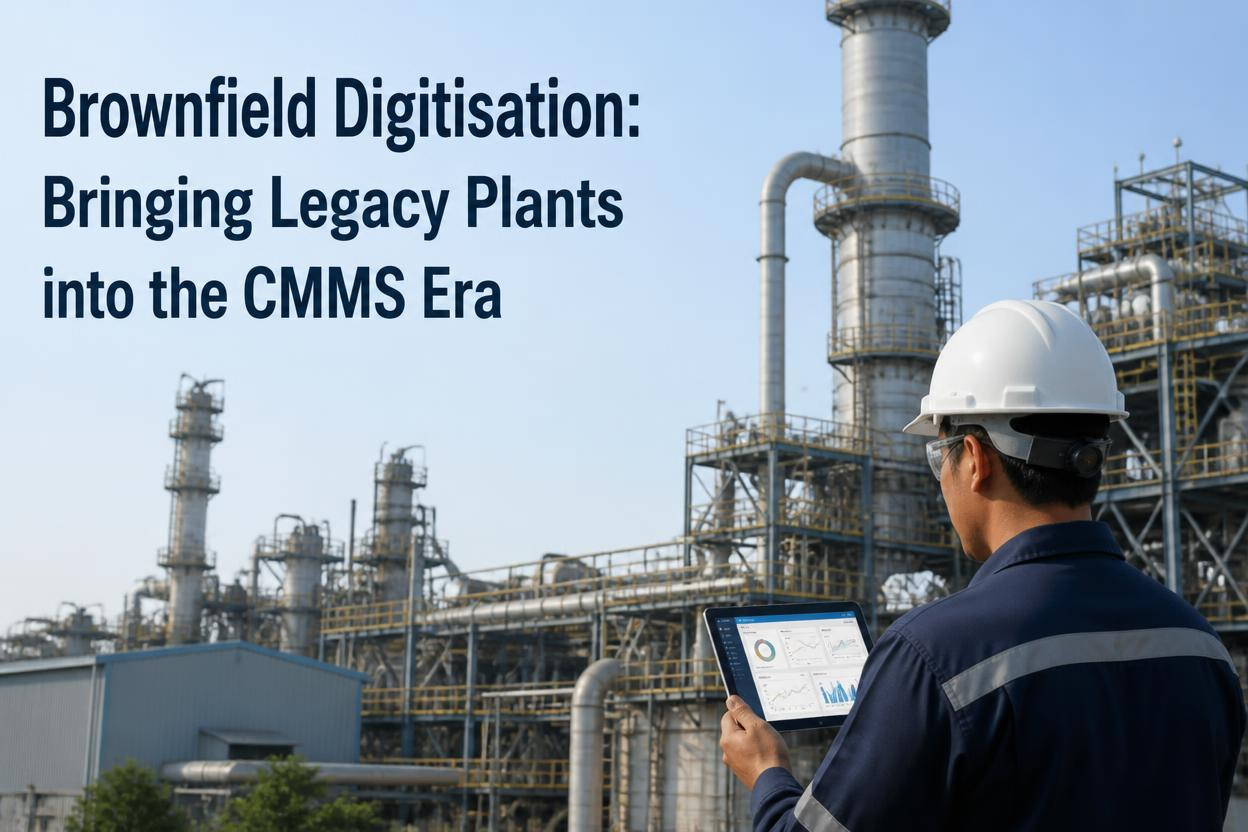
Almost every plant a transformation lead is asked to modernise was built years, sometimes decades, before anyone used the phrase "Industry 4.0." Brownfield isn't the exception in UK manufacturing — it's the default. The mistake most digitisation projects make is trying to leap straight to sensors and predictive dashboards on a site that doesn't even have a reliable asset register yet. A phased approach respects both the budget and the engineers who've kept that 30-year-old line running on memory and instinct. A CMMS like OxMaint is built to start at exactly the stage a brownfield plant is actually at, not the stage a vendor slide deck assumes.
Start Digitising Wherever Your Plant Actually Is
Build a live asset register, digitise paper PM schedules, and add condition monitoring in phases that match your budget and your team's pace.
Brownfield Is the Rule, Not the Exception
Most digitisation case studies feature a shiny new greenfield site. Most real transformation budgets are spent on plants that have been running for decades already.
The Three-Phase Route That Actually Works
Build the Asset Register
Walk the floor and capture every asset, location, and parent-child relationship before touching a single sensor or schedule.
Digitise the Paper PMs
Move existing preventive maintenance routines into the system as they are, before trying to optimise or redesign them.
Add Condition Monitoring
Fit sensors only to the assets where downtime cost justifies it, once the basics are already trusted and in use.
Handling the Engineer Pushback
The technical rollout is rarely the hard part. The harder part is the engineer who's kept a machine running for fifteen years without a system telling them how, and doesn't see why that should change now.
| What Engineers Say | What's Really Being Said | How to Respond |
|---|---|---|
| "I don't need a system, I know this machine" | Their knowledge feels at risk of being replaced, not supported | Frame the register as capturing their knowledge, not overriding it |
| "We tried something like this before and it died" | A previous rollout was too big, too fast, or never used day to day | Show the phased approach and start with their most painful asset first |
| "This will slow me down" | Mobile logging feels slower than a habit built over years | Prove speed with a two-minute log on their own most-used task |
| "Sensors won't tell us anything we don't know" | Fair, for an asset they already watch closely every shift | Save sensors for the assets nobody has time to watch closely |
Brownfield Digitisation Maturity
Paper and Memory
Asset knowledge lives with individual engineers, and maintenance schedules exist on paper sheets or not at all.
Digitised but Basic
A live asset register and digital PM schedule exist, but the plant still reacts to failures rather than predicting them.
Phased and Condition-Ready
Condition monitoring sits on top of a trusted asset and PM foundation, targeted at the equipment where it earns its cost.
Why the Order of Operations Matters More Than the Technology
A sensor feeding data about an asset that isn't properly registered just produces noise nobody can act on. A predictive alert with no digitised PM history to compare against is a number without context. The technology in each phase isn't complicated — the discipline is in not skipping ahead because a vendor demo made phase three look more exciting than phase one.
Plants that get this right treat the asset register as infrastructure, not a project with an end date. Everything else — digitised PMs, sensors, predictive models — sits on top of it, and only works as well as that foundation was built. Sign up free to start building your asset register today, or book a demo to map out a phased digitisation route for your own plant.
Digitise in Phases Your Team Will Actually Use
Asset register, digitised PMs, and condition monitoring rolled out in an order that respects budget and earns engineer trust.
Frequently Asked Questions
Do we need a full asset register before starting anything else?
Yes, a trustworthy asset register is the foundation every later phase depends on, since digitised PMs and sensor data both need to attach to something accurate.
Which assets should get condition monitoring first?
Start with the assets where unplanned downtime is most costly and least visible to the team already watching them closely on the floor.
How do we get engineer buy-in for a digitisation project?
Framing the system as capturing their knowledge rather than replacing it, and starting with the asset that causes them the most pain, tends to work better than a plant-wide mandate.
What if a previous digitisation attempt already failed here?
A failed rollout is usually a sign the scope was too large too fast, so restarting with a narrow, phased approach on one problem asset can rebuild confidence.
How long does a realistic brownfield digitisation timeline take?
The asset register phase can often be completed in weeks, with digitised PMs and targeted condition monitoring following in stages over the following months rather than all at once.