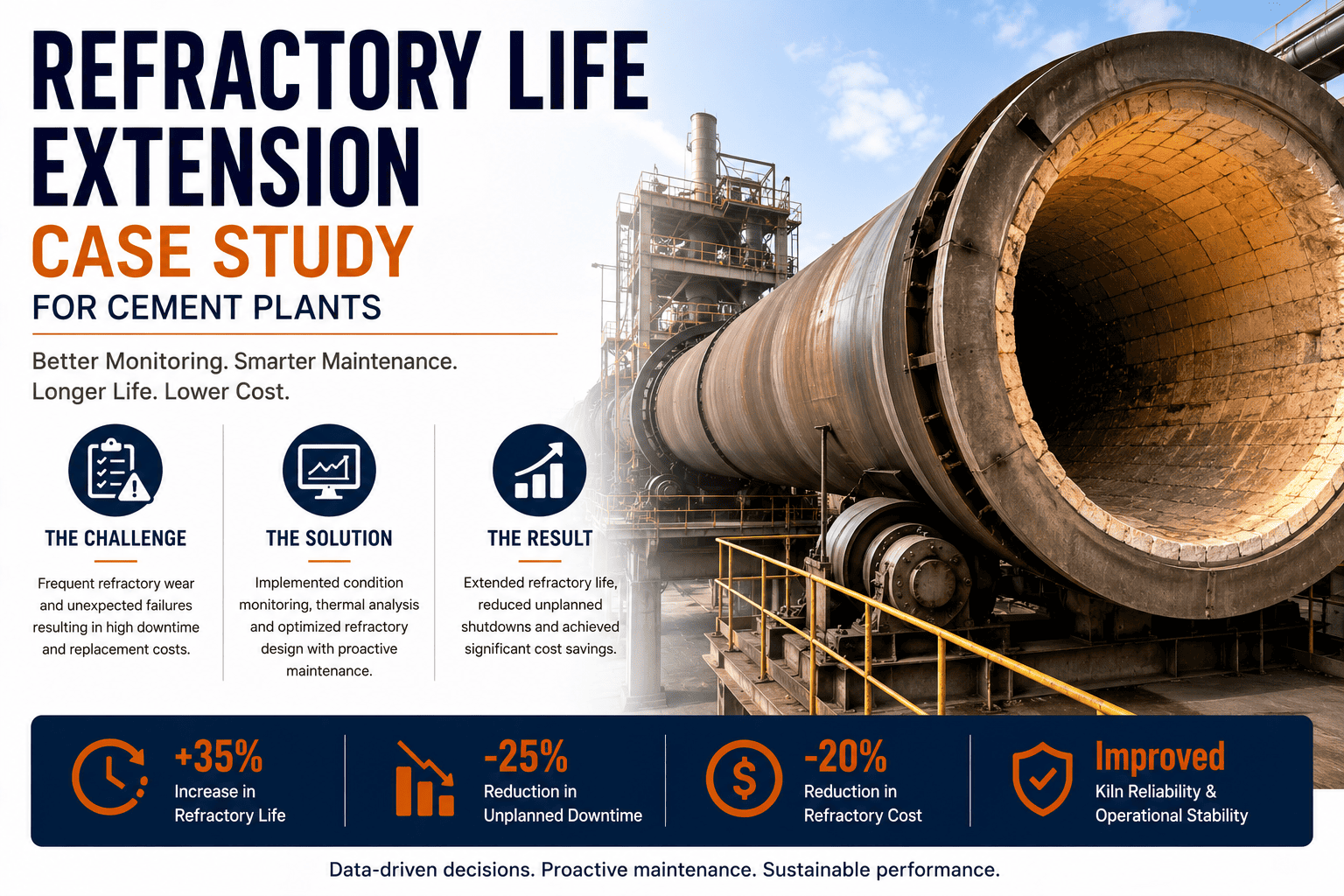
A rotary kiln refractory lining doesn't fail all at once. It thins gradually, shift after shift, until a hot spot appears on the shell and the plant is staring down an unplanned shutdown mid-campaign. This case study looks at how a mid-sized cement plant moved from reactive refractory replacement to a predictive routine using shell temperature scanning and a CMMS, and what changed in lining life, downtime, and planning once they did. Sign up to see how a similar approach could work for your kiln.
+28% Lining Life
Increase in average refractory campaign length after the change
2 Unplanned Stops
Down from 5 unplanned kiln stops per year to 2 in the following year
Daily Shell Scans
Frequency of shell temperature readings logged against the kiln asset
Weeks Of Notice
Advance warning gained before the next hot spot needed a repair
The Challenge: Refractory Failures Kept Arriving Without Warning
Where Things Stood Before
The plant relied on manual shell walks with handheld thermal cameras, done inconsistently across shifts and rarely logged against the same reference points. Hot spots were often caught only once they were visibly glowing, by which point a section of lining was already compromised and a stop was unavoidable.
The Approach: Continuous Scanning Tied To A CMMS
1
Fixed-Point Shell Scanning
A rotating shell scanner was installed to take continuous temperature readings around the kiln's full circumference
2
Baseline & Threshold Setup
Normal shell temperature ranges were logged against the kiln asset in the CMMS to define what counted as a real deviation
3
Automatic Work Order Triggers
A reading drifting past its threshold automatically raised a work order for a closer inspection at the next opportunity
4
Planned Repairs Instead Of Emergency Stops
Refractory patches were scheduled into the next planned outage rather than forcing an immediate kiln stop
Give Your Refractory The Same Head Start
Oxmaint ties shell temperature trends to your kiln asset and raises a work order automatically when a reading drifts, so a hot spot becomes a planned repair, not an emergency stop. Sign up for a free trial to get started, or book a demo to see it in action.
Before And After: What Actually Changed
| Metric |
Before |
After |
| Average lining campaign length |
Roughly 9 months |
Roughly 11.5 months |
| Unplanned kiln stops per year |
5 |
2 |
| Shell temperature checks |
Manual walk, inconsistent |
Continuous, logged automatically |
| Repair planning |
Reactive, emergency stops |
Scheduled into planned outages |
Where A CMMS Fits Into Refractory Life Extension
Oxmaint connects shell scanner data directly to the kiln asset record, tracking temperature trends over the full lining campaign so a hot spot becomes a scheduled repair well before it forces an unplanned stop.
Frequently Asked Questions
Q
How does shell scanning help extend refractory life?
Continuous shell temperature data catches a lining thinning down gradually, well before it becomes a visible hot spot, giving the plant weeks of notice to plan a repair instead of reacting to an emergency.
Q
Is this approach only useful for large cement plants?
No, the underlying idea scales down easily since it just needs a temperature reading source and a system to log trends and raise a work order, which works whether the plant runs one kiln line or several.
Q
Can a CMMS raise work orders from sensor data automatically?
Yes, a CMMS can be set to raise a work order automatically once a tracked reading, like shell temperature, drifts past a defined threshold against the equipment record.
Turn Refractory Wear Into A Planned Repair, Not A Surprise
Oxmaint logs shell temperature trends against your kiln asset and raises a work order the moment something drifts. Sign up for a free trial to see it work on your data, or book a demo to walk through it live.