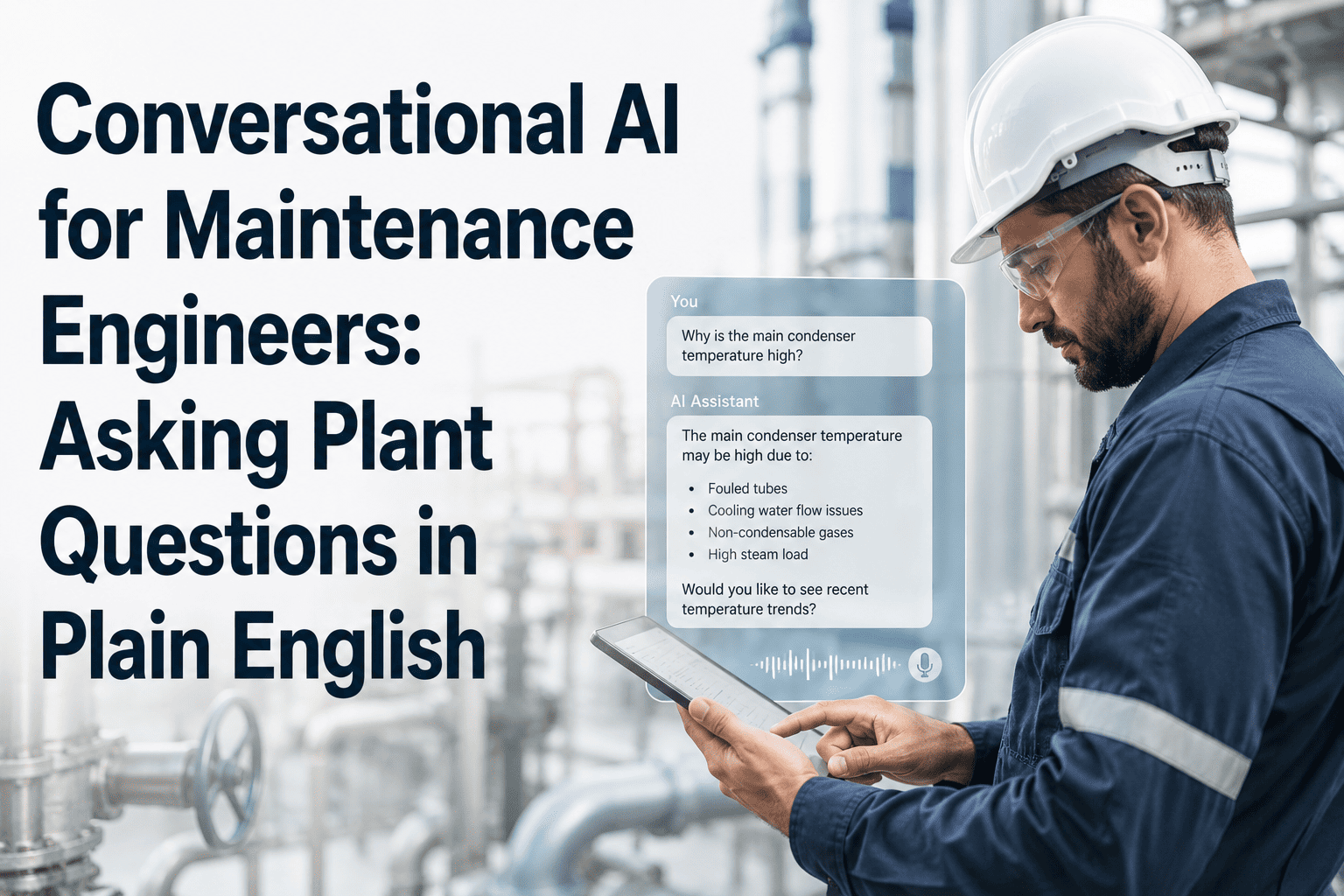
A reliability engineer on night shift wants to know why Line 3 has had three stoppages in the last fortnight. In a traditional workflow, that question takes 25 minutes: open the CMMS, filter by asset, export to a spreadsheet, look for the pattern. With a conversational AI grounded in the plant's actual CMMS data, the same question takes 15 seconds — typed in plain English, answered with failure modes, dates, cause codes, and a suggested action. This is not a future scenario. It is what is in production at leading manufacturing sites in 2026, and the gap between plants that have it and plants that do not is already visible in MTTR and shift productivity numbers.
Ask Your CMMS Questions in Plain English — and Get Answers Grounded in Your Plant's Actual Data
OxMaint's conversational AI is trained on your work order history, asset register, and failure codes — so engineers get specific, actionable answers, not generic guidance. Sign up free or book a demo to see the plant AI in action.
Why "Just Search the CMMS" Is Not Enough Anymore
The CMMS was designed to store and retrieve structured maintenance records. It does that well. What it does not do well is answer questions — and engineers ask questions, not database queries. The gap between the question an engineer has ("which failure mode is costing us the most downtime on our pump fleet?") and the query required to answer it from a traditional CMMS ("filter work orders by asset class, export to CSV, pivot by failure code, sort by total duration") is exactly where conversational AI operates.
The productivity gain compounds across every shift. An engineer who spends 20 minutes less per day on CMMS data assembly has an additional 80 hours per year for actual reliability work — root cause analysis, PM optimisation, condition monitoring programme design. That is the real value of conversational AI in maintenance: not replacing the engineer, but removing the administrative layer that prevents them from doing engineering. Sign up free on OxMaint to deploy conversational AI grounded in your plant's actual CMMS data.
What "Grounded in Your Plant's Data" Actually Means
This distinction is the most important technical concept for any Tech Lead evaluating conversational AI for maintenance. A general-purpose AI (a public LLM with no connection to your systems) cannot answer plant-specific questions. It can explain what MTBF means, but it cannot tell you what MTBF is on Compressor C-201 this quarter, because it has never seen your work order history. Grounded conversational AI is different in a specific technical way:
Twenty Questions Engineers Actually Ask — and What the AI Returns
The questions below are drawn from real maintenance engineering workflows. The value of conversational AI is best understood by reading the question category and imagining how long each one takes to answer today through a traditional CMMS interface.
Every one of these questions is answerable today through a traditional CMMS — but only by someone who knows how to navigate the reporting interface, remembers what the filters are, and has 15–30 minutes available. Conversational AI removes all three barriers simultaneously. Book a demo to see these questions answered live from OxMaint data.
The Technical Architecture: What Tech Leads Need to Understand
For Tech Leads evaluating conversational AI for a plant environment, three architectural questions determine whether the system will actually work at scale.
Where Conversational AI Fits in the Maintenance Technology Stack
Conversational AI does not replace any existing layer of the maintenance technology stack. It adds a natural language interface on top of the data that already exists, making it accessible to more people, faster. Understanding where it sits helps Tech Leads scope the implementation correctly.
The practical implication: the richer and better-structured the data in your CMMS, the more accurate the conversational AI answers will be. Structured failure codes, complete work order histories, and a well-maintained asset hierarchy are not just maintenance best practices — they are the fuel that makes conversational AI reliable enough to trust. Sign up free on OxMaint to build the data foundation that makes conversational AI answers trustworthy from day one.
The Three Maturity Levels of Conversational AI in Maintenance
Stop Searching. Start Asking. OxMaint's Conversational AI Knows Your Plant.
Every work order, failure code, asset history, and PM record in OxMaint is queryable in plain English — no report-building, no spreadsheet exports, no CMMS navigation training required. Sign up free to deploy conversational AI grounded in your plant's data, or book a demo to see it answer questions from a live CMMS dataset.
Frequently Asked Questions
What is conversational AI for maintenance and how is it different from a standard CMMS search?
Conversational AI for maintenance is a natural language interface built on top of your CMMS data that lets engineers ask questions in plain English and receive structured, data-backed answers in seconds. A standard CMMS search requires the user to know the right filters, date ranges, and report parameters — and then interpret the raw output themselves. Conversational AI accepts an unstructured question ("why did Line 3 stop three times last week?"), retrieves the relevant work orders, failure codes, and cause data, and synthesises an answer that directly addresses the question. The practical difference is approximately 20–30 minutes of data retrieval and analysis compressed into under 15 seconds — per question, per shift, per engineer.
Can a general-purpose AI like ChatGPT answer maintenance questions about my plant?
A general-purpose LLM can explain maintenance concepts, define MTBF, describe bearing failure modes, and suggest generic troubleshooting approaches — all accurately. It cannot answer plant-specific questions because it has no access to your CMMS data: it does not know the work order history on Compressor C-201, the current stock level of mechanical seals for your pump fleet, or which failure cause has been appearing most frequently on your conveyor line in the last quarter. Useful plant answers require an AI grounded in your specific data through a retrieval layer connected to your CMMS — not a general model that generates plausible-sounding answers from training data alone.
What data quality does conversational AI require to produce reliable answers?
The reliability of conversational AI answers is directly proportional to the quality of the underlying CMMS data. The three most important data quality requirements are: structured failure codes (mode, cause, and effect captured as dropdowns rather than free text — so the AI can aggregate and pattern-match rather than interpret inconsistent language); complete work order histories (every failure event logged with a closed work order containing the failure code and resolution); and a properly structured asset hierarchy (failures recorded at the equipment unit level, not just a location or system). Plants with well-maintained structured CMMS data get highly specific, actionable answers. Plants with free-text failure records and incomplete work order histories get less reliable outputs — which is itself an argument for improving data discipline as a precursor to AI deployment.
How does role-based access control work with conversational AI?
In a well-designed conversational AI implementation, the AI layer inherits the role-based access controls of the underlying CMMS. A technician querying the AI can only receive answers based on data they are authorised to see in the standard CMMS — they cannot bypass access restrictions by asking a natural language question that happens to touch restricted data. This is a critical governance requirement that Tech Leads should verify before deployment: the AI should not provide a route around existing data permissions, and queries from different user roles (technician, supervisor, engineering director) should be scoped to their respective access levels automatically.
What is retrieval-augmented generation and why does it matter for plant AI?
Retrieval-augmented generation (RAG) is the architecture that makes grounded plant AI possible. When a question is asked, a retrieval layer searches the connected data sources (CMMS work orders, asset records, parts inventory) for the most relevant records, and provides those records as context to a language model that generates the answer. This is preferable to fine-tuning a model on historical plant data because it keeps answers current — a new work order created this morning is immediately queryable, rather than requiring model retraining. It also makes answers more verifiable, since the AI can cite the specific source records that support each claim — reducing hallucination risk and allowing engineers to cross-check answers directly against the underlying CMMS records. Sign up free on OxMaint to deploy RAG-powered conversational AI grounded in your plant's live data.