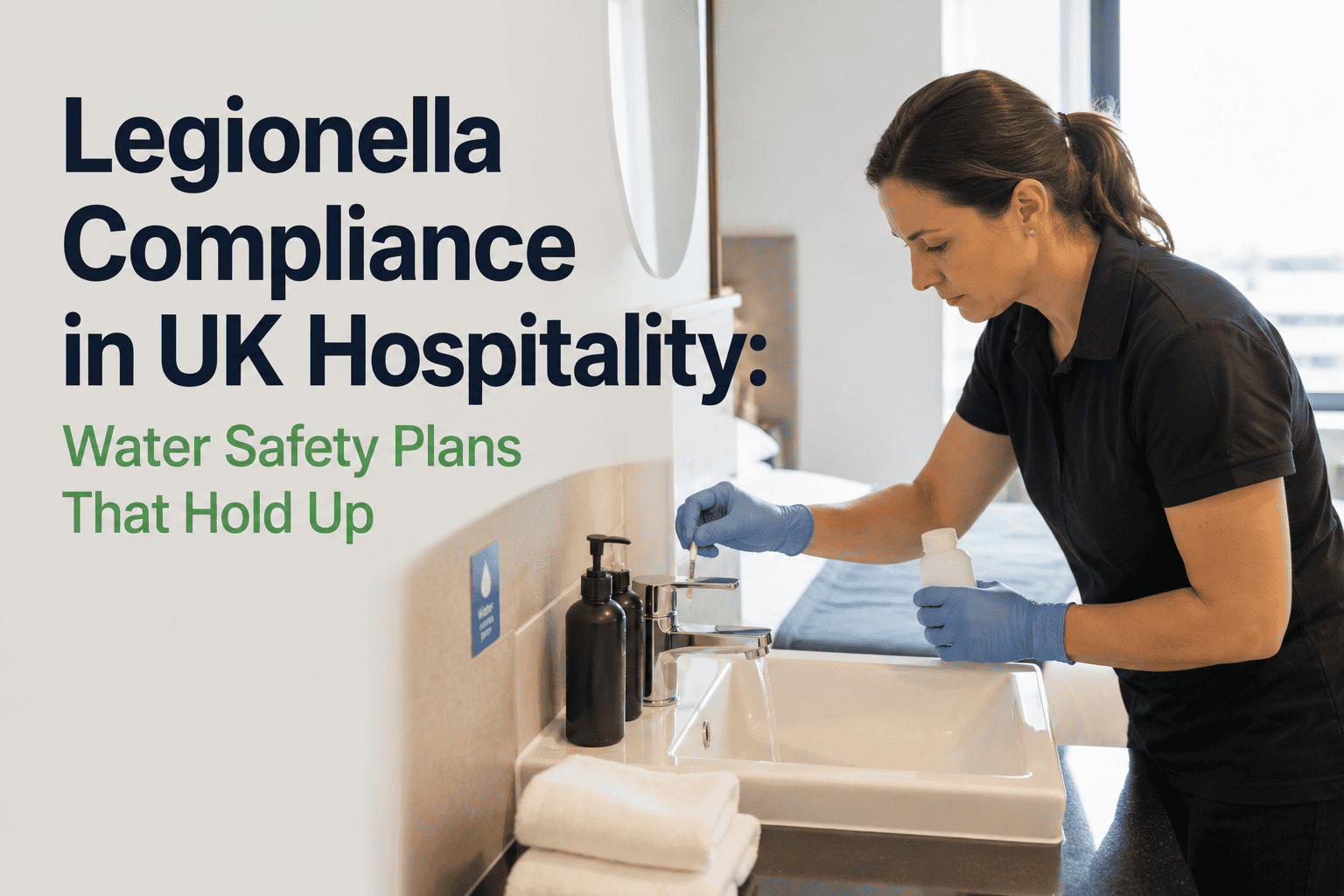
A hotel with fifty rooms rarely runs all fifty showers every week. Off-season closures, low-occupancy floors, and rooms held back for refurbishment all create exactly the stagnant, lukewarm water conditions legionella bacteria need to multiply. Guests never see this risk, but engineers live with it daily, and a written scheme that looks fine in a filing cabinet is worth nothing if the temperature checks behind it were never actually done. A CMMS like OxMaint keeps sentinel point temperature logs, flushing records, and risk assessment reviews in one place, so a water safety plan holds up when someone actually asks to see it.
Build a Legionella Water Safety Plan That Holds Up
Sentinel point temperature logs, flushing schedules, and risk assessment reviews, organised and ready for inspection.
The Legal Layers: L8, HSG274, and What Applies to Hotels
| Document | What It Covers | Practical Meaning for Hotel Engineers |
|---|---|---|
| ACOP L8 | The legal framework and duties under health and safety law | Sets what a dutyholder must do; departing from it shifts the burden of proof onto the hotel |
| HSG274 Part 2 | Technical guidance for hot and cold water systems | The section that applies to almost every hotel: taps, showers, tanks, and calorifiers |
| COSHH 2002 | Legal duty to assess and control biological hazards | The underlying law that makes a legionella risk assessment a requirement, not a suggestion |
Four Pillars of a Water Safety Plan That Holds Up
Dutyholder Appointment
A named, competent person formally responsible for managing legionella risk across the property.
Risk Assessment
A documented assessment covering every water system, reviewed at least every two years or after any significant change.
Written Scheme of Control
The operational backbone: what to monitor, how often, and exactly what to do if a reading falls outside the safe range.
Records and Monitoring
Temperature logs, flushing records, and remedial actions kept for at least five years and ready on request.
The Numbers Every Hotel Engineer Should Know
Hot Water Storage
Calorifiers should store hot water at 60°C or above, the temperature that kills legionella outright.
Hot Water at Outlet
Hot water should reach the tap or shower head at 50°C or above within one minute of running.
Cold Water Limit
Cold water should be stored and distributed below 20°C, where legionella growth slows significantly.
The Danger Zone
Between 20°C and 45°C, legionella thrives, which is exactly the range a lukewarm, low-use outlet can sit in.
Building a Plan That Survives Inspection
Map Every Outlet
Identify sentinel points, the nearest and furthest outlets from storage, plus any known low-use taps and showers.
Set a Monitoring Rhythm
Monthly temperature checks at sentinel points as a baseline, more frequently for higher-risk areas.
Flush Low-Use Outlets
Run water through closed rooms and out-of-season areas on a fixed schedule, not only before reopening.
Log Every Reading
Record every check as it happens, so the written scheme is backed by evidence rather than a signature.
Water Safety Plan Maturity
Document Without Evidence
A written scheme exists, but temperature checks are inconsistent and low-use outlets get flushed only when someone remembers.
Monitored but Manual
Checks happen reliably, but logs live on paper sheets that take time to compile into an audit-ready record.
Continuously Evidenced
Every reading, flush, and review is logged in real time, producible in minutes for an HSE inspector or auditor.
Why Hotels Carry Extra Risk
Hotels are not a typical office water system. Seasonal closures, refurbishment holds, and rooms that simply don't sell for weeks at a time create the low-use conditions where stagnant water sits in the legionella danger zone. HSG274 flags voids and low-use outlets as a specific stagnation risk, and a hotel with dozens of rarely used rooms has more of them than almost any other building type. ACOP L8's legal status also matters here: because it carries a reverse burden of proof, a hotel that departed from its guidance has to actively demonstrate its own approach was just as effective, which is a difficult position to argue from after an incident.
A defensible water safety plan isn't built the week before an inspection. It's built from monthly readings that were actually taken, flushes that actually happened, and a record that shows it. Sign up free to start logging your sentinel point readings today, or book a demo to see how a hotel engineering team keeps its water safety plan continuously evidenced.
Turn Your Written Scheme Into Continuous Evidence
Temperature logs, flushing records, and risk assessment reviews, always current and ready for inspection.
Frequently Asked Questions
Is ACOP L8 itself the law, or just guidance?
ACOP L8 is not law in itself, but it carries special legal status; departing from it shifts the burden onto the dutyholder to prove their alternative approach was equally effective.
How often does a hotel's legionella risk assessment need reviewing?
At least every two years, and sooner following any significant change to the water system, building use, or occupancy.
Who has to be the dutyholder in a hotel?
Typically a director or senior manager formally named as responsible for legionella risk, though the day-to-day monitoring is often delegated to engineering staff.
How long must temperature and monitoring records be kept?
Records of risk assessments, the written scheme, monitoring results, and remedial actions must be retained for at least five years.
Do closed or rarely used rooms need any special attention?
Yes, low-use outlets and voids carry a specific stagnation risk and should be flushed on a fixed schedule, not just before a room is put back into inventory.