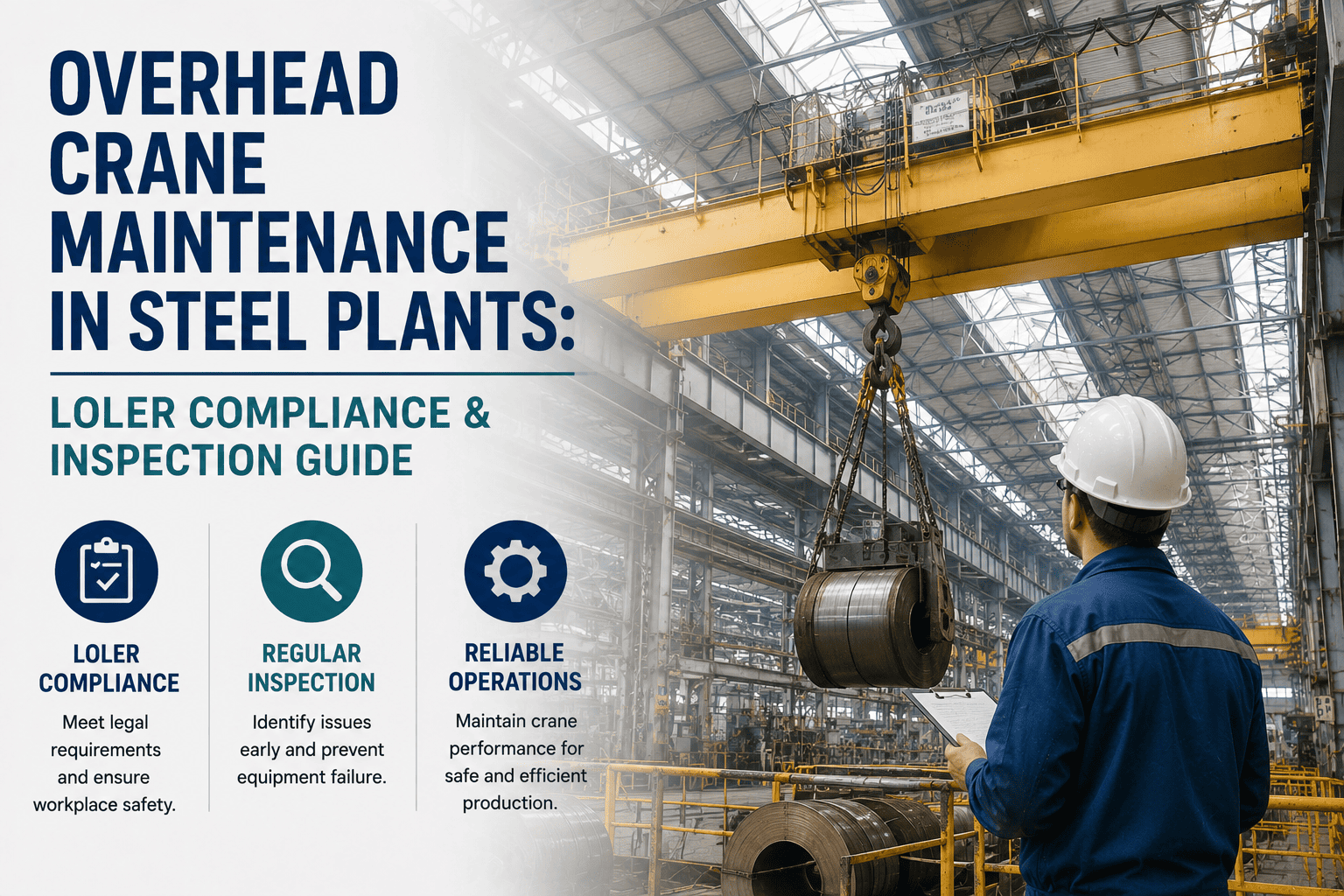
An overhead crane in a steel plant lifts ladles of molten metal, coils weighing tonnes and billets moving between furnace and mill, often for two or three shifts a day without a break. In the UK, that same crane sits squarely inside LOLER 1998 — and a missed thorough examination isn't a paperwork slip, it's a legal breach that can shut the bay down. Sign up free to see how Oxmaint keeps every crane's LOLER record, wire rope history and defect log in one place.
12 months
Maximum LOLER thorough examination interval for an overhead crane
6 months
Interval for lifting accessories such as chains, slings and shackles
£45K-£180K
Range of recent UK fines for lapsed or falsified crane examinations
11 items
Mandatory contents of every Schedule 1 report of thorough examination
Compliance Isn't A Checkbox
A steel plant crane sits at the intersection of safety law, production uptime and asset value. A brake that's ten seconds slow to engage, a limit switch that's drifted, or a wire rope with hidden broken wires are the kind of defects a thorough examination is designed to catch before they become a stopped bay or a HSE investigation.
What LOLER Actually Requires From a Steel Plant Crane
01
The Thorough Examination Interval
Every crane, every 12 months, no exceptions
Every overhead crane must have a thorough examination by a competent person at least every 12 months. Lifting accessories used with it — hooks, chains, slings, below-the-hook attachments — carry their own separate 6-month interval, and a pristine crane certificate does not cover an overdue sling.
02
The Competent Person Rule
Independent from routine maintenance, by design
The person carrying out the examination must have the practical and theoretical knowledge to detect defects and judge their significance, and must be independent from the engineer who services the same crane. In-house examiners are permitted, but they cannot mark their own maintenance work.
03
The Schedule 1 Report
A formal written record, not a tick sheet
Every thorough examination ends in a written report covering the specific items set out in LOLER Schedule 1 — identification of the crane, date of the last examination, condition of safety-critical parts, and any defect that is or could become a danger. There's no fixed form, but no item can be left out.
04
Defect Categories and Reporting
Immediate danger vs. timescaled repair
Defects are graded by urgency: an immediate danger takes the crane out of service on the spot, while a lesser defect is given a repair timescale. Where a defect presents a serious risk, the competent person must notify the enforcing authority directly, in writing.
One Record for Every Crane, Every Examination
Oxmaint keeps thorough examination dates, wire rope readings and defect history against every crane's own identity, so nothing lapses quietly. Sign up for a free trial to load your own crane register, or book a demo and we'll walk through your LOLER schedule with you.
Paper Crane Logs vs. Digital LOLER Compliance
| Paper-Based Crane Log |
What It Costs the Plant |
Digital Fix |
| Examination dates tracked on a wall calendar |
A crane runs weeks past its LOLER due date unnoticed |
Automatic alerts before every 6 and 12-month deadline |
| Defect reports filed loose in a site office folder |
No proof a Category A defect was actually closed out |
Defect logged, assigned and closed against the crane's record |
| Wire rope readings written up after the shift |
No trend line to show wear accelerating before failure |
Rope diameter and discard readings tracked over time |
| HSE audit means searching filing cabinets for certificates |
Hours lost proving compliance that should be instant |
Full LOLER history for any crane pulled in minutes |
Best Practices for Steel Plant Crane Maintenance
Practice 01
Inspect Wire Rope on a Fixed Rhythm
Broken wires, corrosion and diameter loss build gradually. A fixed inspection rhythm between thorough examinations catches rope approaching its discard criteria before it becomes a lifting emergency.
Practice 02
Test Brakes and Limit Switches, Not Just Look at Them
A brake or limit switch can look fine while its response time has drifted. Functional testing, not just visual checks, is what a genuine thorough examination and daily pre-use check both depend on.
Practice 03
Treat Ladle Cranes as Higher-Risk by Default
A ladle crane operates in heat, vibration and thermal cycling that accelerate deterioration far faster than a general EOT crane. A written examination scheme can set a shorter interval than the statutory 12 months to reflect that risk.
Practice 04
Align Daily Checks With BS 7121 Practice
BS 7121 sets out the safe use practices that sit alongside LOLER's legal minimums. Daily operator checks built around it catch the small issues long before they reach a scheduled examination.
How Oxmaint Supports Crane Compliance
Oxmaint gives maintenance teams a single digital record per crane — thorough examination dates, Schedule 1 reports, defect categories and wire rope readings, all timestamped and attributed. Alerts fire ahead of every 6 and 12-month deadline, and a complete LOLER history for any crane is retrievable in minutes for an HSE audit or insurance review. Book a demo to see it set up against your own crane register.
Frequently Asked Questions
Q
How often does LOLER require a steel plant crane to be examined?
At least every 12 months for the crane itself, and every 6 months for lifting accessories used with it, such as slings and shackles. A competent person can set a shorter interval in a written scheme where the operating environment justifies it.
Q
Is a service the same thing as a LOLER thorough examination?
No. A service covers lubrication, adjustment and minor repairs to keep the crane running. A thorough examination is a legal safety inspection that establishes whether the crane is safe to keep using — a crane can be well serviced and still fail one.
Q
Can our own maintenance engineer carry out the examination?
Only if they are genuinely competent for that crane type and independent from the routine maintenance work on it. An engineer cannot be the competent person examining a crane they also service day to day.
Q
What happens if a defect is found during examination?
It's graded by risk. An immediate danger takes the crane out of service until fixed, and must be reported to the enforcing authority. A lesser defect is given a repair timescale and confirmed in the written Schedule 1 report either way.
Never Miss Another LOLER Deadline
Oxmaint gives maintenance and safety teams one connected record for every crane's thorough examinations, defects and wire rope condition, so compliance decisions are backed by data instead of memory. Sign up for a free trial to load your crane register, or book a demo and we'll walk through it against your own LOLER schedule.