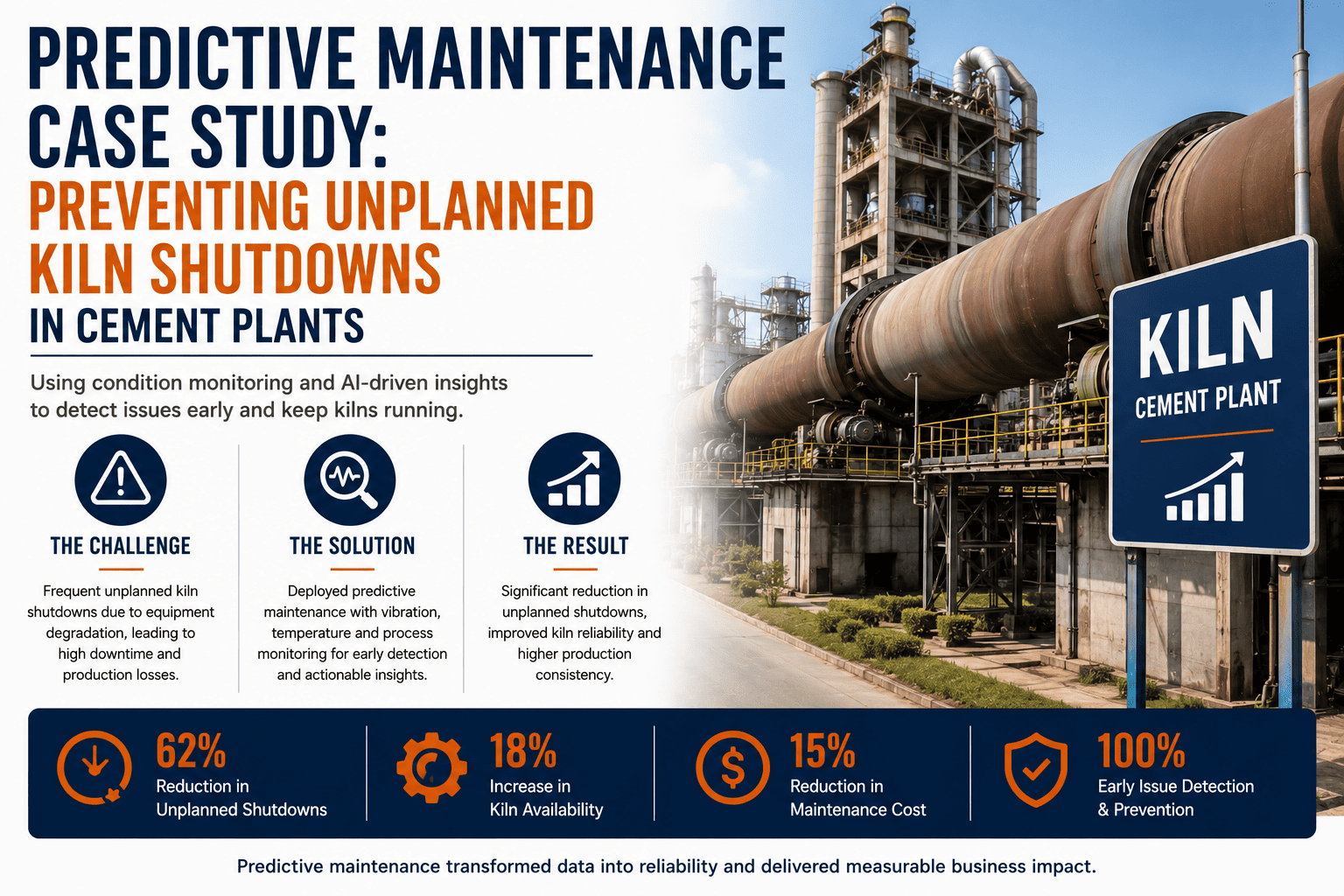
An unplanned kiln shutdown at a cement plant doesn't just stop one machine, it stops the whole line, since the kiln sits at the center of the entire pyroprocess. Refractory damage, a stuck tyre, or a bearing running hot rarely gives a clear warning until the moment it forces a trip. This is a look at how a cement plant moved from reacting to kiln failures to catching them days in advance, using condition monitoring and predictive alerts inside a CMMS. Sign up to see how the same approach could work on your kiln, or read on for how it played out.
3 Signals Tracked
Shell temperature, tyre vibration, and drive amperage monitored together
Days Of Warning
Lead time gained between an early trend alert and a potential trip
One Dashboard
All kiln readings and work orders tracked in a single CMMS view
Planned, Not Forced
Repairs scheduled around production instead of stopping it mid-run
The Cost Of An Unplanned Kiln Stop
A rotary kiln that trips mid-burn doesn't restart in minutes. The refractory needs to cool and reheat carefully, clinker quality suffers during ramp-up, and every downstream process from cooler to mill sits idle waiting on the kiln. That's the gap predictive maintenance is built to close.
The Challenge: Reacting After The Fact
Based on how many cement plants operate before adopting predictive maintenance, kiln issues typically surface only once they're already visible: a shell hot spot noticed on a manual scan, an unusual sound from a tyre, or a trip alarm that's already tripped. Maintenance teams were reading gauges shift to shift, not tracking how those readings moved over time, so a slow drift toward failure looked like noise until it suddenly wasn't.
No Trend Visibility
Shell temperature and vibration readings were logged on paper, with no easy way to see a trend building over weeks
Alerts Came Too Late
Alarms fired only at hard thresholds, by which point the kiln was already close to a forced trip
Repairs Fought For Time
Any repair meant stopping the kiln immediately, with no chance to plan around the next scheduled outage
See How Predictive Alerts Work On Your Kiln
Oxmaint turns raw shell temperature, vibration, and amperage readings into trend-based alerts, logged and tracked against your kiln as a single asset. Sign up for a free trial to try it on your own data, or book a demo to walk through the setup.
The Approach: Condition Monitoring Plus Predictive Alerts
Based on this use case, the shift started with connecting the kiln's existing sensors into a CMMS instead of adding new hardware. Shell temperature, tyre and trunnion vibration, and drive amperage were pulled into one system, with trend-based rules set to flag movement away from the normal baseline, not just a fixed alarm point.
Baseline & Trend Alerts
Set a normal operating baseline for each sensor and alert on the rate of change, not just the absolute reading
Auto-Generated Work Orders
Have the CMMS raise a work order automatically the moment a reading crosses its early warning band
Single Asset History
Keep every reading, inspection, and repair against the kiln asset so patterns become visible over time
Before Predictive Maintenance vs After
| Area |
Before |
After |
| Warning Lead Time |
Minutes, once an alarm threshold was already reached |
Days, based on trend movement away from baseline |
| Data Visibility |
Paper logs checked shift to shift, trends easy to miss |
Live dashboard showing shell, vibration, and amperage together |
| Repair Scheduling |
Forced stops whenever a fault became visible |
Repairs planned around the next scheduled outage window |
| Work Order Trigger |
Manual, raised after someone noticed a problem |
Automatic, raised the moment a reading crosses its early band |
Where A CMMS Fits Into Predictive Kiln Maintenance
Oxmaint connects kiln sensor data, inspection checklists, and work orders in one place, so a slow drift in temperature or vibration turns into a scheduled repair instead of a forced shutdown.
Frequently Asked Questions
Q
What sensors are typically used for kiln predictive maintenance?
Shell temperature scanners, tyre and trunnion vibration sensors, and drive amperage readings are the most common inputs, since together they reveal refractory wear, alignment issues, and load changes before they cause a trip.
Q
How is predictive maintenance different from preventive maintenance?
Preventive maintenance follows a fixed schedule regardless of condition, while predictive maintenance triggers action based on how equipment is actually performing, catching faults that a calendar-based schedule might miss or check too late.
Q
Can existing kiln sensors be connected to a CMMS without new hardware?
In most cases, yes. Existing temperature, vibration, and amperage sensors can usually be integrated into a CMMS to enable trend-based alerts without replacing the underlying instrumentation.
Turn Kiln Data Into Days Of Warning, Not Minutes
Oxmaint connects your kiln sensors, inspection checklists, and work orders in one system so a slow drift becomes a scheduled repair instead of a forced shutdown. Sign up for a free trial to see it on your own data, or book a demo to walk through the setup.