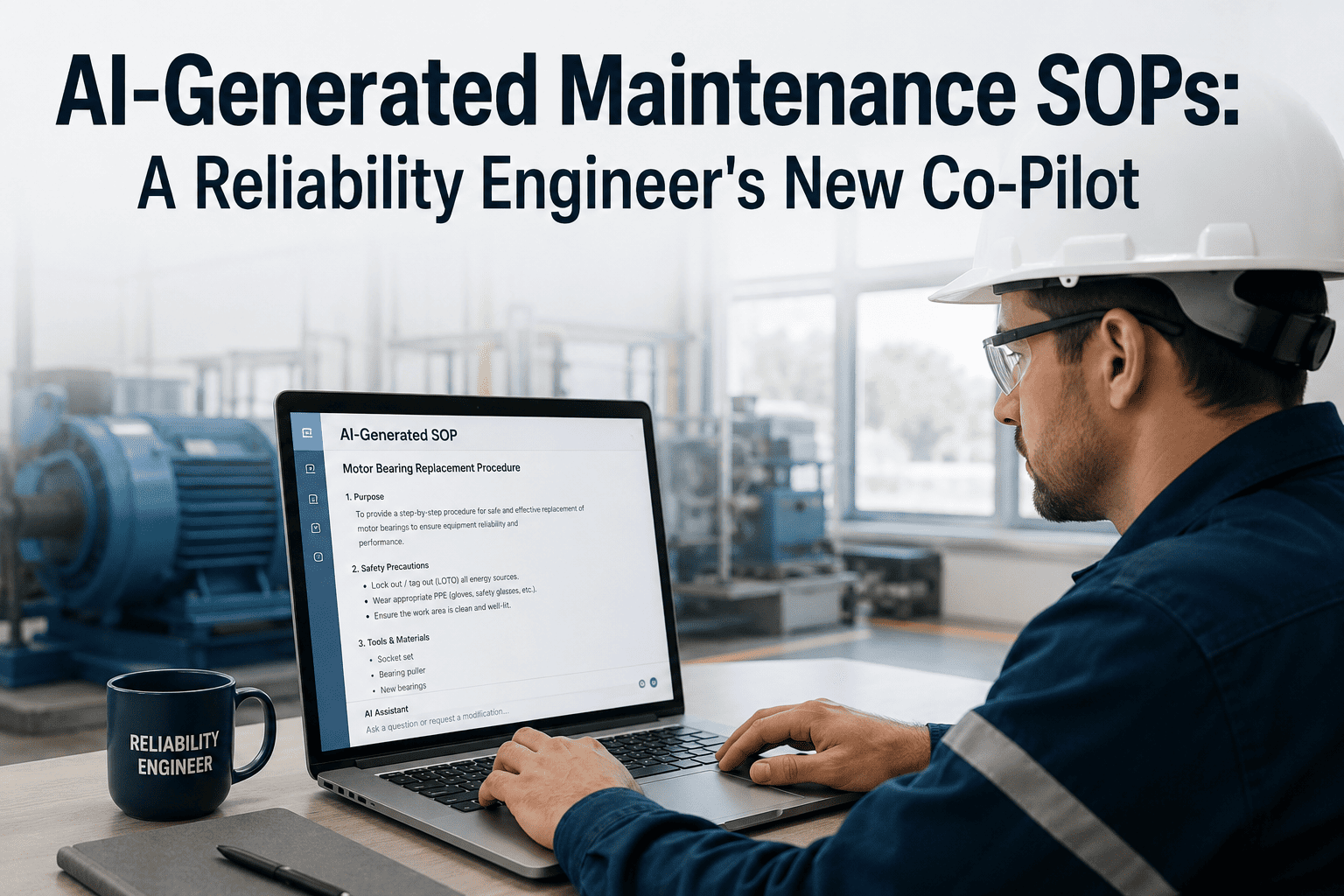
A comprehensive maintenance procedure for a single complex asset takes 4–8 hours to research and write properly. Multiply that across a fleet of 200 assets with outdated documentation, factor in the institutional knowledge walking out the door as experienced engineers retire, and the SOP backlog becomes a reliability risk that no team has the hours to close manually. AI changes that arithmetic. Not by replacing the reliability engineer — by handling the draft so the engineer can focus on what only they can do: verify, refine, and approve. Sign up free to see OxMaint's AI SOP generation running on your own asset data.
AI Drafts the SOP. Your Engineer Approves It.
OxMaint generates structured maintenance procedures from your asset history, work orders, and failure records — then routes them through your engineer review and approval workflow before they go live.
The Problem AI Is Solving — and Why It Is Urgent Now
Between 30–40% of skilled tradespeople will retire within the next decade. In many facilities, the figure is higher — and when experienced engineers leave, their knowledge of how specific assets actually fail, what actually works, and what the manual does not tell you leaves with them. That knowledge never made it into a documented SOP because writing SOPs was always the thing that got done after everything more urgent. AI makes it the fastest part of the process instead of the slowest.
What AI Actually Does in SOP Generation — Step by Step
The co-pilot model is the right framing. AI handles the blank-page problem and the synthesis problem — pulling relevant data from work orders, failure histories, and equipment records and turning it into a structured draft. The reliability engineer's role shifts from author to editor and technical authority. That is not a downgrade: it is a sharper use of expertise. Book a demo to see a live SOP generation from an OxMaint asset record.
What the AI Gets Right — and What Still Needs Your Engineer
AI Does Well
Consistent structure and formatting across every procedure — no more format variation between engineers or sites
Synthesising failure history into safety warnings — patterns across dozens of work orders that a single author would not recall
Expanding maintenance shorthand into complete procedure steps — "R&R bearing" becomes a full step sequence with torque specs and alignment checks
Scaling across a full asset registry — generating first-draft SOPs for hundreds of assets simultaneously rather than one at a time
Engineer Still Needed For
Site-specific conditions not captured in CMMS records — process deviations, plant layout constraints, local safety rules that live in the engineer's head
Verification that AI-generated steps are safe and correct for this specific asset — not just generically correct for the equipment type
Regulatory compliance sign-off — the engineer's approval is the documented accountability that an AI-generated procedure cannot provide on its own
Failure mode judgement on novel fault patterns that have not appeared in historical work orders — experience the data does not yet reflect
The Governance Layer — What Stops AI SOPs From Becoming a Liability
An AI-drafted SOP published without review is a documentation risk, not a reliability asset. The governance model that works is straightforward: AI drafts, human approves, the system tracks both. Every published procedure carries an author (the approving engineer), a version number, a review date, and an audit trail of changes. The AI creates the starting point; the engineer creates the accountable record. Sign up free to see how OxMaint's approval workflow governs AI-generated procedures end to end.
| Governance Element | Why It Matters | How OxMaint Handles It |
|---|---|---|
| Engineer Approval Workflow | No AI-generated procedure goes live without a named engineer sign-off — the approval creates documented accountability | Mandatory review routing before publication; draft and approved versions stored separately |
| Version Control | Technicians must always work from the current approved version — not a cached copy from a previous revision | Full version history with change log; live procedures update automatically in asset and work order records |
| Scheduled Review Dates | AI-generated procedures can drift from current best practice if left unreviewed — a review date ensures they stay accurate | Automatic review reminders triggered by expiry date or by a defined number of new work orders completed against the asset |
| Technician Feedback Loop | The people using the SOP in the field will find errors the engineer did not — that knowledge needs a channel back into the document | Technicians flag issues directly from the work order view; flags route to the approving engineer for assessment and update |
Prompting AI Well — Inputs That Produce Better First Drafts
The quality of an AI-generated SOP is directly proportional to the quality of the input. A generic prompt produces a generic procedure. Providing context — asset type, failure mode history, operating environment, regulatory regime — produces a draft the engineer can refine in minutes rather than rebuild from scratch. These are the input categories that make the most difference.
Asset Context
Equipment type, manufacturer, model, age, operating environment. The more specific the asset record, the more accurate the generated step sequence and parts list.
Failure History
The failure modes this asset has actually exhibited — from work order records. These drive the safety warnings and inspection checkpoints the AI includes that a generic procedure would miss.
Regulatory Regime
PSSR, LOLER, IEE, or site-specific permits to work. Specifying the applicable standards allows the AI to include the right compliance references and safety checkpoints in the correct format.
Technician Skill Level
A procedure written for a senior engineer needs fewer explanatory notes than one written for a first-year apprentice. Specifying the intended audience calibrates the level of detail in each step.
Parts and Tools Used
Historical parts consumption from CMMS records gives the AI a verified parts list — removing the risk of the SOP referencing a superseded part number or omitting a critical tool.
Site-Specific Notes
Access constraints, local isolation points, proximity hazards, or coordination requirements with other teams. This is the context that distinguishes a site-accurate procedure from a textbook one.
How OxMaint Supports AI SOP Generation
OxMaint connects AI SOP generation directly to the asset records and work order history where the relevant data already lives — so the draft is grounded in what this asset has actually done, not a generic template. The procedure is then attached to the asset in the CMMS, accessible by technicians at the point of work, and updated automatically as new work order data accumulates. Book a demo to see it generate a procedure from a live asset record in real time.
Asset-Grounded Draft Generation
AI generates the SOP from the asset's actual CMMS record — failure history, parts consumed, technician notes, and sensor baselines. The draft reflects this asset, not a generic equipment category.
Structured Approval Workflow
Every AI-generated draft routes to a named reliability engineer for review and approval before publishing. The approved version carries the engineer's credentials and a timestamp — the audit trail that regulatory inspections require.
Bulk Generation Across Asset Registry
Generate first drafts for your entire asset fleet simultaneously — eliminating the documentation backlog in days rather than years. Engineers review in priority order, starting with the highest-criticality assets.
Continuous Refinement From Work Orders
Every completed work order feeds back into the AI's knowledge of the asset. Procedures improve over time as repair outcomes, technician feedback, and new failure patterns update the underlying data.
Close Your SOP Backlog Before the Next Engineer Retires
OxMaint AI generates structured, asset-grounded SOP drafts from your existing CMMS data — routed through engineer review before they go live. Your expertise stays in the system even when people move on.
Frequently Asked Questions
Does AI replace the reliability engineer in SOP creation?
No — and this is by design. AI handles the drafting: structure, formatting, and synthesis of historical data into a first-draft procedure. The reliability engineer reviews, edits, and approves. The engineer's expertise is applied where it has most value — critique and verification — rather than on formatting and blank-page drafting. Every published SOP carries the engineer's approval and accountability.
How accurate are AI-generated maintenance SOPs?
When grounded in actual asset data and work order history, AI-generated SOPs score at least equivalently to manually written procedures on completeness and parts accuracy in comparative evaluations. The key variable is input quality — a procedure generated from a rich CMMS record with structured failure history will be substantially better than one generated from minimal data. The review step catches what the AI misses about site-specific conditions.
What data does OxMaint need to generate an SOP?
OxMaint can generate a useful first-draft SOP from an asset record and equipment type alone. The more historical context available — work order descriptions, failure codes, parts used, technician notes — the more accurate and asset-specific the output. A rich work order history produces a procedure that reflects how this equipment actually behaves in your plant, not a generic textbook procedure.
How do we prevent AI-generated SOPs from becoming outdated?
OxMaint's governance layer sets scheduled review dates on every published procedure. Automatic reminders trigger when a procedure approaches its review date or when a defined number of new work orders have been completed against that asset. Technicians can also flag issues directly from the work order view, routing feedback to the approving engineer immediately rather than waiting for a scheduled review cycle.
Can AI help capture knowledge from engineers who are about to retire?
Yes — and this is one of the strongest use cases. When a retiring engineer reviews and approves AI-generated SOPs for their assets, they are formalising the institutional knowledge they hold about those assets into documented procedures. The AI provides the structure; the engineer adds the site-specific expertise that no data set captures. The result is a knowledge base that stays in the organisation when the engineer leaves.