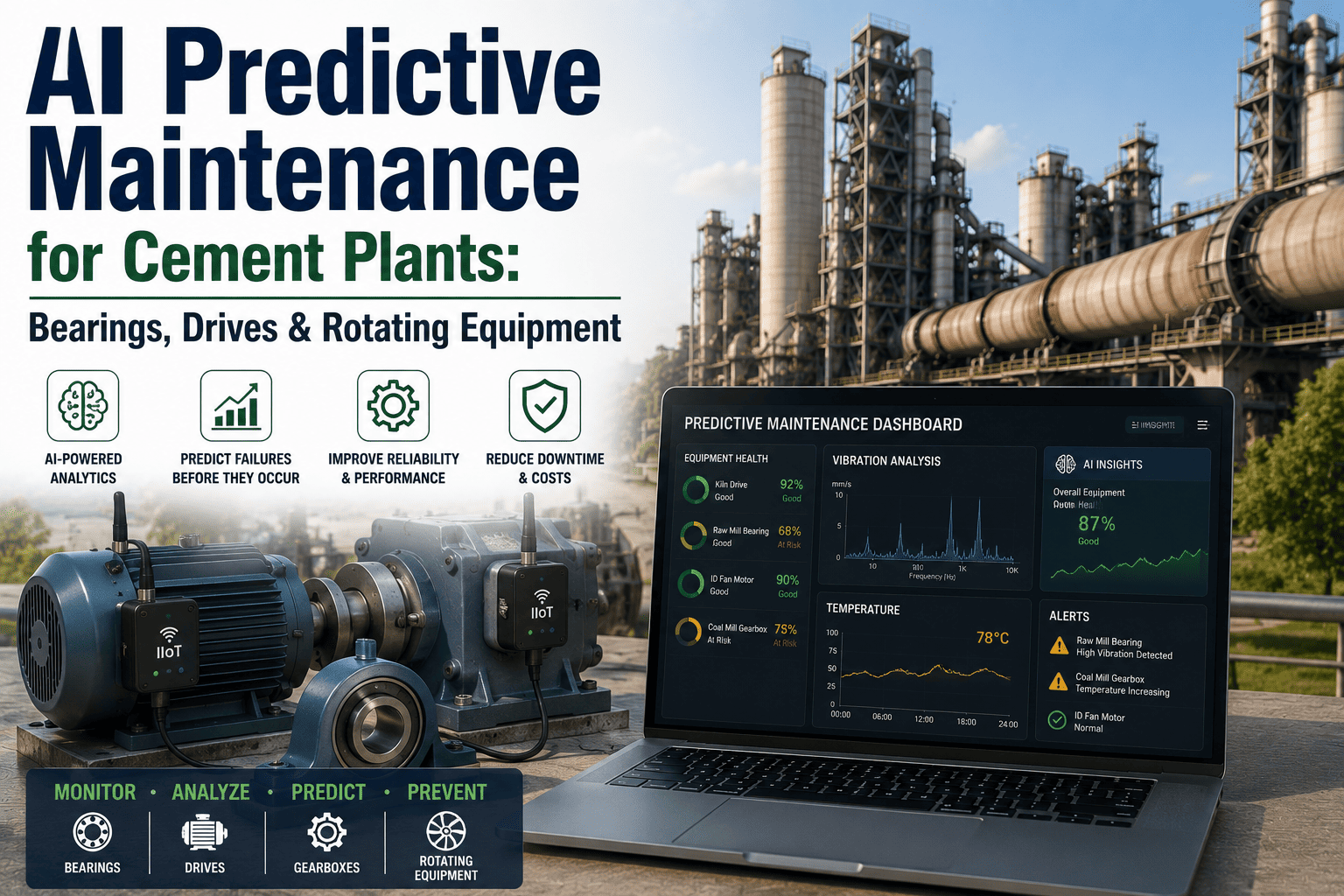
A kiln support roller bearing doesn't announce it's failing, it just runs a little rougher, a little hotter, week after week, until one day it doesn't run at all. Cement plants live or die by their rotating equipment, and most of it gives clear warning signs long before it actually fails, if anyone's watching for them. Sign up to see how Oxmaint turns vibration and oil analysis data into an alert your team can act on weeks early.
2-8 Weeks
Typical early warning window vibration monitoring gives before a bearing actually fails
Majority Share
Of unplanned cement plant downtime typically traces back to rotating equipment failures
30-40%
Typical reduction in unplanned rotating equipment failures after predictive monitoring is adopted
Two Signals
Vibration and oil analysis together catch far more than either one running alone
Why Rotating Equipment Dominates Cement Plant Downtime
A cement plant is essentially a chain of large rotating machines, kiln, mills, fans, all running continuously under heavy load and constant vibration. When one of these fails unexpectedly, it doesn't just stop that machine, it usually stops the whole production line behind it. Machine learning models built on vibration and oil data don't eliminate that risk, but they turn a sudden failure into a scheduled repair with weeks of notice instead of none.
The Rotating Assets Worth Watching Closest
| Asset |
Primary Monitoring Focus |
Why an Outage Hurts |
| Kiln support rollers |
Bearing vibration and temperature trend |
A single roller failure can halt the entire kiln |
| ID and preheater fans |
Bearing vibration and imbalance detection |
Directly limits kiln airflow and overall throughput |
| Raw and cement mill drives |
Vibration signature and oil condition |
Stops grinding output, a direct production bottleneck |
| Kiln girth gear and pinion |
Gear mesh vibration and lubrication condition |
Extremely costly and slow to replace if damage progresses |
From a Drifting Reading to a Scheduled Repair, Automatically
Oxmaint connects vibration and oil analysis data directly to your kiln, mill, and fan assets, so a developing fault generates a work order weeks before it becomes an outage. Sign up for a free trial to connect your first rotating asset, or book a demo and we'll walk through your current monitoring setup.
What an Oil Analysis Report Is Actually Telling You
| Parameter |
What It Indicates |
| Particle count and wear debris |
Active internal wear on gears, bearings, or seals |
| Viscosity |
Oil breakdown or the wrong lubricant being used |
| Water content |
Seal failure or condensation entering the lubrication system |
| Total acid number (TAN) |
Oxidation and oil aging beyond its useful service life |
Vibration-Only Monitoring vs Vibration Plus Oil Analysis
Vibration-Only Monitoring
Catches mechanical faults once physical wear is already underway
Misses lubrication problems until they've caused actual wear
Good at telling you something's wrong, less clear on why
Vibration Plus Oil Analysis
Oil chemistry flags lubrication issues before they cause wear
Vibration confirms whether a mechanical fault is actually developing
Together they point to root cause, not just symptom
How Oxmaint Supports Rotating Equipment Reliability
Oxmaint pulls in vibration and oil analysis data from your kiln, mill, and fan assets, learning what normal looks like for each machine individually rather than applying a generic industry threshold. When a reading drifts, it creates a work order automatically with the underlying trend attached, so your team knows exactly what to check and why before a small issue becomes a shutdown. Book a demo to see it running against your own rotating equipment.
Frequently Asked Questions
Q
Which rotating assets should get sensors first if budget is limited?
Start with assets where an unplanned failure stops the whole line, kiln support rollers, main ID fans, and mill drives, then expand coverage to less critical rotating equipment as the program proves its value.
Q
How often should oil samples actually be taken?
Quarterly is common for most critical rotating equipment, though continuous online sensors are increasingly used on the highest-value assets where even a quarterly gap feels too long.
Q
Can a machine learning model tell the difference between normal wear and a real fault?
Yes, once it's learned that asset's normal operating pattern over time. Early on it may flag things that turn out fine, but each confirmed outcome fed back in sharpens its ability to tell a real fault from ordinary variation.
Q
Does this replace scheduled bearing and gearbox inspections entirely?
Not entirely. Predictive monitoring tells you where and when to look closer, but a physical inspection is still how a technician confirms the finding and decides on the actual repair.
Catch the Bearing Failure Weeks Before It Stops the Kiln
Oxmaint gives cement plant teams vibration and oil analysis monitoring, machine learning-based failure prediction, and automatic work order generation for every rotating asset. Sign up for a free trial to connect your first machine, or book a demo and we'll walk through it against your own kiln, mill, and fan equipment.