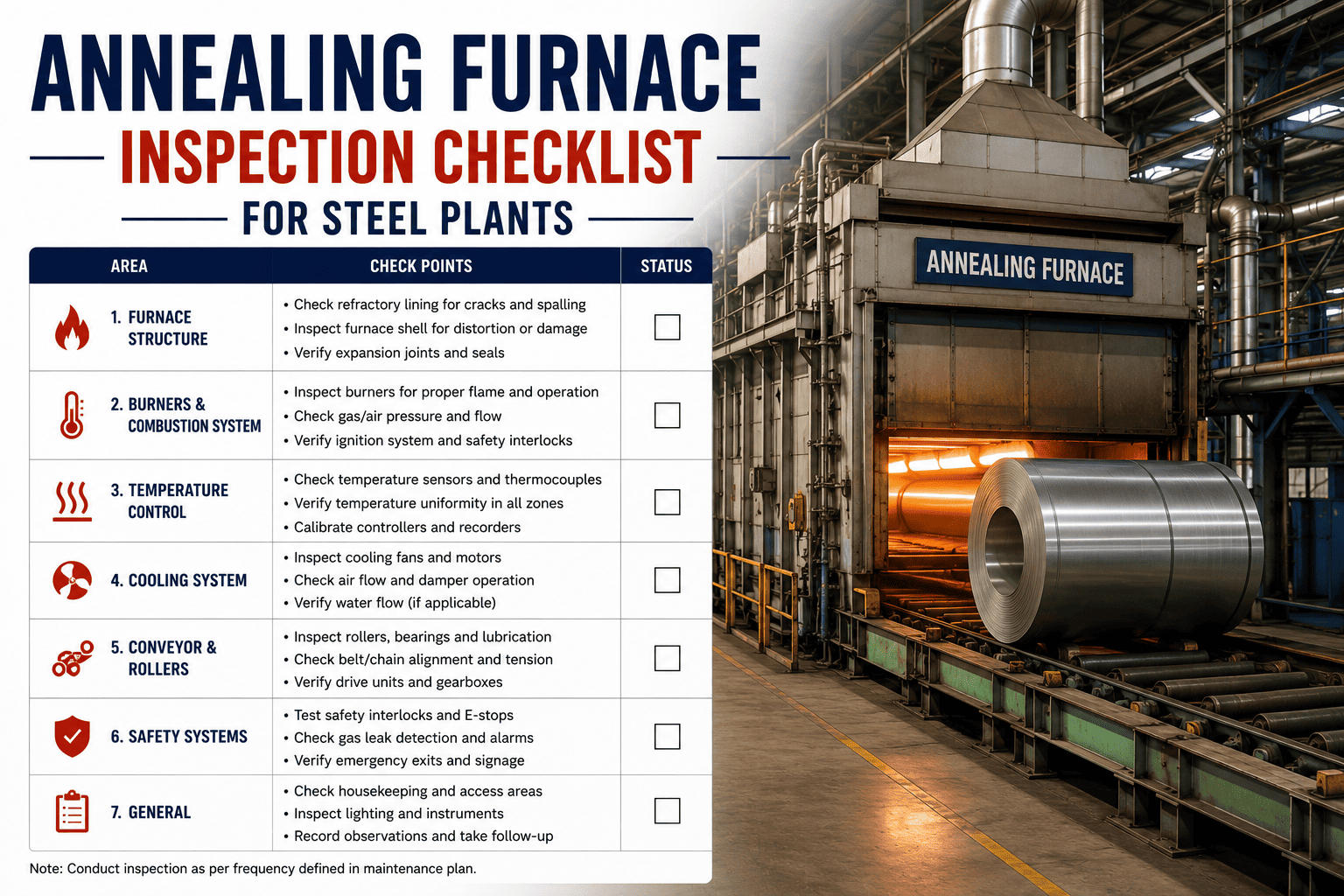
An annealing furnace holds steel strip at temperatures up to 1,250°C inside a hydrogen or nitrogen atmosphere, and it runs continuously through preheat, soak, and cooling zones for weeks at a time. A problem here rarely announces itself loudly. It shows up as a radiant tube burning slightly uneven, a hearth roll picking up a build-up that scratches the strip, or a bearing seal starting to let outside air creep into a hydrogen zone. This checklist covers the eight points an annealing furnace inspection route should never skip. Sign up to turn this checklist into a recurring digital inspection your team can't miss a step on.
8 Points
Core checks that belong on every annealing furnace inspection route
1250°C
Maximum typical heat treatment temperature inside the furnace chamber
100% H2
Hydrogen concentration used in some zones to achieve a bright anneal
Zero Skips
Tolerance for missed checks, since early drift rarely repeats itself
Why Hearth Rolls Are The Quiet Risk In Every Anneal Cycle
Hearth rolls run inside a furnace held at 700 to 1,300°C, supporting and conveying the strip nonstop, and their bearing grease seals are what keep outside air from entering a hydrogen atmosphere. A seal that's wearing thin, or a roll picking up surface pickup, causes strip scratching and safety risk long before it causes a visible breakdown, which is exactly why this point deserves a dedicated look on every pass.
The Annealing Furnace Inspection Checklist
Radiant Tube Condition & Flame
Check radiant tubes for hot spots, sagging, or flame pattern changes that signal alloy creep or a failing burner
Hearth Roll Surface & Bearings
Inspect roll surface for pickup or scoring, and track bearing condition since these rolls run continuously at extreme heat
Bearing Seal & Hydrogen Integrity
Confirm grease seals at each hearth roll bearing block are intact, since this is what stops outside air entering the hydrogen zone
Furnace Atmosphere Composition
Monitor hydrogen, nitrogen, and oxygen levels against the process target, since even small drift affects the surface finish
Dew Point Control
Check dew point readings closely, since carbon-level control depends on this measurement to hit the right surface chemistry
Furnace Shell & Refractory
Scan the shell and refractory for hot spots or spalling that would point to insulation breakdown in a specific zone
Jet Cooler & Rapid Cooling Section
Verify jet coolers are hitting the required cooling rate, since a slow cooling zone directly affects final steel properties
Strip Tracking & Tension
Watch for strip wander across the hearth rolls, since misalignment here accelerates roll wear and risks strip damage
Never Miss An Annealing Furnace Inspection Point
Oxmaint turns this eight-point checklist into a recurring digital route, logging readings across radiant tubes, hearth rolls, and hydrogen systems so drift is caught before it reaches the strip. Sign up for a free trial to build your annealing furnace inspection route, or book a demo to see it in action.
What An Abnormal Reading Might Be Telling You
| What You Notice |
Possible Cause |
| Radiant tube sagging or discoloring |
High-temperature alloy creep, often the first sign before a tube failure |
| Strip scratching or surface pickup |
Hearth roll surface wear or material buildup on the roll face |
| Dew point drifting from target |
Atmosphere control issue that can shift the surface chemistry of the finished strip |
| Bearing seal showing grease loss |
Seal wear that risks letting outside air enter the hydrogen atmosphere |
Paper Checklist vs A Digital Inspection Route
Paper Checklist
Radiant tube and atmosphere readings filed away, hard to compare zone by zone
Easy for a busy shift to skip a check without anyone noticing
No trend line until someone manually pulls old sheets together
Digital Inspection Route
Every reading logged against the exact zone or asset automatically
A skipped point flags itself instead of quietly disappearing
Trend lines build on their own, making slow drift easy to catch early
Where A CMMS Fits Into Annealing Furnace Inspections
Oxmaint turns this eight-point checklist into a recurring digital route, capturing each reading against the furnace zone or asset so trends are visible instantly and a missed check never slips through unnoticed.
Frequently Asked Questions
Q
How often should an annealing furnace be inspected?
Atmosphere composition and dew point are best logged every shift, while radiant tubes, hearth rolls, and bearing seals are typically walked daily with a more detailed review on a weekly basis.
Q
Which check on this list matters most?
Hearth roll bearing seal integrity tends to matter most, since a compromised seal risks both strip quality and letting outside air enter a hydrogen atmosphere.
Q
Can a CMMS turn this checklist into a recurring digital inspection?
Yes, a CMMS can schedule the checklist as a recurring route, prompt the technician for each reading by zone or asset, and build a trend history automatically across the furnace and its atmosphere systems.
Turn This Checklist Into A Route Your Team Follows Every Day
Oxmaint schedules this eight-point annealing furnace inspection as a recurring digital route, capturing readings and trends automatically across every zone. Sign up for a free trial to build your annealing furnace inspection route, or book a demo to see it in action.