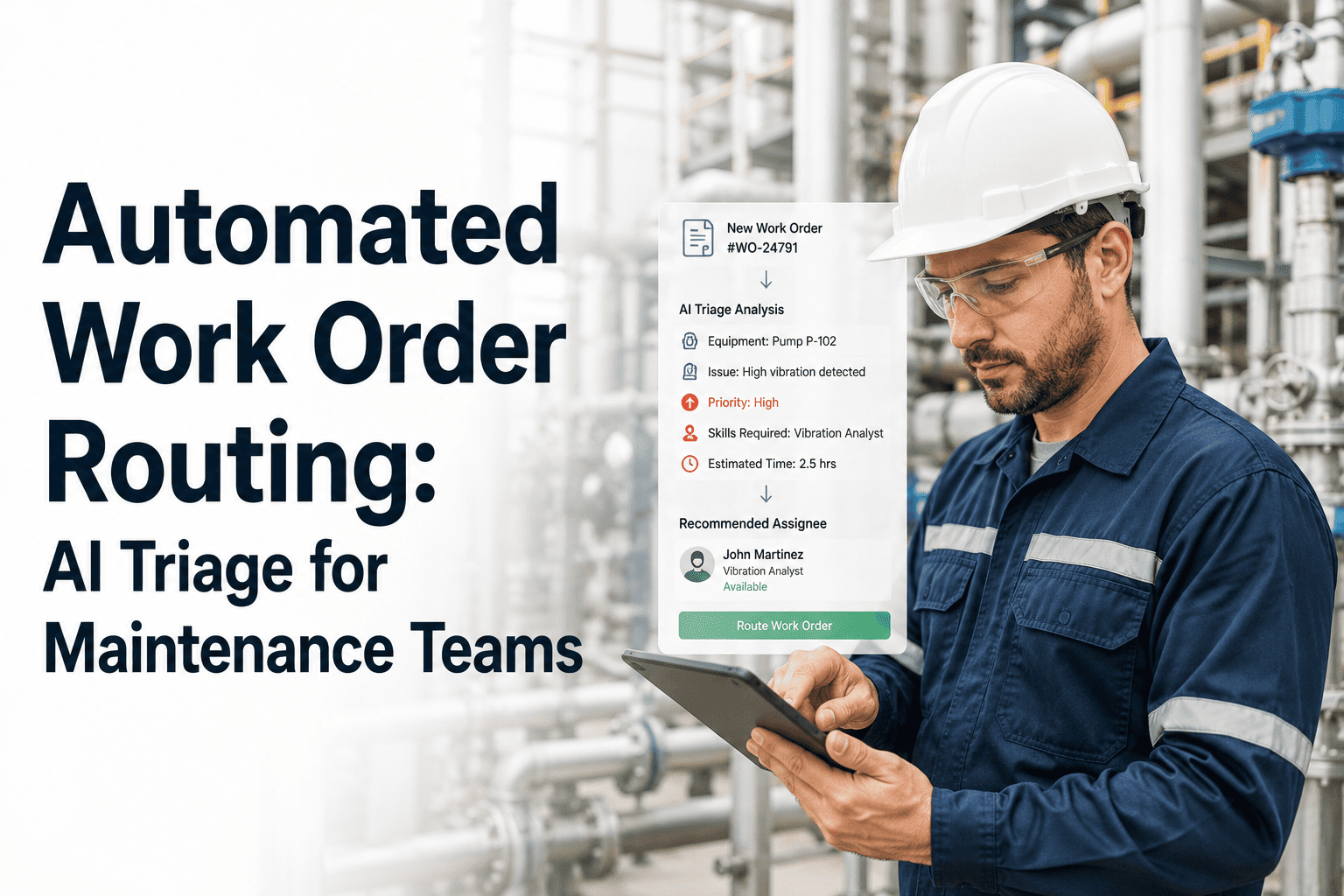
A request lands in the helpdesk inbox: "boiler making a noise, urgent." Before anyone fixes anything, a human has to read it, decide what it actually is, check whether it's already been reported by someone else, work out how urgent "urgent" really means, and find a technician who's both available and qualified. That sorting step — not the repair itself — is where most maintenance helpdesks lose the most time, every single day. Oldham Council's AI-powered contact centre chatbot cut call volumes by 86%, saving around £40,000 a year. Thirteen Group's automation of 10,000 Universal Credit claims saved thousands of staff hours that went straight back into resident-facing work. The same triage logic applies directly to maintenance requests. A CMMS like OxMaint classifies, deduplicates, and routes every incoming request the moment it arrives — no human triage step in between.
Cut Helpdesk Triage Time From Minutes to Seconds
Every incoming request classified, deduplicated, and routed to the right engineer automatically — no manual sorting before the real work even starts.
What's Actually Slow About Manual Triage
It isn't the volume of requests that kills helpdesk efficiency — it's the few minutes before each one even reaches a technician. Someone has to read it, classify it, check for duplicates, and guess at urgency, often with incomplete information: "email isn't working" with no device, no error, no indication of how many people are affected. A dispatcher's real first job is filling in those gaps before routing can even start.
Classification
What is this actually about? Plumbing, electrical, HVAC — read for meaning, not keywords, since two people describe the same fault completely differently.
Deduplication
Has this already been reported? Five tenants reporting the same leak shouldn't become five separate work orders competing for attention.
Urgency Scoring
Does this actually need attention now? Language that sounds urgent and a fault that genuinely is urgent are not always the same thing.
Routing
Which technician is both free and actually qualified for this fault type — not just whoever happens to be next in a generic rota.
Rule-Based vs. AI Triage: Why the Old Approach Plateaus
| Approach | Routing Accuracy | Breaks When |
|---|---|---|
| Manual Triage | ~77% on first attempt | Volume rises or the dispatcher is away |
| Keyword / Rule-Based | 40-50% ceiling | A request is phrased differently than the rule expects |
| AI Classification | 85-95% on mature deployments | Rarely — accuracy improves further with each correction |
The gap between rule-based and AI triage isn't marginal — it's the entire reason teams are moving off legacy automation. A rule tree breaks the moment someone phrases a request in a way nobody anticipated when the rules were written. AI reads for intent instead of matching exact wording, so it doesn't need every possible phrasing mapped in advance. Book a demo to see a real request triaged live, end to end, in seconds.
The Hidden Cost of Getting Routing Wrong
The Reassignment Tax
15-25% of manually triaged tickets get reassigned at least once after misrouting — and every reassignment adds roughly 47 minutes to total resolution time.
The Duplicate Work Order
Several reports of the same fault, logged separately, can send two technicians to the same job — or worse, make a genuinely urgent fault look routine because it's split across entries.
The Buried Urgent Request
A genuinely urgent fault sitting in the same queue as routine requests, simply because nobody got to it yet, is how a minor issue becomes a major one.
British Examples: Where the Time Savings Actually Showed Up
Oldham Council
An AI chatbot deployed on the council's website cut contact centre call volumes by 86%, saving approximately £40,000 a year by resolving routine queries before they ever needed a human.
Thirteen Group
Automated processing of 10,000 Universal Credit claims saved thousands of staff hours, freeing customer-facing teams to focus on residents instead of administrative backlog.
The Common Thread
Neither result came from a flashy feature — both came from removing a slow, repetitive sorting step that was eating staff time without adding value.
What Maintenance Teams Can Expect
How OxMaint Automates Work Order Triage
Instant Classification
Every incoming request is classified, deduplicated, and scored for urgency the moment it arrives — no human triage step in between.
Skills-Matched Routing
Requests route straight to a technician who is both available and actually qualified for that specific fault type.
Multi-Channel Intake
QR codes, email, and the request portal all feed the same triage engine, so nothing skips classification depending on how it arrived.
Learns From Corrections
Classification accuracy improves with use, learning from your facility's specific request patterns and any manual corrections made.
Stop Losing Hours to Sorting Before the Real Work Starts
Instant classification, deduplication, and skills-matched routing — built so every request reaches the right engineer without a manual triage step.
Frequently Asked Questions
How much faster is AI triage compared to manual sorting?
Many facilities see triage time drop from several minutes per request to seconds, with overall helpdesk dispatch time falling by 50% or more once classification and routing no longer require a human to read every request first.
Can AI triage handle requests that don't fit a standard category?
Yes, better than rule-based systems. AI reads for intent and meaning rather than matching exact keywords, so it copes with varied phrasing far more reliably than a fixed rule tree, which breaks the moment wording falls outside what was anticipated.
What happens when the AI isn't confident about how to route a request?
Mature systems use confidence thresholds, routing uncertain or unusual requests to a human for review rather than guessing. This keeps accuracy high on routine requests while ensuring edge cases still get proper judgement.
Does AI triage replace the helpdesk dispatcher entirely?
Not typically, and not immediately. Most teams start with AI as an assistant to the dispatcher, automating the routine majority of requests while freeing the dispatcher to focus on complex or judgement-heavy cases.
How does AI avoid creating duplicate work orders?
Incoming requests are compared against existing open work orders for similarity before a new one is created, so multiple reports of the same fault are recognised and merged rather than dispatched as separate jobs.