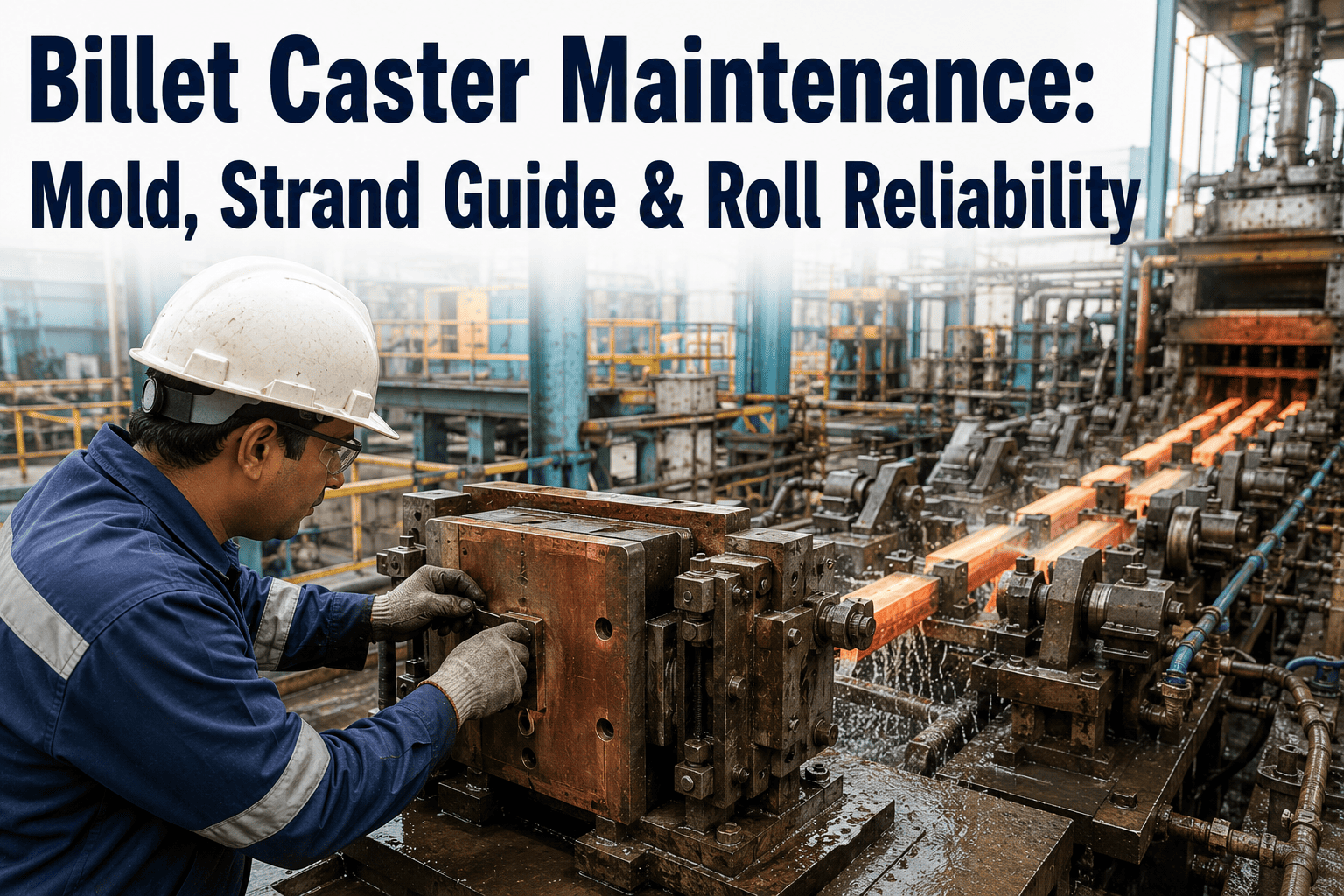
A billet caster only stays reliable when three systems move in sync: the mold that freezes the outer shell, the strand guide rolls that keep that thin shell supported and centered, and the secondary cooling sprays that finish solidification without cracking the surface. Breakout risk almost never appears out of nowhere, it shows up as detectable drift in mold taper, roll alignment or cooling uniformity 6 to 48 hours before it becomes critical. Sign up for a free trial to see how Oxmaint tracks all three systems together instead of managing them as separate checklists.
6-48 Hrs
Typical early-warning window before drift becomes a critical breakout risk
2-3 Feet
Spacing between guide roll sets keeping the strand centered along the caster
150-300°C
Continuous operating temperature bending and straightening roll bearings endure
2-3 Weeks
Advance notice condition-based tracking can give before catastrophic roll wear
Why Bending and Straightening Rolls Carry the Most Risk
Rolls closest to the mold work against the thinnest strand shell at the highest temperatures, which makes a seized or misaligned roll in that zone the single highest-risk scenario on the whole caster. A worn or stuck roll here doesn't just leave a surface mark, it can disturb the fragile shell enough to trigger the tear that leads to a breakout.
Three Systems, Three Different Failure Signatures
| System |
Early Failure Signal |
Maintenance Focus |
| Mold |
Drift in mold taper and uneven oscillation performance |
Thermocouple response checks and oscillation stroke verification |
| Strand guide rolls |
Bearing temperature rise and guide mark severity on the strand |
Laser runout measurement and bearing temperature trending |
| Secondary cooling |
Flow degradation and drift in spray zone uniformity |
Nozzle cleaning and manifold inspection based on flow trend |
Mold, Rolls and Cooling Tracked as One Caster, Not Three Checklists
Oxmaint brings thermocouple data, roll condition trends and cooling zone flow readings into one view, so drift in any single system doesn't get missed while attention is on another. Sign up for a free trial to test it against your own billet caster, or book a demo and we'll walk through your strand guide reliability data.
Not Every Guide Roll Needs the Same Attention
| Roll Zone |
Operating Condition |
Monitoring Priority |
| Bending & upper straightening |
Closest to the mold, highest temperature, thinnest strand shell |
Highest-frequency bearing temperature and lubrication checks |
| Lower guide & withdrawal rolls |
Fully solidified strand, lower thermal load, higher mechanical load |
Withdrawal-straightener torque trend and roll runout scans |
Cooling Water Chemistry Quietly Drives Nozzle Blockage
Secondary cooling problems rarely start as a broken nozzle, they start as water chemistry drifting outside specification, letting scale build up inside spray headers and manifolds. Checking suspended solids, pH and hardness on a set schedule catches that drift while it's still a water treatment fix, before it becomes an uneven cooling profile that shows up as cracking on the strand.
Frequently Asked Questions
Q
How early can a billet caster breakout actually be predicted?
Oscillator degradation, mold wear and cooling drift typically show a detectable pattern 6 to 48 hours before breakout risk turns critical. That window is usually enough to schedule targeted maintenance or adjust casting parameters rather than waiting for a Level 1 PLC alarm that often fires only once the breakout is already underway.
Q
What actually happens when a strand guide roll seizes?
A seized roll can no longer support the strand smoothly, which shows up first as guide marks on the surface. In the bending or straightening zone where the shell is still thin, a seized roll is more severe and can disturb the shell enough to contribute to strand breakage rather than just a cosmetic defect.
Q
Why does lubricant choice matter so much for these rolls?
Bending and straightening zone bearings run continuously in the 150-300°C range while getting sprayed with secondary cooling water, so the grease needs high-temperature stability, water washout resistance and extreme-pressure performance together. Lithium complex or calcium sulfonate complex greases with EP additives are the common specification for this reason, and application frequency matters as much as the product itself.
Q
Can secondary cooling problems be traced back to water chemistry?
Very often, yes. Out-of-specification suspended solids, pH or hardness accelerates scale deposition inside spray headers and manifolds, gradually blocking nozzles and reducing circuit reliability well before anyone notices a spray zone underperforming during casting.
Catch Caster Drift Hours Before It Becomes a Breakout
Oxmaint gives steel plant teams condition-based PM across mold, strand guide rolls and secondary cooling, roll wear trending, and lubrication scheduling in one platform. Sign up for a free trial to explore it yourself, or book a demo and we'll walk through it against your own billet caster.