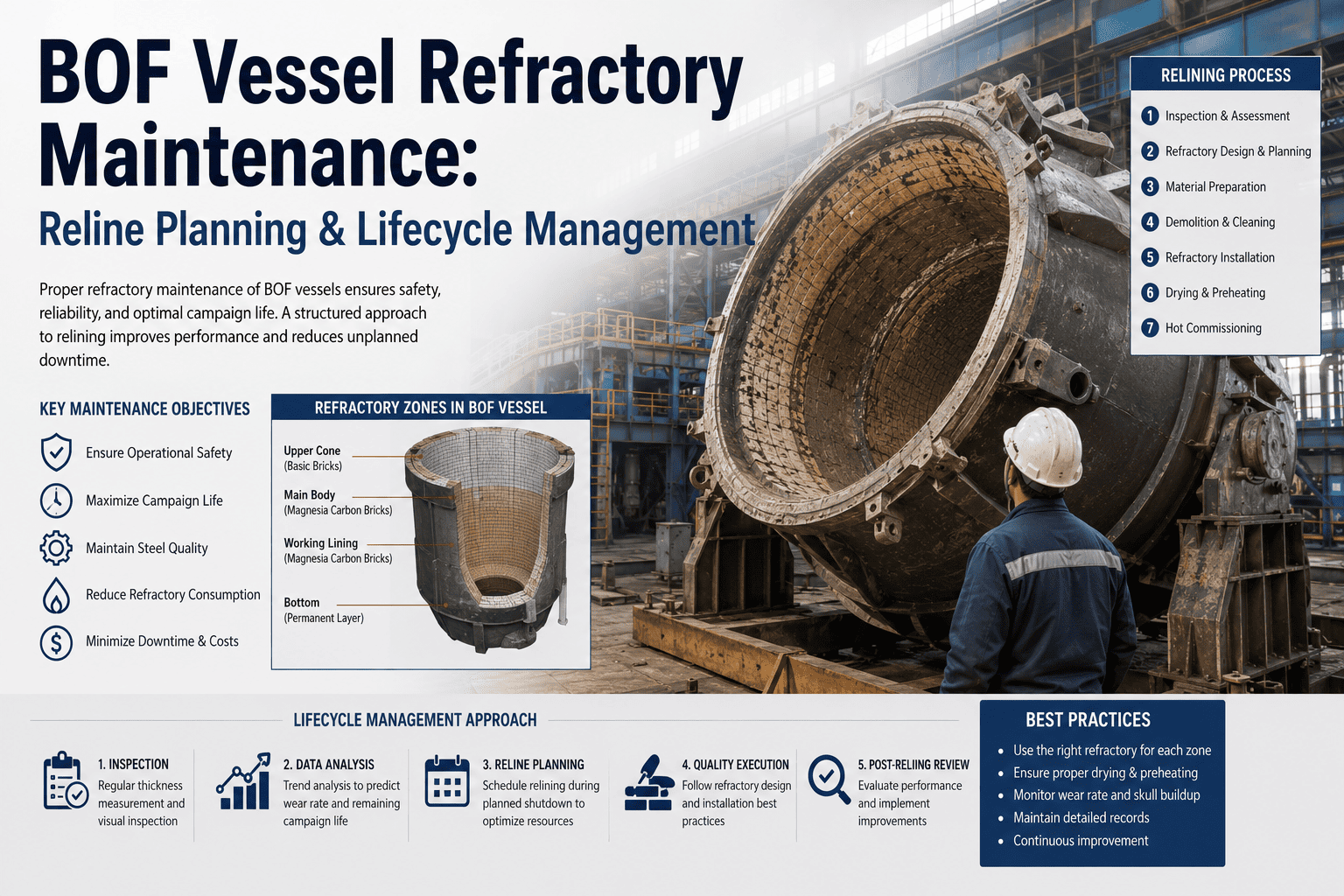
A BOF vessel doesn't wear out evenly, it wears out by zone, and the tap hole area erodes roughly five times faster than the barrel. Two identical converters running the same steel grade can still land on campaigns 1,600 heats apart, and that gap almost never comes down to refractory quality. It comes down to whether gunning and slag splashing were targeted at the fastest-wearing zones based on measured thickness, or applied on a fixed schedule regardless of where the lining actually stood. Start a free trial to see how Oxmaint tracks BOF lining wear zone by zone across every campaign.
5x
Faster wear rate at the tap hole area compared to the barrel of the same vessel
30-50%
Wear reduction in targeted zones from properly optimized slag splashing after each tap
$8-15M
Reline cost deferred by extending a single BOF campaign by 500 additional heats
1-3 wks
Planned outage length for a full reline, recurring roughly every 3 to 5 years per vessel
Why a BOF Campaign Isn't a Passive Countdown
The gap between a 3,200-heat campaign and a 4,800-heat campaign on the same converter rarely comes down to refractory grade. It comes down to whether gunning, patching, and slag splashing were executed throughout the campaign based on actual measured condition in the fastest-wearing zones, rather than on a fixed calendar regardless of where thickness actually stood. Active intervention, not passive waiting, is what separates the two outcomes.
Refractory Fails by Zone, Not by Vessel
| Zone |
Wear Mechanism |
Monitoring Interval |
| Tap hole / trunnion |
Highest mechanical and thermal stress, erosion from metal and slag flow |
Laser profile every 200-300 heats, plus any thermal anomaly |
| Barrel |
Slag chemical attack and thermal cycling, slower than the tap hole |
Laser scan every 50-200 heats depending on campaign stage |
| Bottom |
Gas jet erosion, turbulent metal flow, wear varies with tuyere design |
Tracked separately, often the campaign's actual limiting factor |
Zone-Level Wear Data, Not a Fixed Reline Calendar
Oxmaint logs thickness readings against each zone, calculates wear rate automatically, and triggers a gunning work order the moment residual lining crosses its threshold, not on a preset date. Sign up for a free trial to see it against your own converter fleet, or book a demo and we'll walk through a campaign life extension program built for your shop.
Slag Splashing vs Hot Patching: Different Jobs, Same Goal
Slag Splashing
Performed after every tap, coating the lining with a protective slag layer
Nitrogen-driven through the oxygen lance to blast residual slag onto walls
Reduces wear 30-50% in the zones it targets when properly optimized
Hot Patching / Gunning
Applies refractory material directly to zones nearing minimum thickness
Most effective when targeted using measured wear data, not visual estimate
Extends campaign life 10-25% when timed to zones approaching threshold
How Oxmaint Supports BOF Refractory Programs
Oxmaint integrates with laser scanning systems to log thickness by zone, calculates wear rate automatically between scans using shell thermocouple data, and links gunning and slag splashing records directly to the measurement that justified them. Reline planning shifts from a calendar guess to a data-driven decision, and the same platform tracks tilting drive, tap hole assembly, and hood condition alongside the lining itself. Book a demo to see it mapped against your own converter fleet.
Frequently Asked Questions
Q
Why does the tap hole wear so much faster than the rest of the vessel?
The tap hole and trunnion area absorb the highest mechanical and thermal stress in the vessel, combining erosion from metal and slag flow with the temperature cycling that comes with every tapping angle. That combination wears the area roughly five times faster than the barrel, which is why it needs measurement every 200-300 heats rather than the barrel's longer interval.
Q
How does slag splashing actually protect the refractory?
After tapping, dolomite and lime are added to the remaining slag and blasted onto the vessel walls using nitrogen through the oxygen lance. That slag solidifies into a protective coating over the existing lining, absorbing thermal and chemical attack on the next heat instead of letting it hit the refractory directly.
Q
Why does gunning based on visual inspection alone waste material?
Without a measurement history showing wear rate per zone, gunning material tends to get applied uniformly across the vessel rather than concentrated where it actually extends campaign life. Since gunning material costs the same whether or not it meaningfully extends the campaign, targeting it with measured thickness data is what separates a productive intervention from wasted refractory spend.
Q
How is reline timing actually decided if it isn't just a fixed calendar?
Laser profiling of remaining lining thickness after a campaign guides the decision to extend or reline, combined with continuous shell thermocouple monitoring, since rising shell temperature in a specific zone indicates thinning refractory there. The combination of periodic direct measurement and continuous indirect monitoring gives a complete picture without adding extra downtime just to check.
Turn Every Campaign Into a Data-Driven Decision, Not a Guess
Oxmaint gives steel plant teams zone-specific BOF lining wear tracking, slag splashing and gunning optimization, and reline planning built on measured condition, not a fixed date. Sign up for a free trial to explore it yourself, or book a demo and we'll walk through it against your own converter fleet.