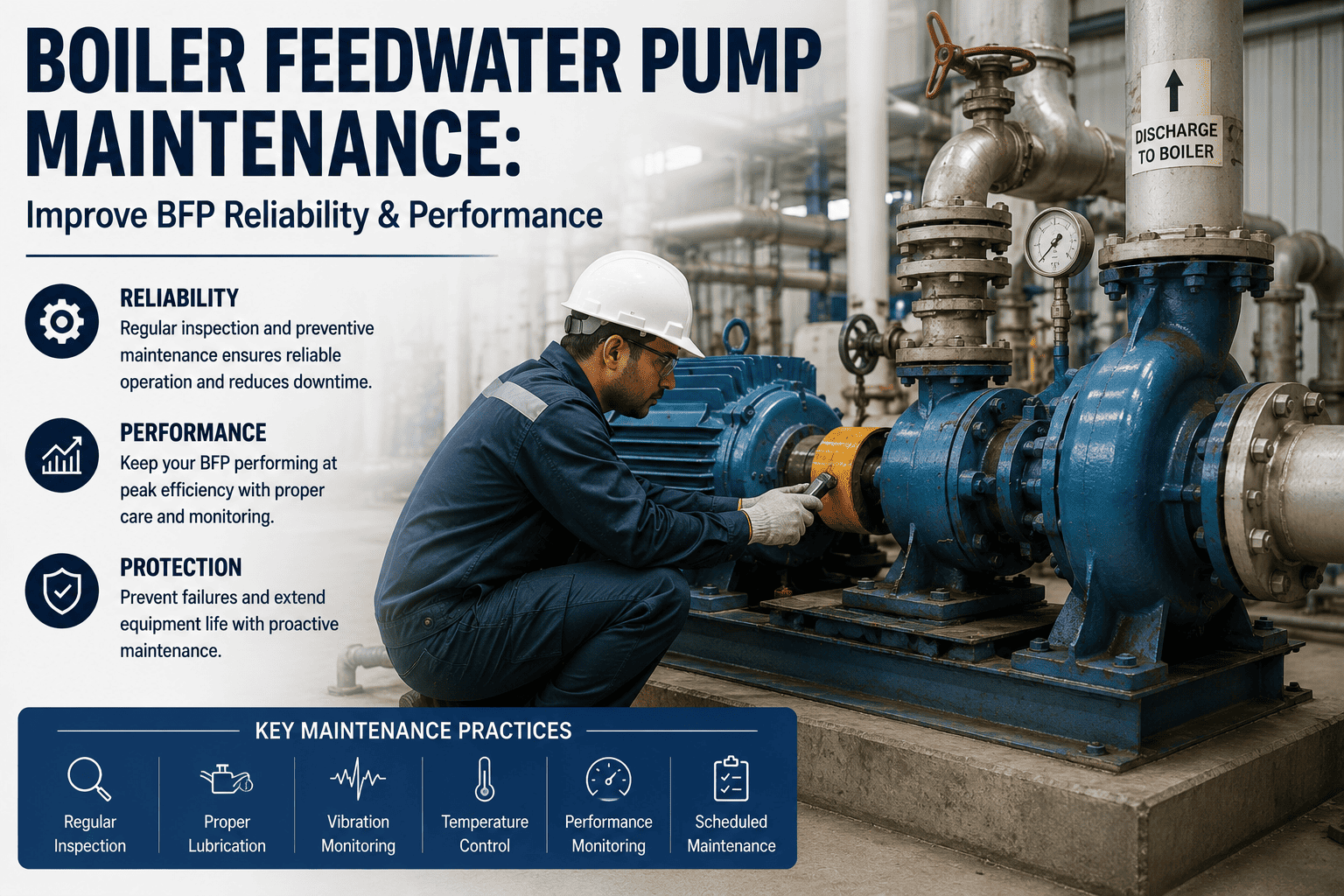
A boiler feedwater pump that loses NPSH margin for even a few minutes doesn't just trip an alarm, it can cavitate the impeller, wipe out the mechanical seal, and force an emergency boiler shutdown on a low-water condition. Unlike a leaking valve you can hear coming, cavitation damage happens inside the pump long before it shows up on a vibration trend. Industry data shows cavitation is responsible for destroying a large share of prematurely failed pump impellers, and boiler feed service is one of the harshest applications a centrifugal pump ever sees. Start a free trial to see how Oxmaint keeps every BFP's maintenance and vibration history in one place.
60m+
NPSH required by large high-speed boiler feed pumps, often beyond deaerator elevation alone
20%
Recommended NPSH margin above NPSHr for critical boiler feed services
3%
Head drop that defines vendor NPSHr, meaning cavitation has already begun at that point
70%
Lower maintenance cost achievable with early cavitation detection and intervention
Why a BFP Failure Is Never Just a Pump Problem
A boiler feedwater pump sits directly between the deaerator and the boiler drum. When it cavitates, loses seal integrity, or trips on high vibration, feedwater delivery stops, and that can force a low-water trip on the boiler itself. Add the cost of an unplanned outage, rushed impeller or seal replacement at overtime labour rates, and lost generation or process uptime, and one BFP failure can cost far more than a full year of scheduled maintenance on that pump.
Where a Boiler Feedwater Pump Actually Fails
| Component |
Common Failure Cause |
Preventive Task |
| Impeller |
Cavitation from insufficient NPSH margin at high feedwater temperature |
NPSH margin verification and suction valve full-open checks every service cycle |
| Mechanical seal |
Dry running, flush line blockage, or shaft misalignment |
Seal flush flow and leakage inspection at every rounds check |
| Balance disc / drum |
Wear from axial thrust excursions causing rotor rub |
Axial position and balance line pressure drop trending |
| Bearings |
Lubrication breakdown or misalignment-driven heat rise |
Oil analysis and bearing temperature checks on a fixed interval |
| Coupling |
Angular or parallel misalignment from thermal growth |
Laser alignment check at every major overhaul or coupling change |
Every BFP, One Vibration and Maintenance Record
Oxmaint tracks running hours, PM intervals and vibration alerts for every boiler feedwater pump on site, so a seal or bearing issue gets scheduled before it turns into an unplanned trip. Sign up for a free trial to see it against your own asset list, or book a demo and we'll walk through your rotating equipment workflow.
Set Your NPSH Margin Before Cavitation Sets It For You
| Parameter |
Vendor / Nameplate Value |
Recommended Operating Margin |
| NPSH available vs required |
NPSHr measured at a 3% head drop, already the onset of cavitation |
1 meter or 20% above NPSHr, whichever is greater |
| Bearing vibration (ISO 20816) |
Zone boundaries set by pump size and mounting class |
Trend into Zone B early, alarm before Zone C is reached |
Maintenance Rhythm: Daily Rounds vs Scheduled Overhaul Work
Daily / Weekly Rounds
Seal flush flow and visible leakage check at every operator round
Suction valve position confirmed fully open, never throttled
Bearing temperature and casing vibration spot readings logged
Scheduled Overhaul
Balance disc clearance and axial position measured against baseline
Oil analysis and full bearing replacement on a fixed run-hour interval
Laser shaft alignment redone after any coupling or motor work
How Oxmaint Supports Power Plant Maintenance Teams
Oxmaint tracks run hours and PM thresholds for every boiler feedwater pump, generates work orders automatically before service intervals lapse, and keeps vibration and NPSH trend history linked to each asset. Cavitation and seal-failure patterns become visible across the fleet instead of buried in individual logbooks. Book a demo to see it mapped against your own rotating equipment list.
Frequently Asked Questions
Q
Why is cavitation the single biggest risk to a boiler feedwater pump?
Boiler feed water is hot, which raises its vapor pressure and shrinks the available NPSH margin. Once vapor bubbles form and collapse inside the impeller, erosion begins immediately, and in feed service a cavitation trip can also interrupt water delivery to the boiler itself.
Q
Why keep a 20% NPSH margin instead of running right at NPSHr?
Vendor NPSHr is measured at the point cavitation has already begun, a 3% head drop. Running with only that margin leaves zero buffer for summer temperature swings, throttled valves, or deaerator level dips, so critical services build in 20% or a full meter of extra headroom.
Q
Does a partially closed suction valve really matter that much?
Yes. A throttled suction valve adds friction losses that quietly eat into NPSH available with no obvious external sign, which is why suction valves should always be operated fully open or fully closed, never partway.
Q
What's the fastest way to move a BFP fleet off manual logbooks?
Start with a CMMS that tracks run hours and vibration trends against each pump automatically, since that alone catches the slow drift a manual round often misses. Layer NPSH and seal-flush checks on top once the baseline data is flowing.
Protect the BFP Before It Cavitates, Not After
Oxmaint gives power plant and process teams pump-specific PM scheduling, vibration and NPSH trend tracking, and audit-ready maintenance documentation in one platform. Sign up for a free trial to explore it yourself, or book a demo and we'll walk through it against your own fleet.