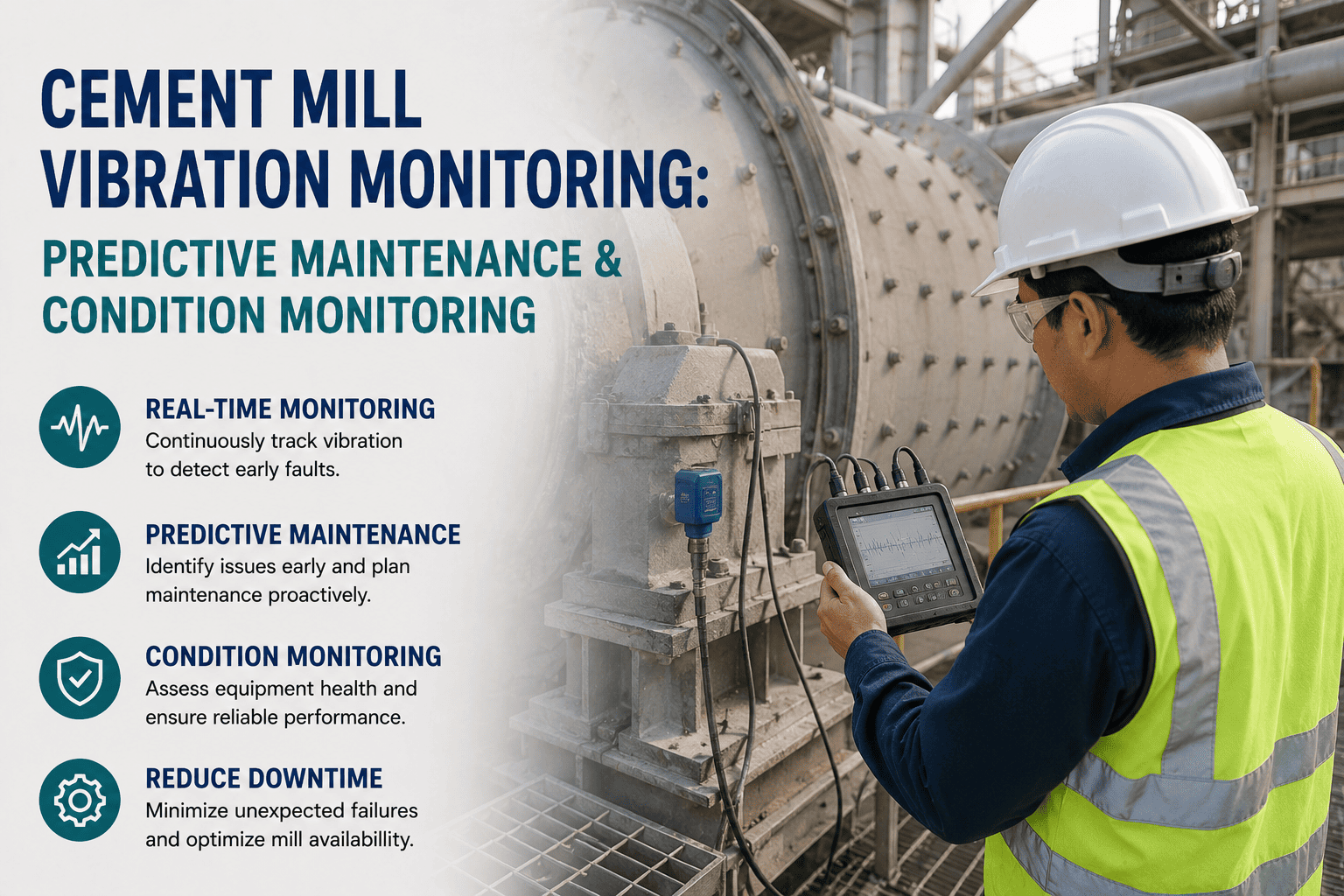
A cement mill doesn't fail without warning — it vibrates differently for weeks before it does. The trouble is most plants still catch that signal with a handheld analyzer on a monthly route, checking a bearing that spins millions of times between visits. Continuous vibration monitoring closes that gap, often giving reliability teams four to eight weeks of lead time before a bearing or gearbox failure that would otherwise cost $180,000 to $500,000 and up to two weeks of downtime. Start a free trial to see how Oxmaint turns raw vibration data into a work order before the bearing lets go.
4-8 Weeks
Typical advance warning continuous monitoring gives before a mill bearing or gearbox failure
7-14 Days
Unplanned downtime a single main bearing failure can cause on a ball mill or VRM
80%
Of ball mill bearing failures trace back to lubrication issues, not fatigue alone
4.5 mm/s
RMS velocity threshold below which most mill bearings are considered healthy under ISO 10816
Vibration Severity Isn't Guesswork
ISO 10816-3 turns a raw vibration reading into a decision. It maps RMS velocity into four zones — from a new-machine baseline through to a level that demands an immediate shutdown — so a reliability engineer isn't relying on instinct to decide whether a rising number means "watch it" or "stop it."
The Four ISO 10816 Zones, in Plain Terms
| Zone |
What It Means |
Action |
| Zone A |
New or freshly overhauled machine baseline |
Record as reference for all future comparisons |
| Zone B |
Acceptable for unrestricted long-term running |
Continue routine monitoring, watch the trend |
| Zone C |
Unsatisfactory for long-term running |
Increase monitoring, schedule corrective work |
| Zone D |
Severe enough to cause damage on continued operation |
Shut down for inspection before running further |
What the Vibration Is Actually Telling You
Overall velocity says something is wrong. Frequency analysis says exactly what and where — turning a shutdown-and-inspect decision into a targeted repair.
01
BPFO / BPFI: Bearing Race Damage
Ball or roller pass frequency spikes
A clean spike at the outer or inner race pass frequency points straight at trunnion or main bearing race damage — the highest-risk failure mode on the mill, since these bearings carry the full weight of the drum.
02
GMF: Gear Mesh Frequency
Tooth pass harmonics rising above baseline
Elevated gear mesh frequency and its sidebands signal tooth pitting, cracking or scoring in open gearing or the main gearbox — a fault that becomes a five to ten day, six-figure replacement if it reaches full tooth fracture.
03
1x RPM Amplitude: Imbalance & Misalignment
The most common — and most fixable — signature
A strong spike at exactly the rotational frequency usually means shaft imbalance or coupling misalignment rather than internal damage — often correctable with a shim or balance adjustment instead of a parts order.
04
Envelope Spectrum: Bearing Faults Under Grinding Noise
Separating real faults from process noise on a VRM
Bearing faults produce a constant-frequency impact regardless of bed depth or feed hardness, while grinding-related vibration shifts with process conditions. Envelope demodulation is what separates the two on a busy VRM signal.
From Vibration Reading to Work Order, Automatically
Oxmaint applies ISO 10816-3 thresholds to every mill bearing, gearbox and motor and raises a prioritized work order the moment a zone is crossed. Sign up for a free trial to see it on your own mill fleet, or book a demo and we'll walk through your sensor setup together.
Route-Based Checks vs. Continuous Monitoring
Handheld Route
Seconds of Data Against Millions of Cycles
A monthly walkaround captures a brief snapshot per point. Fast-developing faults spall and progress in the weeks between visits, unseen until the next scheduled reading — or a shutdown.
Continuous Wireless
Trend Visible Days After It Starts
Sensors streaming at fifteen-minute intervals catch the early, slow-rising phase of a developing fault — the window where a planned replacement is still an option instead of an emergency one.
Handheld Route
Relies on an Analyst's Availability
Interpretation depends on the technician reading the spectrum that day. If the route slips a week during a busy shutdown, so does the earliest warning on every asset on it.
Continuous Wireless
Auto-Generates the Work Order
Threshold breaches route straight into the CMMS with asset ID, alert value and recommended action — reaching the planner the same shift, not at the next scheduled review.
How Oxmaint Supports Mill Vibration Monitoring
Oxmaint connects to your existing wireless vibration sensors, applies ISO 10816-3 thresholds per asset class and operating speed, and turns a zone breach into a prioritized work order in seconds. Every alert, repair and outcome is logged against the asset so reliability engineers can see which interventions actually restored mill health. Book a demo to see it configured for your ball mill and VRM fleet.
Frequently Asked Questions
Q
What vibration level should trigger concern on a cement mill?
Under ISO 10816-3, overall RMS velocity below 4.5 mm/s is generally considered healthy, while sustained readings above 11.2 mm/s indicate a risk of catastrophic failure requiring immediate shutdown for inspection.
Q
Is lubrication really that big a factor in mill bearing failure?
Yes — roughly 80% of ball mill bearing failures are lubrication-related rather than pure fatigue, which means oil cleanliness monitoring is often a stronger predictor of bearing life than vibration alone.
Q
Do we need to replace our route-based vibration program?
No. Continuous monitoring on your most critical bearings and gearboxes works alongside an existing route program covering lower-risk equipment — the two layers complement rather than replace each other.
Q
Where should a plant start with vibration-based predictive maintenance?
Start with the highest-consequence assets — mill trunnion bearings and main gearboxes — and set an accurate baseline before expanding sensor coverage. Thresholds mean little without a documented normal to compare against.
Catch the Bearing Fault While It's Still a Work Order, Not an Emergency
Oxmaint applies ISO 10816-3 thresholds to every mill asset and turns a vibration alert into a prioritized work order automatically. Sign up for a free trial to explore it yourself, or book a demo and we'll walk through your mill's sensor and asset setup together.
ISO 10816-3 Thresholds
Continuous Wireless Monitoring
Auto Work Order Generation
Bearing & Gearbox Fault Tracking
Mobile Reliability Dashboard