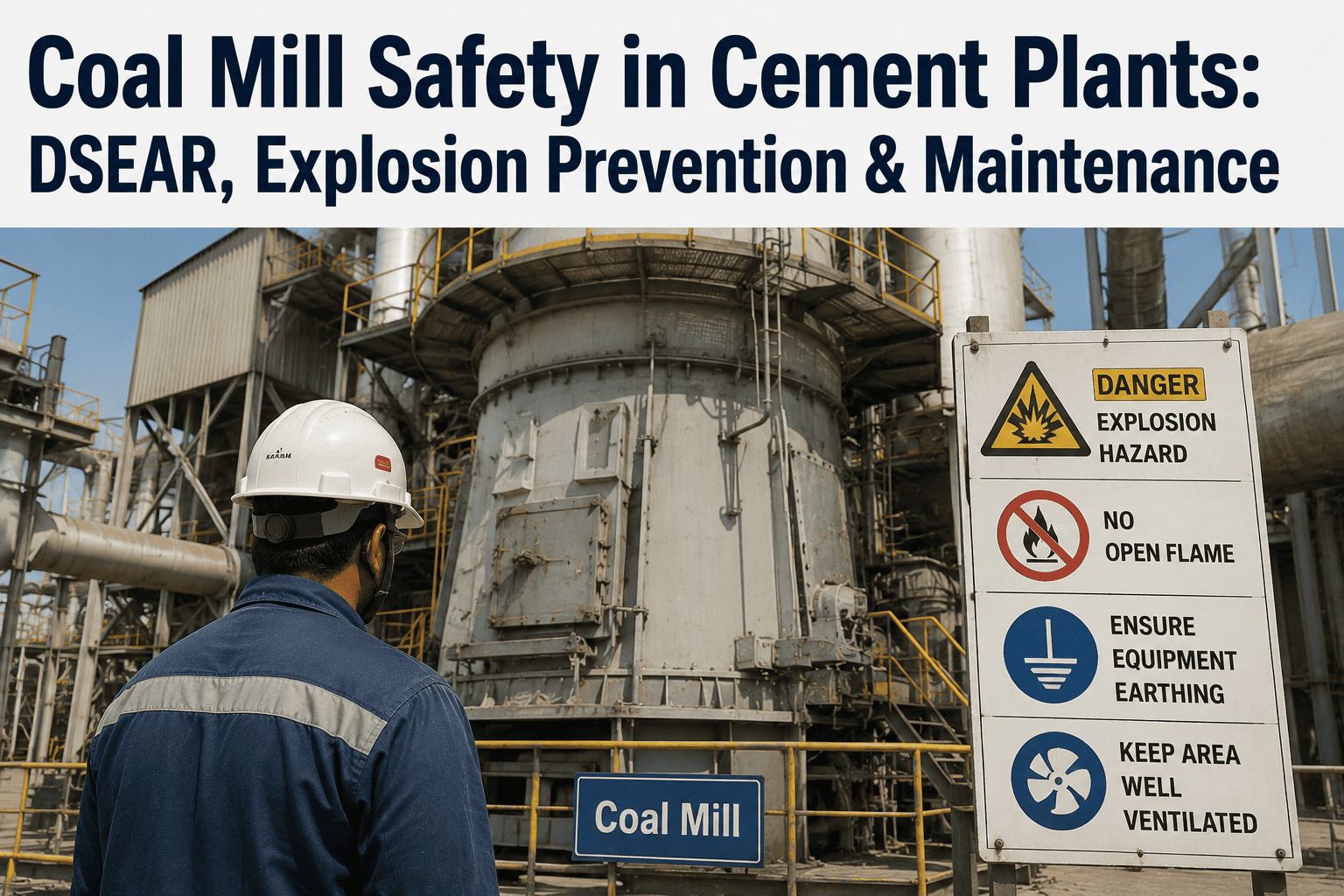
A coal mill explosion doesn't start with a bang, it starts with a CO reading nobody escalated fast enough. A localised hot spot in a dust accumulation lifts carbon monoxide above 200 ppm, outlet temperature creeps up a few degrees, and if that signal sits in a logbook instead of triggering an immediate response, the next stage is smouldering material meeting fresh air at a mill restart, with pressure rising at 2,000 psi per second and peaking in 45 milliseconds. Start a free trial to see how Oxmaint turns a CO alarm into an automated, escalating response instead of a note for the next shift.
200 ppm
CO level where a hot spot typically starts to be treated as an emergency-response trigger
12-13%
Oxygen concentration above which an explosive atmosphere becomes possible in most coal grinding systems
80°C
Pile core temperature where spontaneous combustion risk becomes active in accumulated coal dust
45 ms
Time to peak pressure once fresh air meets smouldering coal dust, leaving no room for a manual response
Why the Fire Triangle Can't Be Broken the Easy Way
An explosion needs oxygen, a fuel source, and an ignition source in the same place at the same time. In a coal mill, the fuel can't be removed, since that's the product, and the ignition source can't be removed either, since grinding energy, hot surfaces, and static charge are inherent to the process. That leaves only one lever: keeping oxygen concentration below the level where combustion becomes possible, which is exactly why inerting systems and continuous CO and O2 monitoring sit at the centre of coal mill safety, not around the edges of it.
The Escalation Path a CO Reading Actually Follows
| Stage |
Signal |
Required Response |
| Early hot spot |
CO climbs above 200 ppm, outlet temperature lifts 5-8°C from normal |
Raise an emergency work order and start the pre-shutdown checklist |
| Intensified oxidation |
Confined pocket heating further, restart risk introduces O2 to smouldering material |
Force a controlled shutdown, arm the inerting system, lock out maintenance entry |
| Uncontrolled ignition |
Fresh air meets smouldering coal at an inspection door or mill restart |
This stage should never occur if every earlier stage triggered its response |
An Alarm That Escalates Itself, Not One That Waits for a Shift Change
Oxmaint watches CO, O2, and outlet temperature readings against defined stage thresholds and automatically raises the correct level of work order the moment a signal crosses the line. Sign up for a free trial to see it against your own coal mill safety instrumentation, or book a demo and we'll walk through your escalation workflow.
Engineering Controls vs Ongoing Monitoring
Engineering Controls
Inerting systems maintained and pressure-tested on a fixed interval
Dust collection and de-dusting filters cleaned to prevent accumulation
Explosion venting and isolation doors inspected for correct operation
Ongoing Monitoring
CO, O2 and outlet temperature logged continuously, not spot-checked
Housekeeping and dust accumulation tracked as a direct explosion-risk lever
Bearing condition watched, since bearing failure sparks are a known ignition source
How Oxmaint Supports Coal Mill Safety Programs
Oxmaint connects CO, O2 and temperature sensor data to an automated escalation chain, so a 400 ppm reading at any hour raises the correct work order level, assigns a safety technician, and starts the pre-shutdown checklist without waiting on a manual review. Inerting system maintenance, dust housekeeping records, and every escalation event stay attached to the coal mill's safety record, giving DSEAR and combustible dust compliance documentation that's ready before an inspector asks for it. Book a demo to see it mapped against your own coal grinding system.
Frequently Asked Questions
Q
Why can't a coal mill simply remove the fuel or ignition source to prevent explosions?
Coal is the product being ground, so removing the fuel isn't an option, and ignition sources like grinding energy, hot process air, and static charge are inherent to the milling process itself. That leaves oxygen concentration as the only practical control point, which is why inerting and continuous O2 monitoring are the core of coal mill explosion prevention.
Q
Why is a mill restart one of the most dangerous moments for ignition?
If smouldering material has developed inside the mill and goes undetected, restarting introduces fresh air and oxygen directly to that hot material. That combination is a documented ignition path, which is why an automated shutdown and inerting sequence needs to trigger before a restart is attempted, not after.
Q
Is cement dust itself an explosion risk, the way coal dust is?
No, powdered cement is not classified as a combustible dust, which is part of why some cement plants under-protect their coal milling systems, mistakenly assuming the same applies there. Coal dust is a genuinely separate and significant hazard that needs its own dedicated prevention and monitoring measures.
Q
What role does housekeeping play in explosion prevention?
Dust accumulation in a baghouse, cyclone, or duct is where localised hot spots typically develop first. Since particle size below roughly 74 microns dramatically increases ignition sensitivity, tracking and controlling dust buildup is a direct, manageable lever on explosion risk rather than a secondary housekeeping task.
Turn a CO Reading Into Action, Not a Logbook Entry
Oxmaint gives cement plant safety teams automated CO, O2 and temperature escalation, inerting system PM tracking, and DSEAR-ready compliance records in one platform. Sign up for a free trial to explore it yourself, or book a demo and we'll walk through it against your own coal mill safety program.