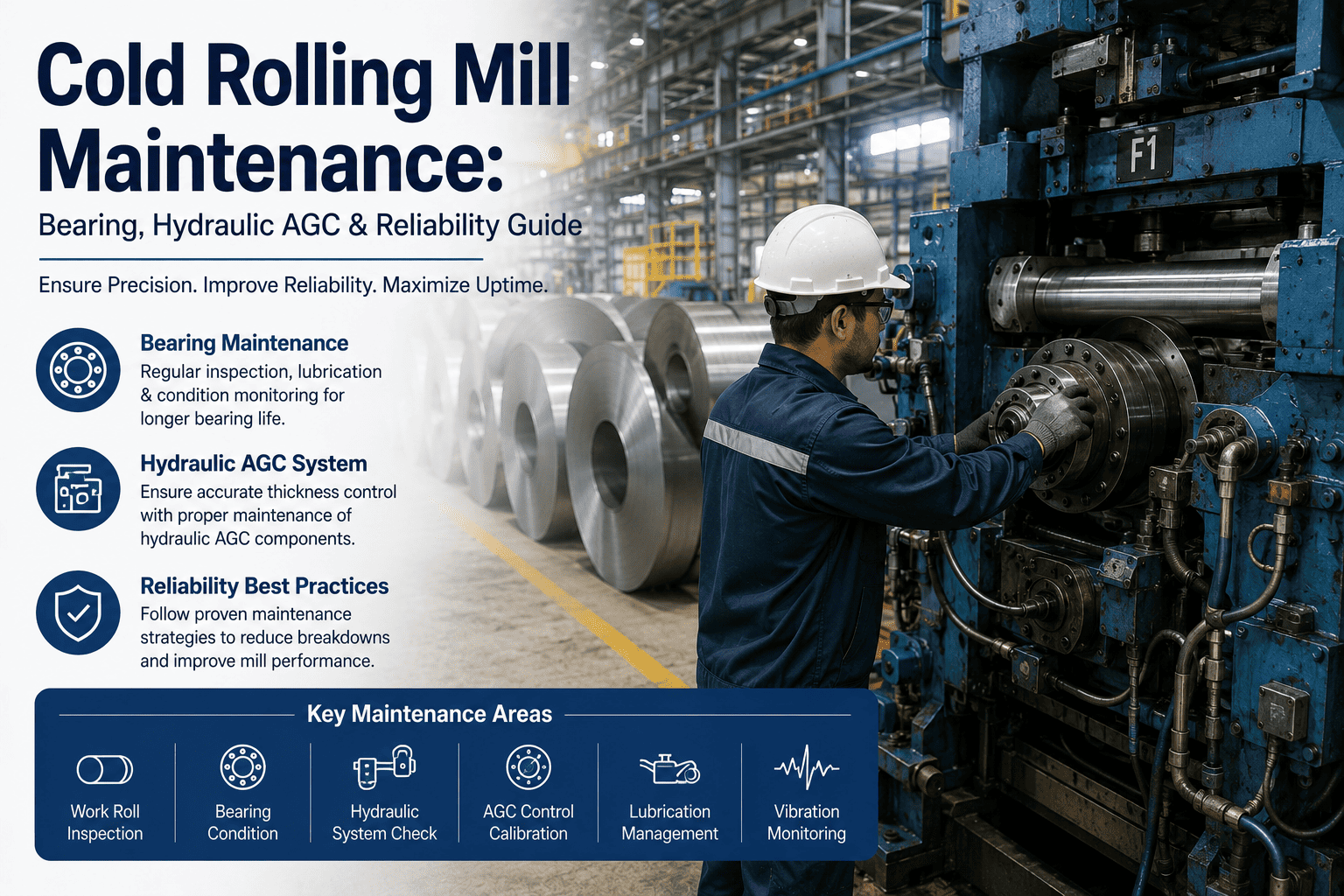
A cold rolling mill holds strip thickness within 5 microns while running at speeds over 1,500 metres a minute, and the entire tolerance rests on a servo valve with internal clearances of just 5 to 15 microns. Push a few too many contaminant particles through that valve and the whole precision system starts to drift. Bearing failures, gearbox degradation and hydraulic AGC faults together account for 67% of all unplanned rolling mill downtime, and all three are typically detectable 3 to 8 weeks in advance. Start a free trial to see how Oxmaint turns those early signals into scheduled work instead of a stopped line.
67%
Of unplanned rolling mill downtime traced to bearing, gearbox and hydraulic AGC faults combined
75%+
Of hydraulic system failures attributed directly to contaminated oil rather than mechanical wear
5-15µm
Internal servo valve clearance controlling the AGC roll gap, easily fouled by oversized particles
3-8 Wks
Typical advance warning window available from vibration and oil analysis before a critical failure
The Systems That Define Cold Mill Precision
Hydraulic AGC
Servo valves respond in roughly 5 milliseconds when the oil is clean, but degrade to 15-30 milliseconds once contaminated, directly translating to strip thickness variation the control system can no longer correct in real time.
Roll Bearings
Bearing defect frequency signals can grow substantially in the weeks before overall vibration readings show anything unusual, which is why calendar-based handheld checks routinely miss early-stage bearing distress.
Gearboxes
Iron and chromium particle counts in oil analysis reveal gear and bearing wear well before a failure, and with finishing stand gearbox replacements running six-figure costs and a lead time of months, monthly analysis pays for itself many times over.
Coiler & Tension Reel
Operating at the mill's highest speed point under constantly growing cyclic load, the coiler sees the highest bearing replacement frequency in the plant and is the most common source of campaign-interrupting failures.
Catch the Signal 3 to 8 Weeks Before the Failure
Oxmaint connects bearing vibration, oil analysis and hydraulic cleanliness data straight to work order execution, so a rising BPFO signal or a contamination event turns into a scheduled task, not a stopped line. Sign up for a free trial to see it against your own mill, or book a demo and we'll walk through your reliability program.
Oil Cleanliness: The Single Biggest Lever in Cold Mill Reliability
| Circuit |
Typical Operating Reality |
Target Cleanliness |
| AGC Servo Circuit |
Most mills run ISO 18/16/13 to 19/17/14 and accept 12-18 month servo valve life as normal |
ISO 16/14/11 or better, doubling typical servo valve service life |
| Hydraulic Power Unit |
Sets the contamination floor for every downstream cylinder and valve in the mill |
Continuous 3µm absolute filtration with sealed reservoirs |
Daily Checks That Catch Problems Before the Next Shift
✓
Roll bearing temperature — sustained readings above roughly 65°C accelerate grease degradation sharply
✓
Filter clogging indicators — checked at every shift start, since these are the earliest visible sign of oil contamination
✓
Roll surface for chatter marks — visible amplitude beyond a few microns signals it's time for a grind
✓
Hydraulic pressure stability — fluctuations beyond a small tolerance during rapid gap changes flag valve or seal issues
How Oxmaint Supports Cold Mill Reliability Teams
Oxmaint tracks roll grinding history, bearing condition, hydraulic oil cleanliness per circuit and gearbox oil analysis results against every asset in the mill, with automatic work orders when readings cross a configured threshold. Servo valve response time, filter loading and pump performance are trended over time rather than checked in isolation. Book a demo to see it mapped against your own mill's asset hierarchy.
Frequently Asked Questions
Q
Why does oil cleanliness matter more on a cold mill than most other industrial hydraulics?
Because the AGC servo valves controlling roll gap have internal clearances of just 5 to 15 microns. Particles that would be harmless in a general hydraulic system are large enough to cause spool sticking and scoring here, degrading response time and directly showing up as strip thickness variation.
Q
Can bearing failures really be caught weeks in advance?
Yes, when vibration is analysed at the bearing defect frequency rather than just overall RMS level. A bearing can show entirely normal overall vibration while its defect frequency amplitude has grown substantially over the preceding weeks, which is exactly the gap a targeted monitoring programme is built to close.
Q
What's the most common cause of unexplained AGC gauge deviation?
LVDT position transducer zero drift is the most frequently reported cause, followed closely by hydraulic oil contamination causing servo valve stiction. A calibration check at the end of each campaign catches transducer drift before it produces a customer-visible strip quality issue.
Q
Is monthly gearbox oil analysis really worth the cost?
Given that a large finishing stand gearbox replacement can run into six or seven figures with a lead time of many months, a routine oil sample analysis is a small fraction of the risk it's protecting against, and it's usually the earliest available warning of developing gear or bearing wear.
Protect Rolling Geometry Before It Shows Up on the Strip
Oxmaint tracks bearing condition, hydraulic oil cleanliness and gearbox oil analysis across your mill, turning early warning signals into scheduled work orders. Sign up for a free trial to explore it yourself, or book a demo and we'll walk through it against your own mill.