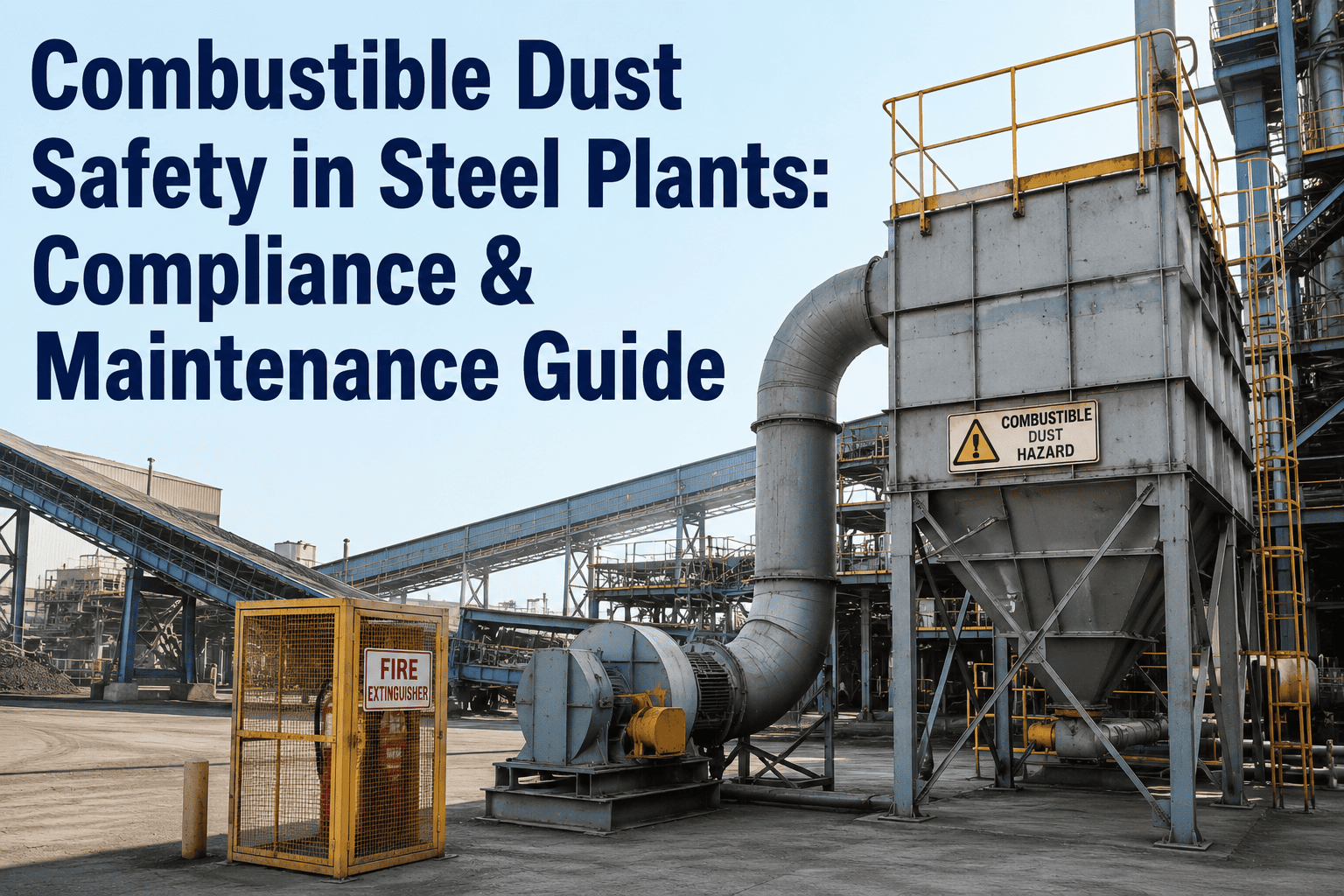
Combustible dust does not need much to become dangerous, a fine layer settled on a beam, a cloud stirred up during cleaning, and an ignition source that was already there for another reason. Steel plants generate this dust constantly, from coal handling to grinding to material transfer, which is exactly why dust hazard analysis and maintenance discipline matter as much as any other safety program on site. Sign up to see how Oxmaint tracks dust hazard inspections and housekeeping compliance across your plant in one place.
The Five Conditions Behind a Dust Explosion
Fuel
Combustible dust in fine enough particle form
Oxygen
Present in ordinary ambient air
Ignition
A spark, hot surface, or friction source
Dispersion
Dust suspended in the air as a cloud
Confinement
An enclosed space that lets pressure build
Why a Secondary Explosion Is Often Worse Than the First
The Chain Reaction Risk Housekeeping Is Meant to Break
A small primary dust explosion, often minor on its own, can release a shockwave that dislodges accumulated dust layered on beams, ledges, and equipment surfaces throughout the plant. That dislodged dust becomes an airborne cloud exposed to the same ignition source, and the resulting secondary explosion is frequently far more destructive than the event that triggered it. This is the core reason combustible dust programs put as much emphasis on housekeeping and dust layer thickness as they do on eliminating ignition sources.
Where Combustible Dust Actually Accumulates
Overhead Surfaces
Beams, ledges, cable trays and duct tops collect dust that housekeeping crews on the floor level rarely see, yet these surfaces are exactly where a secondary explosion chain begins.
Material Transfer Points
Conveyor transfer chutes, crushers and screening equipment generate fine airborne dust continuously, making dust collection system condition directly tied to explosion risk at these points.
Enclosed Equipment
Dust collectors, silos, bins and ductwork provide the confinement that turns a dust cloud into a pressure event, which is why these enclosures carry the strictest inspection requirements.
Inspection and Maintenance Checklist
| Focus Area |
Common Gap |
Preventive Task |
| Dust hazard analysis |
DHA completed once and never revisited after process or layout changes |
Periodic DHA review tied to any process, equipment or layout change |
| Housekeeping rounds |
Floor-level cleaning without checking overhead and hard-to-reach surfaces |
Scheduled inspection of overhead ledges, beams and duct tops |
| Dust collection systems |
Filter fouling and airflow drop reducing collection efficiency |
Airflow and differential pressure monitoring on schedule |
| Ignition source control |
Hot work and static grounding checks not linked to dust zones |
Permit process cross-checked against classified dust hazard areas |
| Explosion protection equipment |
Vents, suppression systems and isolation devices missing inspection records |
Functional testing and documentation on a fixed compliance interval |
Every Inspection, Every Zone, One Compliance Record
Oxmaint registers dust collection systems, explosion protection equipment, housekeeping zones and classified areas as tracked assets with their own inspection history, so gaps in your combustible dust program are visible before an auditor or inspector finds them. Sign up for a free trial to see it against your own plant, or book a demo and we will walk through your dust safety program.
Paper-Based Checklists vs Documented Digital Compliance
| Approach |
How It Plays Out |
Result on Safety and Compliance |
| Paper-based checklists |
Housekeeping and inspection records scattered across binders and forms |
Gaps go unnoticed until an audit or incident investigation surfaces them |
| Ad hoc digital tracking |
Some zones logged digitally, others still tracked informally |
Partial visibility, with blind spots in exactly the areas least monitored |
| Documented digital compliance |
Every dust zone, collector and protection device logged and trended in one system |
Overdue inspections flagged automatically, audit-ready records at all times |
How Oxmaint Supports Combustible Dust Compliance
Oxmaint tracks dust collection systems, explosion vents, suppression equipment and classified housekeeping zones as individual assets, logging inspection readings and overdue tasks against each one. A collector with declining airflow or a housekeeping zone that has missed its scheduled round triggers a work order automatically, keeping your combustible dust program documented and audit-ready. Book a demo to see it mapped against your own facility.
Frequently Asked Questions
Q
What is a dust hazard analysis and why does it need to be revisited?
A dust hazard analysis identifies where combustible dust accumulates, disperses and could ignite across a facility, and it needs to be revisited whenever a process, layout or equipment change could alter those conditions, not treated as a one-time exercise.
Q
Why is overhead dust accumulation more dangerous than it looks?
Dust settled on beams, ledges and duct tops is easy to overlook during routine floor-level housekeeping, but a shockwave from even a small explosion can dislodge it into an airborne cloud that fuels a much larger secondary event.
Q
How does dust collector condition tie into explosion risk?
A collector with fouled filters or reduced airflow lets more airborne dust escape into the surrounding area, increasing both the fuel available for a dust cloud and the amount of dust that settles on nearby surfaces over time.
Q
What is the fastest way to move a combustible dust program off paper records?
Register each dust collector, explosion protection device and housekeeping zone as a tracked asset with a set inspection frequency, then log readings and overdue tasks against it so compliance status is visible at any point, not just at audit time.
Keep Your Combustible Dust Program Audit-Ready
Oxmaint gives steel plant teams dust collection system tracking, explosion protection inspections, housekeeping zone scheduling and compliance documentation in one platform. Sign up for a free trial to explore it yourself, or book a demo and we will walk through it against your own facility.