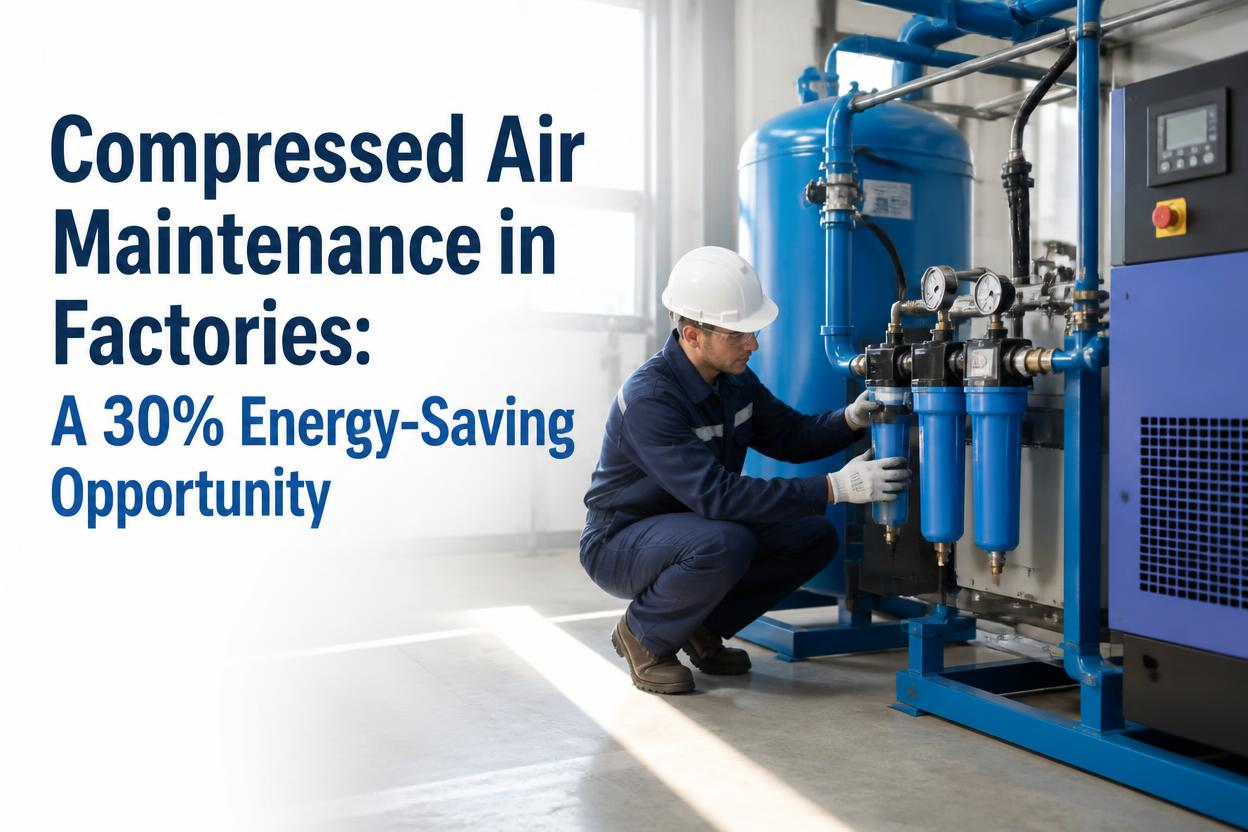
Compressed air is often called the fourth utility on a factory floor, and it's usually the least monitored one. Carbon Trust research shows UK industry burns through roughly 10TWh of electricity a year compressing air, with an estimated 30% of it lost before it ever does useful work. That's not a design flaw — it's a maintenance backlog with a payback period measured in months. Start a free trial to see how Oxmaint schedules and tracks compressed air PM before losses become invisible in your energy bill.
30%
Of compressed air generated is typically lost before reaching a tool or process, per Carbon Trust estimates
10%
Share of total UK industrial electricity use that compressed air systems account for
5–10%
BCAS-recommended leak rate target for a well-managed system, against 40–50% on an unmanaged one
£110m
Estimated annual UK-wide savings available from simple, low-cost compressed air improvements, per Carbon Trust
Why This Keeps Happening
Compressed air waste hides inside a utility bill that never breaks itself down by system. A hissing leak behind a machine guard, a dryer running past its service interval, or a system pressurised two bar higher than any tool on the line needs — none of it trips an alarm. It just quietly raises the compressor's run hours, month after month, until someone finally audits the system.
Where the 30% Actually Goes
Compressed air waste is rarely one big problem — it's three smaller ones compounding on top of each other.
Cause 1
Leaks
Worn seals, loose couplings, open condensate valves. BCAS puts unmanaged leak rates as high as 40–50% of total output.
Cause 2
Wrong System Pressure
Every extra bar of pressure raises energy use by roughly 7%. Many systems run higher than any tool on site actually needs.
Cause 3
Inefficient Drying
Dryers and filters past their service interval increase pressure drop, forcing the compressor to work harder for the same output.
Maintenance Fixes That Pay Back Fastest
01
Run a Quarterly Ultrasonic Leak Survey
The single highest-return fix
Most leaks are silent to the human ear against plant background noise. An ultrasonic detector finds them from several metres away, including leaks hidden behind guards and overhead pipework. A single 3mm hole can cost over £1,000 a year in wasted electricity alone, and most sites have dozens of leak points once surveyed properly.
Typical Payback
3–6 months from repair alone
Who Runs It
In-house engineering team or specialist survey contractor
02
Match System Pressure to Actual Demand
Often a controls change, not a hardware one
Audit what pressure the most demanding tool on the line genuinely needs, then set the system to that plus a small safety margin — not the highest pressure any process has ever needed historically. Reducing pressure lowers both energy use and the rate of leak loss, since leak flow increases with pressure too.
Typical Payback
Immediate — no capital cost involved
Who Runs It
Process and controls engineering, jointly with production
03
Keep Dryers and Filters on a Strict PM Schedule
Deferred servicing here compounds silently
A PSA dryer or filter running past its service interval builds up pressure drop across the drying train, forcing the compressor to generate more pressure to deliver the same usable air downstream. Regular desiccant checks, filter element replacement, and drain valve inspection keep this loss from creeping in unnoticed.
Typical Payback
Ongoing — prevents gradual efficiency decline
Who Runs It
Maintenance team on a scheduled PM plan
04
Consider Variable Speed Drive Retrofits on Base Compressors
Bigger investment, bigger structural saving
Fixed-speed compressors run at full load even when demand fluctuates through a shift. VSD compressors match output to real-time demand, and industry reporting suggests VSD retrofits can deliver energy savings of up to 60% in the right applications — particularly on sites with variable production schedules.
Typical Payback
1–3 years depending on load variability
Who Runs It
Engineering, with finance sign-off on capital spend
Turn the Leak Survey Into a Recurring PM, Not a One-Off
Oxmaint schedules compressor, dryer, and leak-survey PMs against every asset, and logs every fixed leak so the same one never gets found twice. Sign up free or book a demo to see compressed air asset tracking in action.
Fix vs. Payback: Quick Reference
Use this to prioritise where to start — the fastest wins cost the least and need no capital approval. Sign up to Oxmaint to schedule each fix as a tracked PM against the relevant compressor asset.
| Fix |
Typical Energy Saving |
Investment Level |
| Leak survey and repair |
15–30% off compressed air energy bill |
Low — labour and detector only |
| Pressure reduction |
~7% per bar reduced |
None — controls adjustment |
| Dryer and filter PM |
Prevents ongoing efficiency decline |
Low — parts and scheduled labour |
| VSD compressor retrofit |
Up to 60% on variable-demand sites |
High — capital equipment purchase |
Why Fixed Leaks Come Back Within a Year
A one-off leak survey feels like a win — until the same leak rate creeps back twelve months later. It's rarely bad repair work. It's an untracked system.
Gap 01
The Survey Was a One-Time Project
A contractor found and fixed 40 leaks last year. No PM schedule was set up afterward, so new leaks form silently until someone eventually notices the energy bill creeping up again.
Gap 02
Leak Locations Were Never Logged Against the Asset
The survey report sat as a PDF in someone's inbox. Nobody could tell, six months later, whether the coupling that failed again was the same one repaired last year or a new failure entirely.
Gap 03
Pressure Was Raised Again for a "Temporary" Fix
A production issue was quickly solved by raising system pressure rather than diagnosing the actual tool problem. The pressure was never lowered back down once the underlying issue was resolved.
Gap 04
Dryer Servicing Was Deprioritised Under Pressure
Facing a packed PM backlog, the dryer service interval kept slipping to "next month." Pressure drop across the drying train built up gradually enough that no single week looked alarming.
How Oxmaint Closes This Gap
Oxmaint logs every leak find, repair, and dryer service against its exact asset location, and schedules the next survey automatically instead of relying on someone remembering. Pressure adjustments and PM completions are tracked over time, so a creeping leak rate or a slipping dryer interval shows up as a trend, not a surprise on next year's energy bill. Book a demo to see compressed air PM tracking in Oxmaint.
Frequently Asked Questions
Q
How often should a compressed air leak survey be repeated?
The Carbon Trust recommends scheduling leak detection surveys roughly every three months for general industrial use, though high-dependency or continuous operations may benefit from more frequent checks. The right frequency depends on operating hours, system age, and how quickly new leaks tend to form on your specific network.
Q
What is BCAS and why does it matter for leak rate targets?
BCAS, the British Compressed Air Society, is the UK trade body for the compressed air industry and publishes benchmark leak rate guidance widely referenced across the sector. Its figures of 5–10% leak rate for a well-managed system versus 40–50% for an unmanaged one give engineering teams a concrete target to audit against rather than a vague sense of "some waste."
Q
Is lowering system pressure risky for production?
Not if it's done properly. The safe approach is to audit the actual pressure requirement of the most demanding tool or process on the line, set the system to that figure plus a small margin, then monitor for any tool underperformance before rolling the change out plant-wide. Pressure should never be cut blindly without checking downstream requirements first.
Q
Does a CMMS actually help reduce compressed air waste?
Yes — mainly by making the leak survey and dryer service a recurring, tracked PM instead of a one-off project that quietly lapses. Logging each leak against its exact location also lets engineering see whether a repair failed or a new leak formed nearby, which a paper report or spreadsheet rarely makes visible.
Stop Losing 30% of Your Compressed Air to a Backlog
Oxmaint schedules leak surveys, dryer servicing, and compressor PM against every asset, and logs every repair so leak rates trend down instead of quietly creeping back. Preventive maintenance scheduling, asset history, and energy-saving PM tracking live in one platform.
Compressor PM Scheduling
Leak Repair Tracking
Asset History Log
Energy-Saving PM Plans
Dryer & Filter Alerts