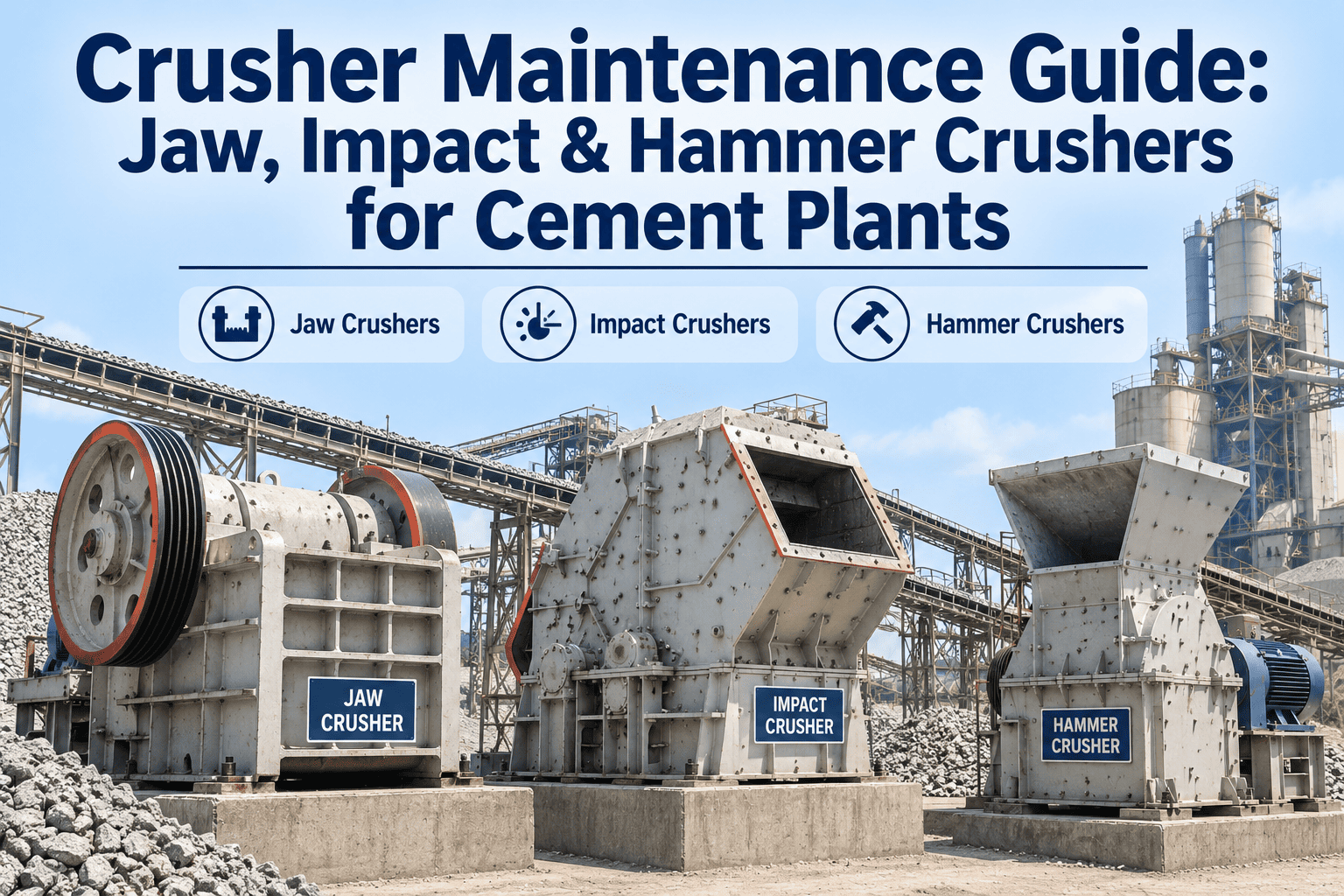
A crusher is built around one deliberate weak point. The toggle plate is designed to shear before anything else on the machine takes the damage, and that single detail says a lot about how crusher maintenance actually works: some wear is expected and managed, and some of it is a warning that something bigger is about to fail. Sign up to see how Oxmaint tracks every wear part across your jaw, impact and hammer crushers in one place.
30-60%
Longer service life typical of upgraded high-chrome or manganese wear parts over standard castings
18-22%
Typical manganese content in jaw liner castings selected for abrasion resistance
Jaw Plates
The single most frequently replaced wear part on any jaw crusher
1 Fuse Part
The toggle plate is engineered to break first, protecting the crusher frame from tramp metal
Why the Toggle Plate Is Designed to Fail First
When a piece of tramp iron or an unbreakable chunk of material enters the crushing chamber, the toggle plate is built to snap before the eccentric shaft, bearings, or frame take the load. It's a simple, low-cost part doing an important job. Treating a toggle plate break as routine rather than investigating what caused it, missed tramp metal detection, feed screening gaps, is where crushers lose far more time than the plate replacement itself.
Where Each Crusher Type Actually Wears
| Component |
Common Wear Cause |
Preventive Task |
| Jaw plates (fixed & movable) |
Abrasive compression wear from rock feed against the crushing surface |
Thickness inspection with a planned rotation schedule |
| Toggle plate |
Intentional shear failure from tramp iron or an oversized, uncrushable feed piece |
Spare stock verification and immediate replacement after a break |
| Blow bars & impact plates |
High-velocity impact wear as material strikes the rotor and breaker plates |
Wear profile check and bar rotation at scheduled intervals |
| Hammer heads & grates |
Continuous impact and abrasion from raw material passing through the hammer mill |
Thickness gauge check against the condemn limit |
| Bearings & eccentric shaft |
Contamination or inadequate lubrication under continuous cyclic load |
Scheduled lubrication and vibration trend monitoring |
Every Wear Part, Every Crusher, One Replacement History
Oxmaint registers jaw plates, blow bars, hammer heads, and toggle plates as tracked components with their own wear history, so a rotation or replacement gets scheduled from actual thickness data instead of a guess. Sign up for a free trial to see it against your own crusher fleet, or book a demo and we'll walk through your primary and secondary crushing setup.
Set Wear Thresholds Before Product Size Drifts Off Spec
| Component |
Design Condition |
Trigger for Action |
| Jaw plate thickness |
Full original casting thickness |
Rotate or flip at roughly 50% wear to extend total service life |
| Blow bar profile |
Original impact edge geometry |
Replace once wear visibly changes product size distribution |
| Toggle plate condition |
Intact, no cracking or deformation |
Replace immediately after any shear event before restart |
Reactive Wear Part Swaps vs Scheduled Rotation and Tracking
Reactive Wear Part Swaps
Jaw plates and blow bars replaced only once product size visibly drifts
Toggle plate breaks treated as one-off events, not tracked for a pattern
Spare parts ordered after a failure instead of ahead of one
Scheduled Rotation & Tracking
Wear parts flipped or rotated at a set thickness point to extend life
Repeated toggle plate breaks flagged to check tramp metal detection and feed screening
Replacement parts staged ahead of the projected wear date
How Oxmaint Supports Crusher Reliability
Oxmaint registers jaw plates, toggle plates, blow bars, and hammer heads as individually tracked components across your jaw, impact, and hammer crushers, logging thickness readings and replacement events against each one. Repeated toggle plate failures or accelerating blade wear generate a work order and a flag for root-cause review, so the fix addresses the cause, not just the part. Book a demo to see it mapped against your own crushing circuit.
Frequently Asked Questions
Q
Why is jaw crusher maintenance mostly about wear parts, not the machine itself?
Jaw crushers are mechanically simple by design, which is part of why they're popular for cement crushing. Nearly all the maintenance attention goes to the parts that directly contact material, jaw plates, liners, and the toggle plate, rather than complex machinery.
Q
Why should a toggle plate break trigger an investigation, not just a swap?
The toggle plate is meant to fail occasionally, that's its job. But repeated breaks in a short period usually point to a tramp metal detection gap or feed screening issue upstream, which is worth fixing rather than treating each break as isolated.
Q
Are upgraded manganese or high-chrome wear parts worth the extra cost?
In abrasive applications, upgraded wear parts commonly last 30 to 60% longer than standard castings, which usually outweighs the higher unit price once fewer changeouts and less downtime are factored in.
Q
What's the fastest way to move crusher maintenance off memory and paper tags?
Register each wear part, jaw plates, blow bars, hammer heads, toggle plate, as a tracked component with an installation date, then log thickness readings and replacement events against it going forward.
Know Which Wear Part Needs Attention Before the Product Size Tells You
Oxmaint gives cement plant teams wear part thickness tracking, toggle plate failure history, lubrication scheduling, and predictive maintenance alerts across jaw, impact, and hammer crushers in one platform. Sign up for a free trial to explore it yourself, or book a demo and we'll walk through it against your own crushing circuit.