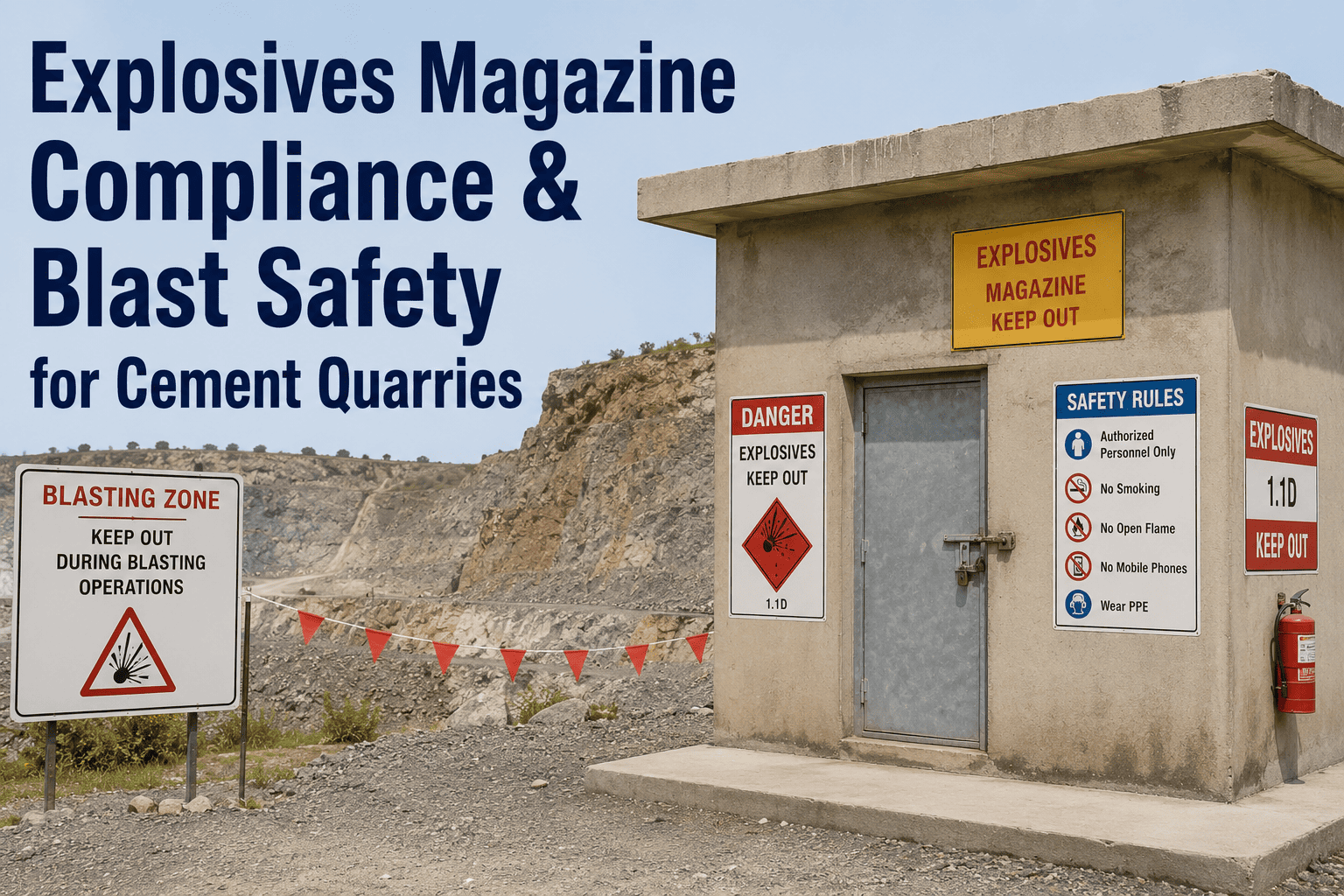
Explosives magazines sit under some of the tightest regulatory scrutiny in the entire quarry operation — a single storage violation, missing blast log, or unsecured perimeter can trigger federal citations and shut down blasting operations for weeks. ATF and MSHA both govern how quarries store, track, and detonate explosives, with overlapping requirements around magazine construction, distance tables, and daily accountability records. A CMMS like OxMaint turns magazine inspections, blast logs, and security checks into automated, audit-ready workflows — sign up free and have your first compliance checklist running the same day.
Explosives Magazine Requirements: What Needs Tracking
Magazine Construction and Security
Bullet-resistant walls, approved locking devices, and perimeter fencing must meet ATF Type 1-5 classification standards for the explosives stored inside.
Quantity-Distance Compliance
Storage magazines must maintain minimum separation distances from inhabited buildings, roads, and other magazines based on net explosive weight tables.
Daily Inventory Reconciliation
Every stick of explosive and detonator in and out of the magazine must be logged, with running totals reconciled against physical counts daily.
Blast Log and Records
Date, time, location, charge weight, seismograph readings, and blaster-in-charge sign-off must be recorded for every shot fired on site.
Electrical and Static Grounding
Magazines storing electric detonators require grounding systems and static discharge points, tested to prevent accidental initiation.
Security and Theft Prevention
Locks, alarm systems, and access logs must be checked for tampering, with lost or stolen explosives reportable to ATF within 24 hours.
Magazine Compliance Checklist by Frequency
OxMaint auto-generates these checklists per magazine — assigned to the right technician, with photo evidence and digital sign-off.
Common Magazine Violations and CMMS Prevention
| Violation | Risk | Root Cause | OxMaint Prevention |
|---|---|---|---|
| Inventory discrepancy | ATF citation, theft suspicion | Missed daily reconciliation | Daily inventory checklist with automatic variance alerts |
| Expired blaster license | Illegal blasting, shutdown | Missed renewal tracking | Monthly license verification with expiry notifications |
| Inadequate quantity-distance | Federal fine, magazine closure | Site changes not resurveyed | Annual distance survey scheduling with alerts |
| Security breach | Theft, diversion risk | Failed lock or alarm system | Weekly security test with instant defect flagging |
| Missing blast records | Audit failure, liability exposure | Incomplete or lost paper logs | Digital blast log with mandatory field completion |
| Grounding failure | Accidental initiation risk | Corroded or untested grounding | Monthly electrical PM with resistance test logging |
Regulatory Bodies Governing Explosives Storage
OxMaint vs. Competitors
| Capability | OxMaint | MaintainX | UpKeep | Fiix | Limble | IBM Maximo |
|---|---|---|---|---|---|---|
| Magazine inspection templates | Yes | No | No | No | No | Custom |
| Digital blast log tracking | Yes | No | No | No | No | Custom |
| Inventory reconciliation alerts | Yes | Limited | Limited | No | No | Yes |
| License/certification expiry tracking | Yes | Limited | Limited | Limited | Limited | Yes |
| Multi-site fleet view | Yes | Limited | Limited | Yes | Limited | Yes |
| Setup | Minutes | Hours | Hours | Days | Hours | Months |
Implementation Roadmap
Results
Data Security
Frequently Asked Questions
What is quantity-distance in explosives storage?
Quantity-distance is the minimum separation required between a magazine and inhabited buildings, roads, or other magazines, calculated from the net explosive weight stored inside.
How often must magazine inventory be reconciled?
Inventory should be reconciled daily against the physical count, with any discrepancy investigated immediately and reported to ATF if theft or loss is suspected.
What must be recorded in a blast log?
Date, time, location, charge weight, seismograph readings, and the certified blaster-in-charge sign-off for every shot fired on site.
How quickly must lost or stolen explosives be reported?
Federal regulations require theft or loss of explosive materials to be reported to ATF within 24 hours of discovery.
Can OxMaint manage multiple explosives magazines across sites?
Yes. OxMaint provides a single dashboard across every magazine with site-specific checklists, blast log tracking, and portfolio-wide compliance reporting.