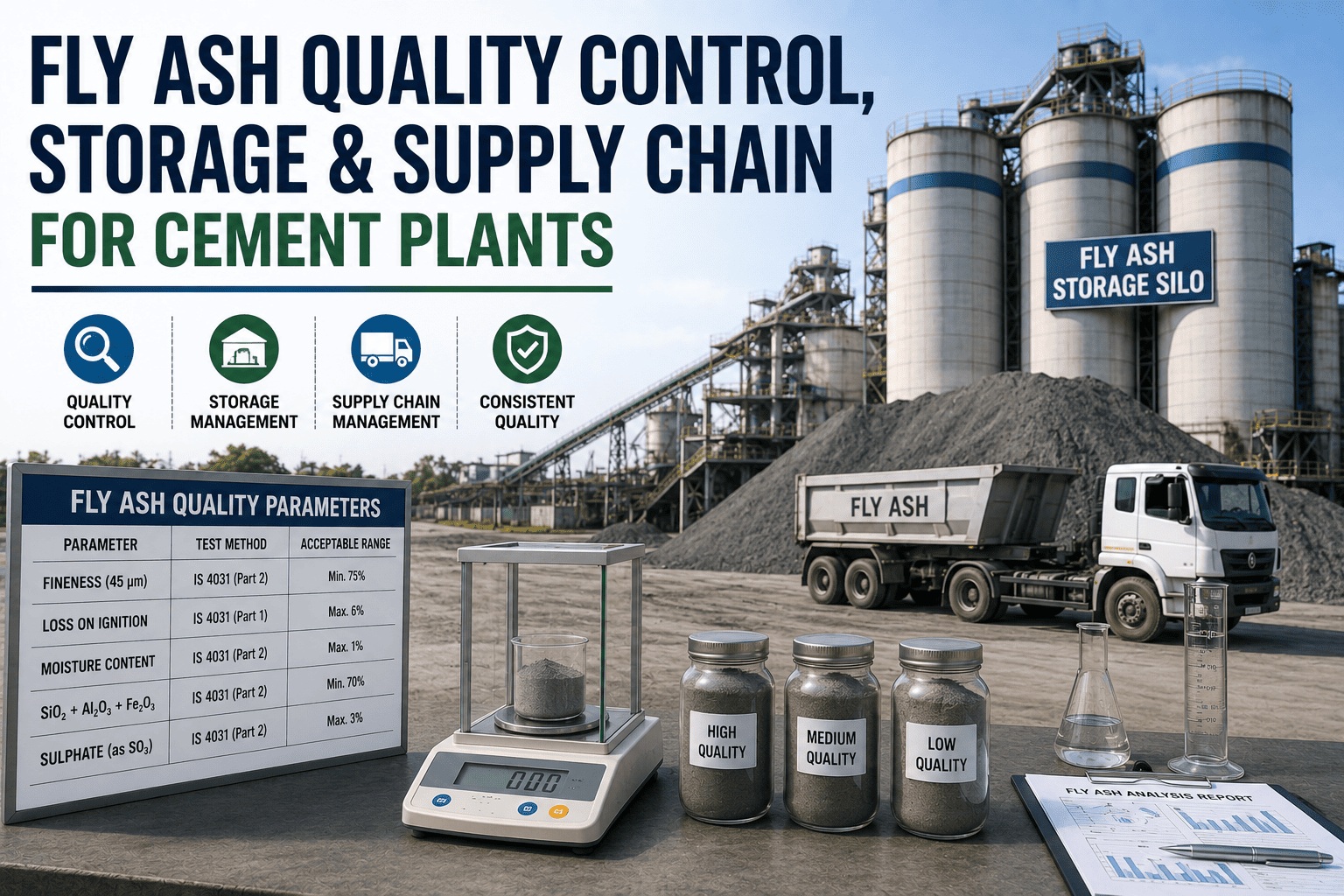
Fly ash doesn't fail a specification the way a machine part fails, it drifts. A silo full of ash that met every number on delivery can sit through a wet season and come out with higher unburned carbon and coarser particles than it went in with, quietly changing how it behaves in every batch of concrete it touches. Sign up to see how Oxmaint keeps fly ash quality data linked to every silo, delivery, and blend record.
6%
Maximum loss on ignition allowed under ASTM C618 for fly ash used as a cement admixture
66%
Minimum fly ash fineness typically required to pass a 45-micron sieve
12.7-21.1%
Moisture content measured in one documented batch of wet-stored stockpile fly ash
10 Batches
Rolling test history commonly used as the baseline for flagging fineness and density variability
Why Wet Storage Quietly Degrades Fly Ash Quality
Fly ash that picks up moisture during storage doesn't just get damp, it changes chemically. Documented research shows wet storage drives surface reactions that raise loss on ignition and cause particles to agglomerate, coarsening the material's effective fineness over time. None of this shows up on a visual check, it only shows up when the ash is tested again, which is exactly why silo dwell time and moisture exposure need their own tracking rather than a one-time certificate on arrival.
Where Fly Ash Quality Actually Slips
| Parameter |
Risk if Unmanaged |
Control Task |
| Loss on ignition |
High unburned carbon disrupts air entrainment and reduces durability |
Sample and test LOI per ASTM C311 on each incoming batch |
| Fineness |
Coarse ash slows pozzolanic reaction and reduces concrete workability |
Sieve or Blaine fineness test against a rolling batch baseline |
| Moisture & wet storage |
Agglomeration and rising LOI develop the longer ash sits in wet conditions |
Track silo dwell time and moisture exposure, rotate stock on a schedule |
| Specific gravity |
An unflagged shift often signals an unnoticed change in ash source or fuel mix |
Regular specific gravity check correlated against LOI and fineness trends |
| Supply source consistency |
Blending mismatched batches destabilizes concrete performance downstream |
Certificate-of-analysis tracking per delivery and blend record by source |
Every Batch, Every Silo, One Quality Trail
Oxmaint links each fly ash delivery's certificate of analysis to the silo it's stored in, tracks dwell time against a moisture-exposure threshold, and flags an LOI or fineness result the moment it drifts outside your internal limit. Sign up for a free trial to see it against your own supply chain, or book a demo and we'll walk through your fly ash handling setup.
Set Acceptance Thresholds Before the Batch Reaches the Mixer
| Parameter |
Common Spec Limit |
Trigger for Action |
| Loss on ignition |
ASTM maximum of 6%, though many agencies set 3-4% |
Reject or reblend any batch above the plant's internal limit |
| Fineness |
Minimum 66% passing a 45-micron sieve |
Investigate and hold release for any batch below spec |
| Moisture on receipt |
Low single-digit percentage for dry-handled ash |
Flag for extended silo monitoring above the set threshold |
Certificate-Only Acceptance vs Batch-Tested Acceptance
Certificate-Only Acceptance
Supplier's certificate of analysis accepted at face value on delivery
No visibility into how storage conditions changed the ash afterward
Quality issues surface downstream, in concrete performance, not at the silo
Batch-Tested Acceptance
Certificate cross-checked against an independent sample at intake
Silo dwell time and moisture exposure tracked against each stored batch
A drifting LOI or fineness trend flagged before the ash reaches the mixer
How Oxmaint Supports Fly Ash Quality Control
Oxmaint links each fly ash delivery's certificate of analysis to a specific silo record, tracking dwell time, moisture exposure, and rolling LOI and fineness history in one place. A batch that drifts outside the set internal threshold generates a hold flag automatically instead of being caught after it's already blended. Book a demo to see it mapped against your own fly ash supply chain and storage setup.
Frequently Asked Questions
Q
Why is loss on ignition the most closely watched fly ash parameter?
LOI reflects unburned carbon, which absorbs air-entraining admixtures and disrupts the air content control that concrete durability depends on. It's one of the few single numbers that connects directly to a real downstream performance risk.
Q
Why does a certificate of analysis alone not guarantee quality at use?
A certificate reflects the ash's condition at the point it was tested, usually before storage. Wet storage conditions can change LOI and particle size afterward, which is why dwell time and moisture exposure need their own tracking rather than trusting the original paperwork indefinitely.
Q
Why track specific gravity if it doesn't directly affect concrete performance?
Specific gravity is a fast, simple check that flags a change in the underlying material, often before LOI or fineness testing catches it. An unexplained shift is usually the first sign that the fuel source or combustion process upstream has changed.
Q
What's the fastest way to move fly ash QC off paper certificates?
Start by linking each delivery's certificate of analysis to a specific silo record with a dwell time counter, then layer in rolling LOI and fineness trending once intake testing data is flowing consistently.
Catch a Drifting Batch Before It Reaches the Mixer
Oxmaint gives cement plant teams fly ash certificate tracking, silo dwell time monitoring, LOI and fineness trending, and supply chain source records in one platform. Sign up for a free trial to explore it yourself, or book a demo and we'll walk through it against your own fly ash storage and blending setup.