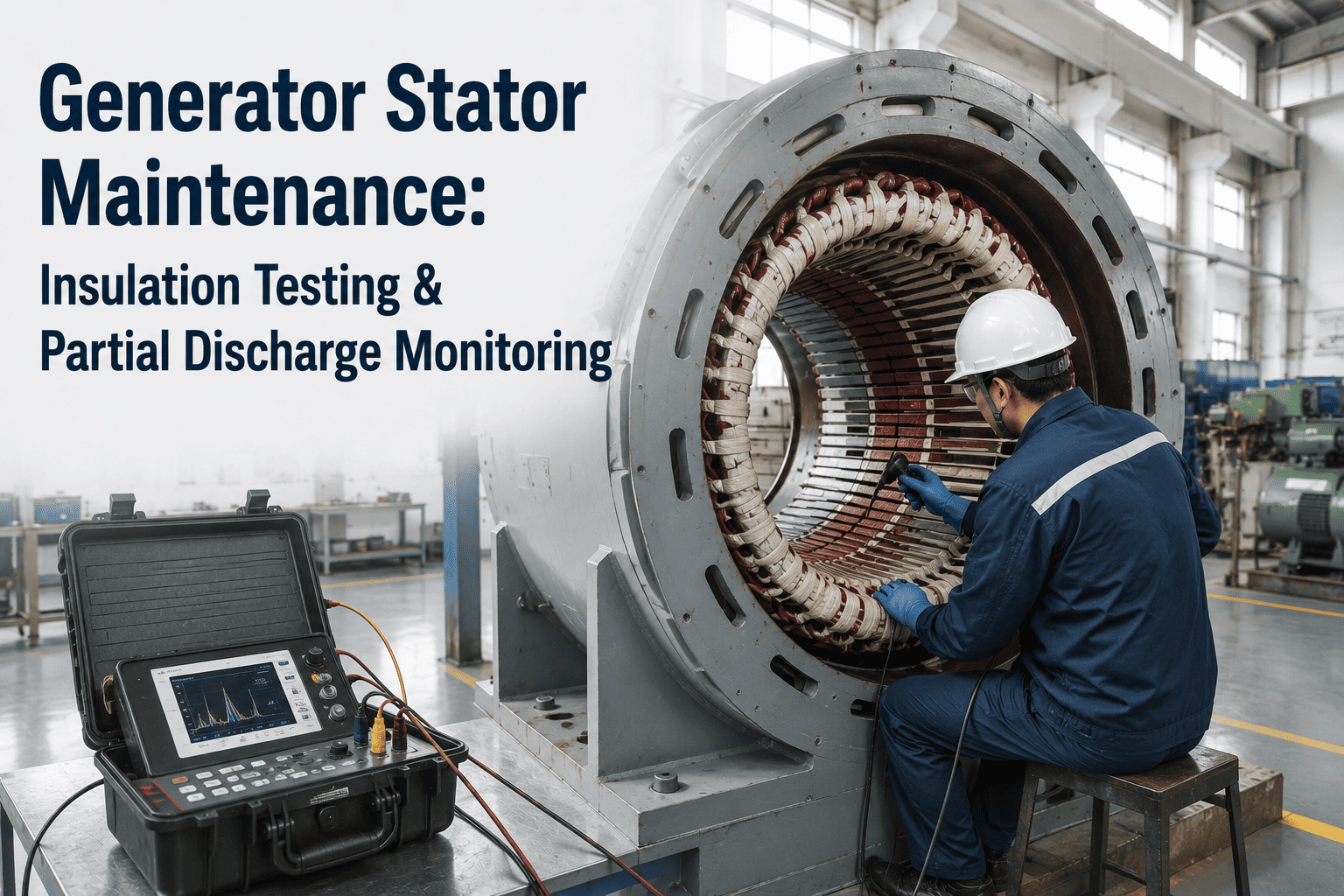
A generator stator that's about to fail rarely gives a sudden warning, insulation deterioration is a slow-acting process that shows up as small electrical sparks bridging weak points in the winding insulation long before anything actually grounds out. Machines with genuinely deteriorated windings show partial discharge activity at least 30 times higher than healthy ones, which is exactly the gap that routine testing is built to catch. Start a free trial to see how Oxmaint keeps every insulation and PD reading tied to the generator's history.
30x Higher
Partial discharge activity typically seen in deteriorated windings compared to healthy ones
PI ≥ 2.0
Polarization Index generally considered acceptable for healthy stator winding insulation
kV+1 MΩ
Minimum one-minute insulation resistance per rated voltage, the standard IEEE 43 benchmark
15,000+
Machines worldwide now equipped with online partial discharge monitoring technology
Why Partial Discharge Is a Symptom, Not the Root Cause
In mica-based insulation systems, partial discharge itself is a symptom of an underlying failure mechanism, not the mechanism itself. Loose windings vibrating in the slot, overheating, delamination, and contamination all show up as PD activity, which is why a rising trend should always trigger further investigation into the specific cause rather than being treated as the problem on its own.
The Core Stator Test Methods, Side by Side
| Test |
What It Reveals |
Typical Timing |
| Insulation resistance & PI |
Overall insulation health and moisture contamination |
Every planned outage, offline |
| Capacitance & tan delta |
Insulation aging, voids, and delamination within the winding |
Every major outage, offline |
| Partial discharge |
Loose, overheated, contaminated, or vibrating windings |
Continuous online, or periodic offline survey |
Every Stator Test, Trended Against the Same Machine's History
Oxmaint logs insulation resistance, PI, and PD readings against each generator's own baseline, so a slow deterioration trend is visible long before it crosses an alarm threshold. Sign up for a free trial to see it against your own generator fleet, or book a demo and we'll walk through your outage test program.
Offline Testing vs Online PD Monitoring
| Factor |
Offline Testing |
Online PD Monitoring |
| When it runs |
During a planned outage, machine de-energized |
Continuously, while the generator is in service |
| Captures |
Point-in-time condition, useful as a periodic health check |
Trend over time and how load and temperature affect the reading |
| Best suited for |
Routine compliance checks and outage-based inspection |
Critical or aging machines where slow deterioration needs early warning |
Routine Outage Tests vs Continuous Monitoring
At Every Planned Outage
Insulation resistance and polarization index measurement
Capacitance and tan delta test for aging insulation
Wedge tightness check to catch loose coils before vibration damage
Continuous Monitoring
Online partial discharge trend logged against the machine's own baseline
Load and temperature correlation to separate real degradation from noise
Escalation to specialized inspection once readings exceed the 90th percentile
How Oxmaint Supports Generator Reliability Teams
Oxmaint records insulation resistance, PI, and PD readings against the specific generator asset at every outage, with automatic flagging when a value drifts outside its own historical range rather than a single generic threshold. Continuous PD data can be linked to the same asset record, so a specialized inspection or repair gets scheduled around the actual rate of deterioration. Book a demo to see it mapped against your own generator fleet.
Frequently Asked Questions
Q
What actually causes partial discharge in a stator winding?
Partial discharge occurs when the electrical field locally exceeds the breakdown strength of the insulation, often due to loose windings vibrating in the slot, overheating, delamination, or contamination. It's best treated as a symptom pointing toward one of these underlying mechanisms rather than a standalone fault to fix directly.
Q
What is the Polarization Index actually measuring?
The Polarization Index compares insulation resistance measured at ten minutes against the reading at one minute, and a healthy winding shows resistance that keeps rising as absorption current decays. A PI of 2.0 or higher is generally considered acceptable, while a low or falling PI points toward moisture or contamination in the insulation.
Q
Is online PD monitoring necessary if outage testing is already done?
Outage testing gives a valuable point-in-time snapshot, but online monitoring captures how discharge activity behaves under real load and temperature conditions between outages. For critical or aging machines, that continuous trend is what catches a slow deterioration mechanism well before the next scheduled test would.
Q
When should a rising PD trend actually trigger action?
Concern is generally warranted once PD levels sit above the 90th percentile compared to similar machines, which should trigger increased test frequency and, where possible, a specialized inspection. The action taken should be based on the severity of the underlying failure mechanism the PD points to, not the raw PD number alone.
Catch Insulation Deterioration on the Trend Line, Not at Failure
Oxmaint gives power plant reliability teams outage test logging, PD trend tracking, and generator-specific baselines in one platform. Sign up for a free trial to explore it yourself, or book a demo and we'll walk through it against your own generator fleet.
Insulation Resistance Logging
PD Trend Tracking
Generator-Specific Baselines
Outage Test Scheduling
Automated Escalation Alerts