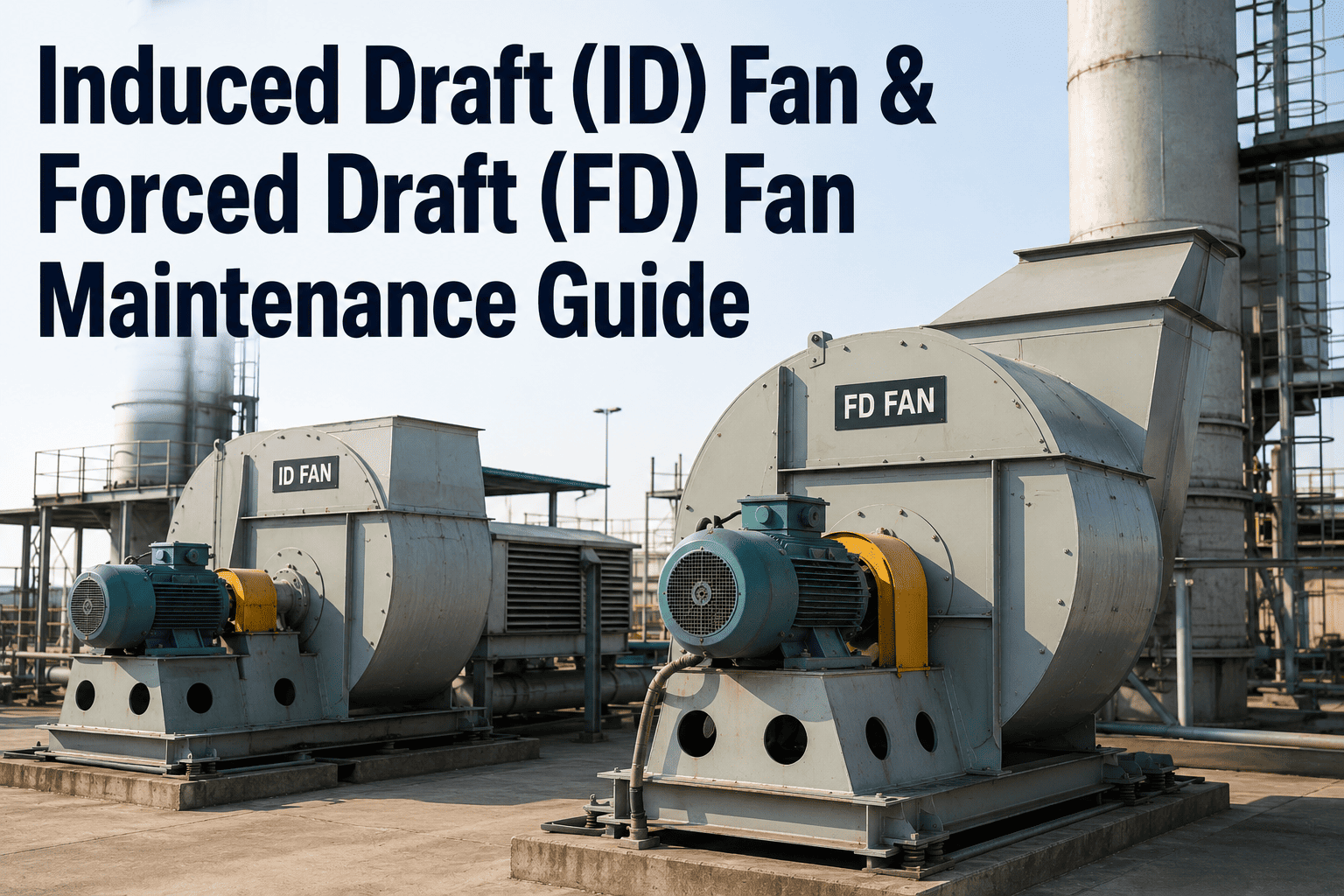
An ID fan blade eroded by fly ash doesn't announce itself with a warning light, it drifts the rotor balance a little more every shift until vibration crosses a threshold and the fan trips on a full load day. Because induced draft fans pull hot, particulate-laden flue gas while forced draft fans push cleaner combustion air, the two sides of the same draft system wear out in completely different ways, and a single maintenance checklist for both is how erosion damage gets missed. Start a free trial to see how Oxmaint tracks vibration, balance and bearing history separately for every ID and FD fan on site.
#1
Cause of ID fan blade damage and the fastest path to an unplanned trip: fly ash erosion
430 mph
Blade tip speed recorded when an eroded ID fan liner fragment broke loose in a documented failure case
4
Bearing locations typically monitored per fan under ANSI/AMCA Standard 204 vibration guidance
99%+
Availability expected of FD fan systems, since they feed combustion air the boiler cannot operate without
Why Draft Fan Failures Escalate So Fast
Erosion and imbalance build up slowly enough that draft pressure and airflow readings often stay normal for weeks before a trip. Once a blade section does let go, the resulting unbalance load hits the bearings and shaft almost instantly, and because ID and FD fans sit on opposite ends of the same combustion air and flue gas path, a failure on either one can force the whole boiler off load, not just the fan.
ID Fan vs FD Fan: Same Job, Different Wear Pattern
| Factor |
Induced Draft (ID) Fan |
Forced Draft (FD) Fan |
| Medium handled |
Hot flue gas carrying fly ash and unburnt particulate |
Cleaner ambient combustion air |
| Dominant wear mode |
Blade and liner erosion from particulate impact |
Bearing wear and expansion joint fatigue from thermal cycling |
| Maintenance cost driver |
Higher, driven by low-density hot gas volume and erosion repair |
Lower, but availability demands are just as strict |
| Priority inspection |
Blade wear strips and liner coating thickness |
Bearing lubrication and expansion joint condition |
Separate Health Records for Every ID and FD Fan
Oxmaint logs vibration trends, balance checks and bearing history against each individual fan, so erosion drift on an ID fan never gets buried under a generic fan checklist. Sign up for a free trial to see it against your own draft system, or book a demo and we'll walk through your fan reliability program.
Reading Vibration Before It Reads a Trip Alarm
| Signal |
What It Usually Means |
Response |
| Gradual vibration rise across weeks |
Progressive blade erosion shifting rotor balance |
Schedule a balance check before the next Zone C alarm |
| Shaft displacement near bearing clearance |
Bearing wear or housing looseness under ANSI/AMCA 204 limits |
Inspect bearing housing fasteners and lubrication at next outage |
Running Checks vs Outage-Window Work
While Running
Vibration readings logged at all bearing locations every round
Bearing temperature and lubrication level spot-checked
Draft pressure and airflow watched for slow drift, not just alarms
At Outage
Blade wear strip and liner coating thickness measured against baseline
Dynamic rotor balancing performed on eroded or repaired blades
Expansion joints, dampers and coupling alignment fully inspected
How Oxmaint Supports Fan Reliability Programs
Oxmaint schedules PM tasks separately for ID and FD fans based on their actual wear pattern, logs vibration and balance data against each asset, and flags gradual drift before it reaches trip territory. Erosion history, bearing changeouts and alignment records stay attached to the fan, not scattered across separate logbooks. Book a demo to see it mapped against your own draft fan fleet.
Frequently Asked Questions
Q
Why does an ID fan wear out faster than an FD fan?
An ID fan handles hot, low-density flue gas loaded with fly ash and unburnt particulate, which erodes blades and liners continuously. An FD fan moves cleaner ambient air, so its wear comes more from thermal cycling and bearing fatigue than particulate erosion.
Q
Why does vibration climb gradually instead of jumping suddenly?
Erosion removes blade material a little at a time, shifting the rotor's balance in small steps. Draft pressure and airflow often stay within normal range for weeks while this happens, which is why vibration trending catches the problem long before an operator would notice a performance change.
Q
What happens if a worn blade liner section breaks off in service?
The sudden loss of that mass creates a severe unbalance load almost instantly, hitting bearings and the shaft with forces far beyond normal operating conditions. Documented cases show fragments breaking free at blade tip speeds in the hundreds of miles per hour, which is why liner coating checks are a priority inspection item.
Q
Is one maintenance checklist enough for both ID and FD fans?
No. Because the two fans wear differently, a shared generic checklist tends to under-inspect the ID fan's erosion-prone parts and over-inspect areas that matter more on the FD fan. Asset-specific PM tasks built around each fan's actual duty give a more accurate picture.
Catch Fan Erosion Before It Reaches the Trip Alarm
Oxmaint gives power plant teams fan-specific PM scheduling, vibration and balance trend tracking, and complete erosion and bearing history in one platform. Sign up for a free trial to explore it yourself, or book a demo and we'll walk through it against your own draft fan fleet.