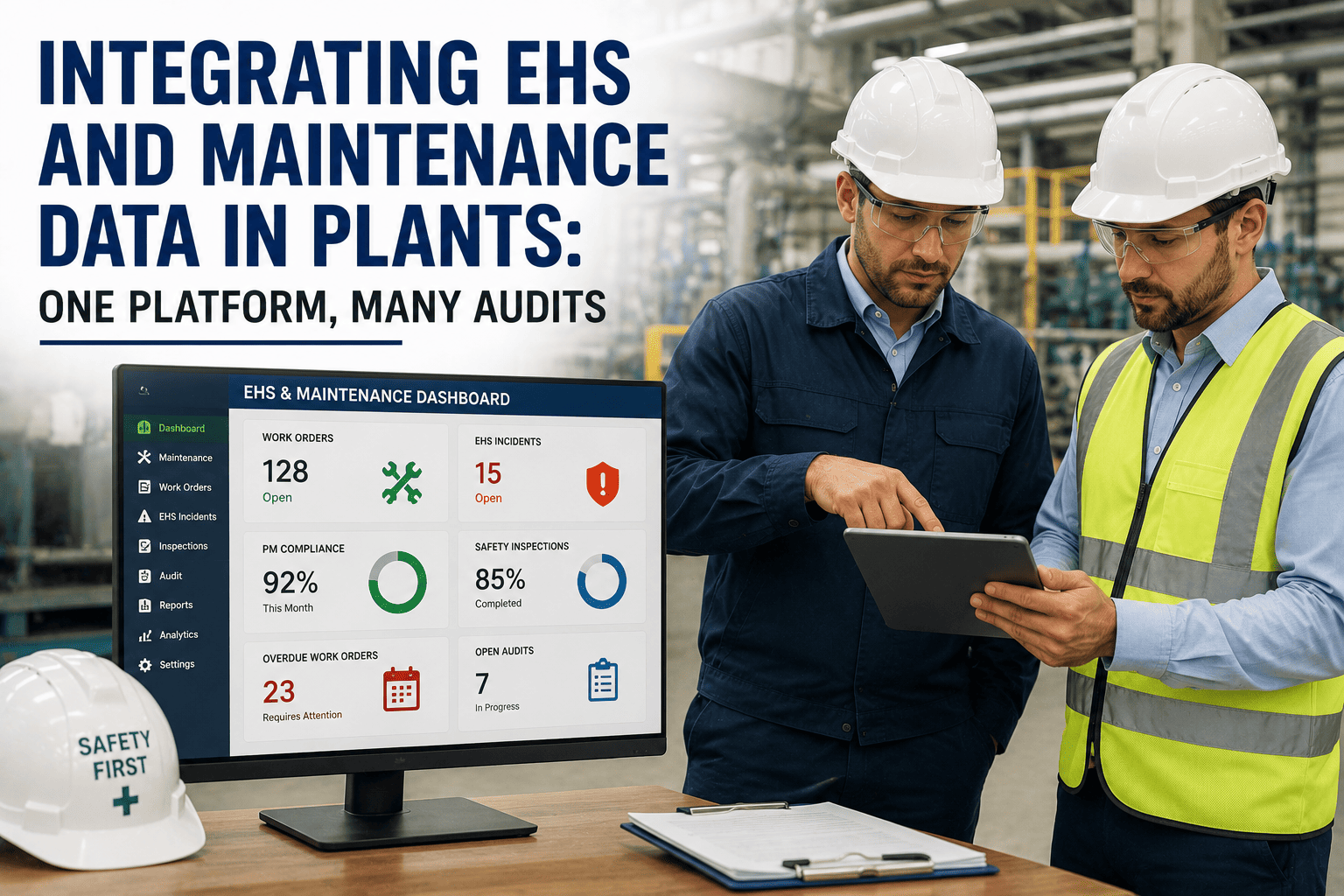
The same fire extinguisher inspection gets entered once for the HSE file, once for the ISO 45001 evidence pack, and once more for the BRCGS audit binder — three separate records of the same single check, maintained by whoever happened to own that spreadsheet that quarter. Multiply that across permit-to-work logs, calibration certificates, and statutory equipment tests, and most plants are running three or four parallel paper trails for data that only ever happened once. Every gap between those versions is a nonconformance waiting to be found. A CMMS like OxMaint captures the inspection once and maps it to whichever standards need it, so the evidence pack for each audit builds itself from the same live record.
Capture Once, Satisfy Every Audit From the Same Record
Unified asset and EHS records, standards-mapped documentation, and exportable audit trails — so HSE, ISO 45001, ISO 14001, and BRCGS all pull from one source.
One Data Point, Four Audit Trails
A single well-structured record can satisfy multiple standards at once, because the underlying evidence overlaps far more than most plants' filing systems suggest.
| Record Captured Once | ISO 45001 | ISO 14001 | BRCGS / HSE |
|---|---|---|---|
| Equipment inspection log | Satisfies | Partial | Satisfies |
| Calibration certificate | Partial | Satisfies | Satisfies |
| Permit-to-work record | Satisfies | Partial | Satisfies |
| Incident / near-miss report | Satisfies | Satisfies | Satisfies |
Where EHS and Maintenance Data Actually Overlap
Permit-to-Work
Confined space entry, hot work, and isolation permits are both a maintenance job requirement and a safety compliance record at the same time.
Equipment Inspections
Lifting equipment, pressure systems, and LEV checks are maintenance activities on paper but statutory safety obligations underneath.
Incident Reports
A near-miss tied to a specific asset connects directly to that asset's maintenance history, which auditors will always ask to see together.
Calibration & Statutory Tests
PUWER, LOLER, and PSSR test records sit at the exact intersection of asset maintenance and legal compliance obligation.
Audit Readiness Levels
Reactive
Evidence gets pulled together in the days before an audit from whichever spreadsheets and folders can be found in time.
Maintained But Siloed
Records are kept current, but EHS and maintenance data live in separate systems, so cross-checking still takes manual effort.
Integrated & Audit-Ready
One record, mapped to every relevant standard, means an auditor's request can be answered on the spot rather than scheduled for follow-up.
Building the Integrated Record
Map Data to Standards
Identify which existing maintenance records already satisfy requirements under ISO 45001, ISO 14001, and BRCGS or HSE inspection criteria.
Consolidate Into One System
Bring inspection logs, permits, and calibration records into a single platform rather than maintaining parallel EHS and maintenance databases.
Assign Ownership
Give each record type a clear owner so updates happen as part of normal work, not as a separate compliance task layered on top.
Continuous Audit Trail
Every update is timestamped and attributable, turning the record into a live audit trail rather than a snapshot assembled on request.
The Numbers Behind Integration
An audit doesn't test whether the work happened — it tests whether you can prove it happened, quickly and consistently, across every standard being assessed. Sign up free to see inspection, permit, and calibration records mapped to ISO 45001, ISO 14001, and BRCGS from one system instead of three.
How OxMaint Connects EHS and Maintenance Records
Unified Asset & EHS Record
Maintenance history, inspections, and safety records live against the same asset, rather than in a separate EHS database.
Standards-Mapped Documentation
Records are tagged to the standards they satisfy, so a single entry can be pulled into evidence for multiple audits at once.
Audit Trail Export
A full, timestamped history is exportable on demand, giving an auditor complete traceability without a manual assembly job.
Statutory Inspection Reminders
PUWER, LOLER, and PSSR test intervals are tracked automatically, so a lapsed statutory inspection never becomes an audit finding.
Stop Assembling Evidence Packs From Scratch Every Audit
Unified records, standards mapping, and instant audit trail export — built so your next HSE, ISO, or BRCGS audit starts from a system that's already ready.
Frequently Asked Questions
Can one maintenance record really satisfy multiple audit standards?
Often, yes. A well-documented equipment inspection typically covers requirements under more than one standard at once, since ISO 45001, ISO 14001, and BRCGS all draw on overlapping evidence around equipment condition, testing, and safety controls.
What's the biggest risk of keeping EHS and maintenance data separate?
The biggest risk is inconsistency — the same event described differently, or updated at different times, across two systems. Auditors specifically look for these gaps, and they're the most common source of nonconformances in integrated management system audits.
Does integrating EHS and maintenance data mean merging departments?
No. The teams and responsibilities can stay exactly as they are; what changes is where the underlying data lives, so both departments are working from the same live record instead of parallel copies.
How long does it typically take to consolidate EHS and maintenance records?
This depends heavily on how many existing systems are involved, but most plants can consolidate core record types — inspections, permits, and calibration data — within a few months once ownership and mapping are agreed.
Do statutory inspection records need to be stored differently from routine PM records?
Not necessarily, provided the system can flag statutory records distinctly and enforce their specific legal intervals. Storing them separately from routine maintenance data usually creates more duplication risk than it solves.