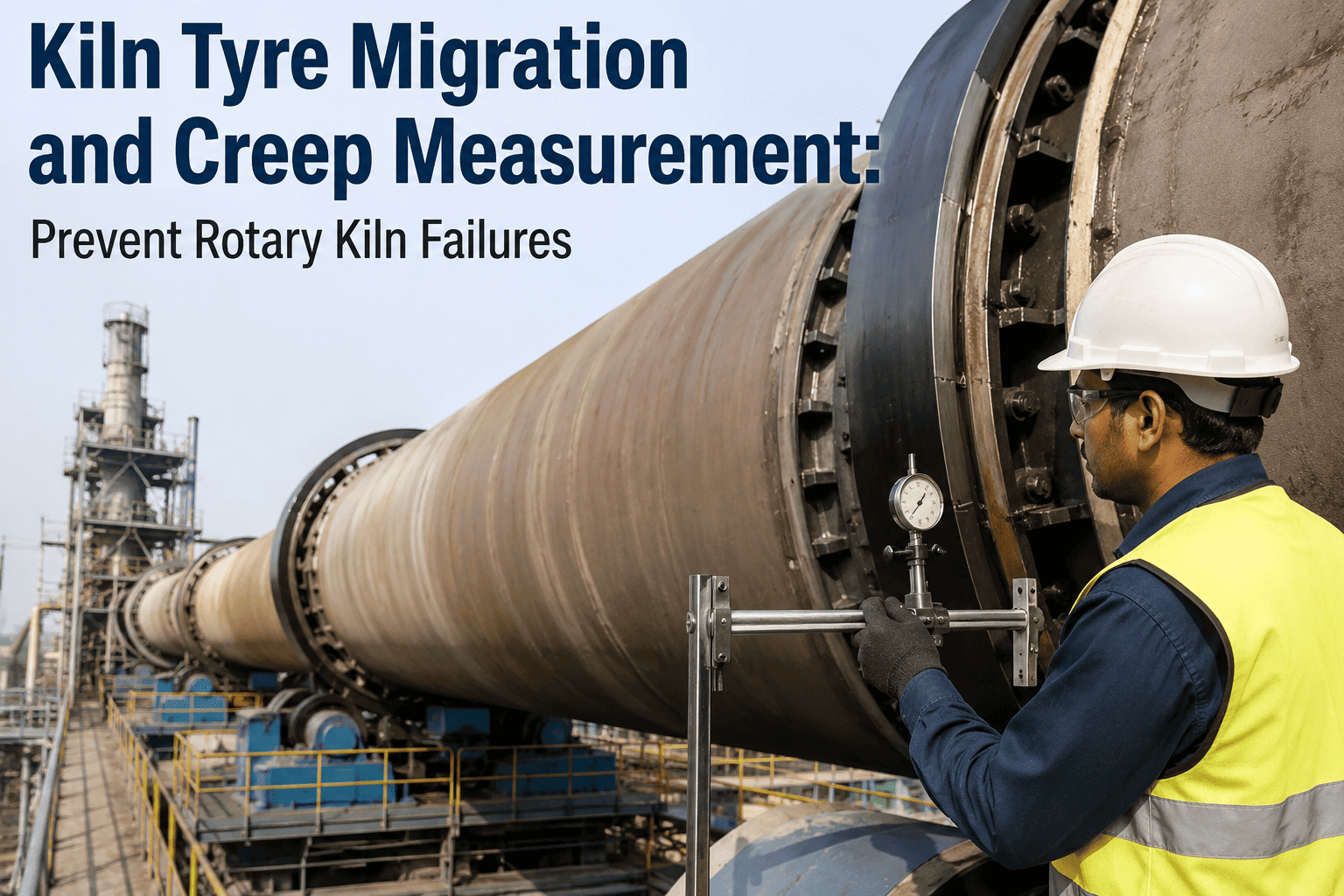
A kiln tyre that migrates 4-12mm per revolution is doing exactly what it should, quietly absorbing thermal expansion between the shell and the riding ring. But once that creep drifts past a 50mm daily threshold, the shell starts to flex, the refractory takes the hit, and a tyre station that looked fine last month can end up coke-bottled beyond repair. Start a free trial to see how Oxmaint trends every kiln tyre measurement before drift becomes downtime.
4-12mm
Normal tyre creep per revolution that lets the shell expand freely under heat
50mm/24h
Migration threshold beyond which shell ovality and refractory stress accelerate
85%
Of alignment-driven kiln failures trace back to just five recurring root causes
60%+
Fewer emergency alignment events reported by plants running CMMS-based trending
Why Tyre Creep Needs Watching, Not Just Measuring
A tyre's inside diameter is deliberately larger than the shell's outside diameter, giving the shell room to expand as it heats up. Too little creep leaves no room for that expansion, and the shell permanently deforms into a coke-bottle shape, damaging refractory brick in the process. Too much creep does the opposite, letting the shell sag and wear accelerate faster than any single inspection would catch.
Too Little Creep vs Too Much Creep
| Condition |
What Happens |
Corrective Action |
| Insufficient creep |
Shell has no clearance to expand, becomes coke-bottled and permanently deformed |
Check filler bar and support pad wear, verify shell OD to tyre ID clearance |
| Excess creep |
Shell sag increases, wear rate on tyre and rollers rises, ovality develops |
Confirm shell temperature stability, inspect roller skewing and lubrication interval |
| Worn filler bars |
Excess gap at the shell's top position lets the plate flex with every rotation |
Replace filler bars on a fixed interval, log clearance at every measurement round |
Every Tyre Measurement, Trended Across Campaigns
Oxmaint logs migration readings, shell temperature, and pad wear against baseline so a slow creep drift shows up on a trend line long before it hits the 50mm threshold. Sign up for a free trial to see kiln tyre trending against your own asset data, or book a demo and we'll walk through your alignment workflow.
Reading the Migration Trend: When to Escalate
| Migration Reading |
Status |
Action |
| 4-12mm per revolution |
Normal |
Log the reading, no intervention required |
| Rising trend across shifts |
Watch |
Verify shell temperature stability and support pad condition |
| Approaching 50mm/24h |
Intervene |
Schedule alignment check before the next campaign |
Two Routines That Actually Catch Drift Early
Weekly Measurement
Mark tyre face and support pad, measure the gap after one full revolution
Average the reading across three to five revolutions for accuracy
Log shell temperature alongside every migration reading
Every Shutdown
Inspect filler bar and support pad wear for excess clearance
Check retainer block position and roller skew angle
Reapply graphite or grease lubrication before restart
How Oxmaint Supports Kiln Reliability Teams
Oxmaint captures tyre migration, shell temperature, and pad wear readings from the field, trends them automatically across campaigns, and triggers a work order the moment a reading crosses your configured threshold. Alignment history stays linked to the asset instead of scattered across shutdown spreadsheets. Book a demo to see it mapped against your own kiln's measurement history.
Frequently Asked Questions
Q
Why does a kiln tyre migrate at all?
The tyre's inside diameter is deliberately made larger than the shell's outside diameter so the shell has room to expand as it heats up. This size difference causes the tyre to lag slightly behind the shell's rotation, which shows up as migration or creep.
Q
How much migration is normal versus dangerous?
Four to twelve millimetres of creep per revolution is typical and simply reflects healthy thermal expansion. Migration approaching 50mm over a 24-hour cycle signals the shell is flexing more than it should and needs an alignment check before the next campaign.
Q
What happens if a tyre doesn't get enough creep?
Without room to expand, the shell becomes permanently deformed into a coke-bottle shape. That deformation damages the refractory lining as well, turning a measurement issue into a costly structural repair.
Q
How is creep actually measured on a running kiln?
A mark is made across the tyre face and an adjacent support pad, then the gap between the two marks is measured after one full revolution. Taking the average over three to five revolutions gives a reliable reading of the true migration rate.
Catch Tyre Drift Before It Becomes a Shell Failure
Oxmaint gives cement plant reliability teams automated migration trending, shutdown-linked inspection checklists, and threshold alerts for every kiln tyre station. Sign up for a free trial to explore it yourself, or book a demo and we'll walk through it against your own kiln.