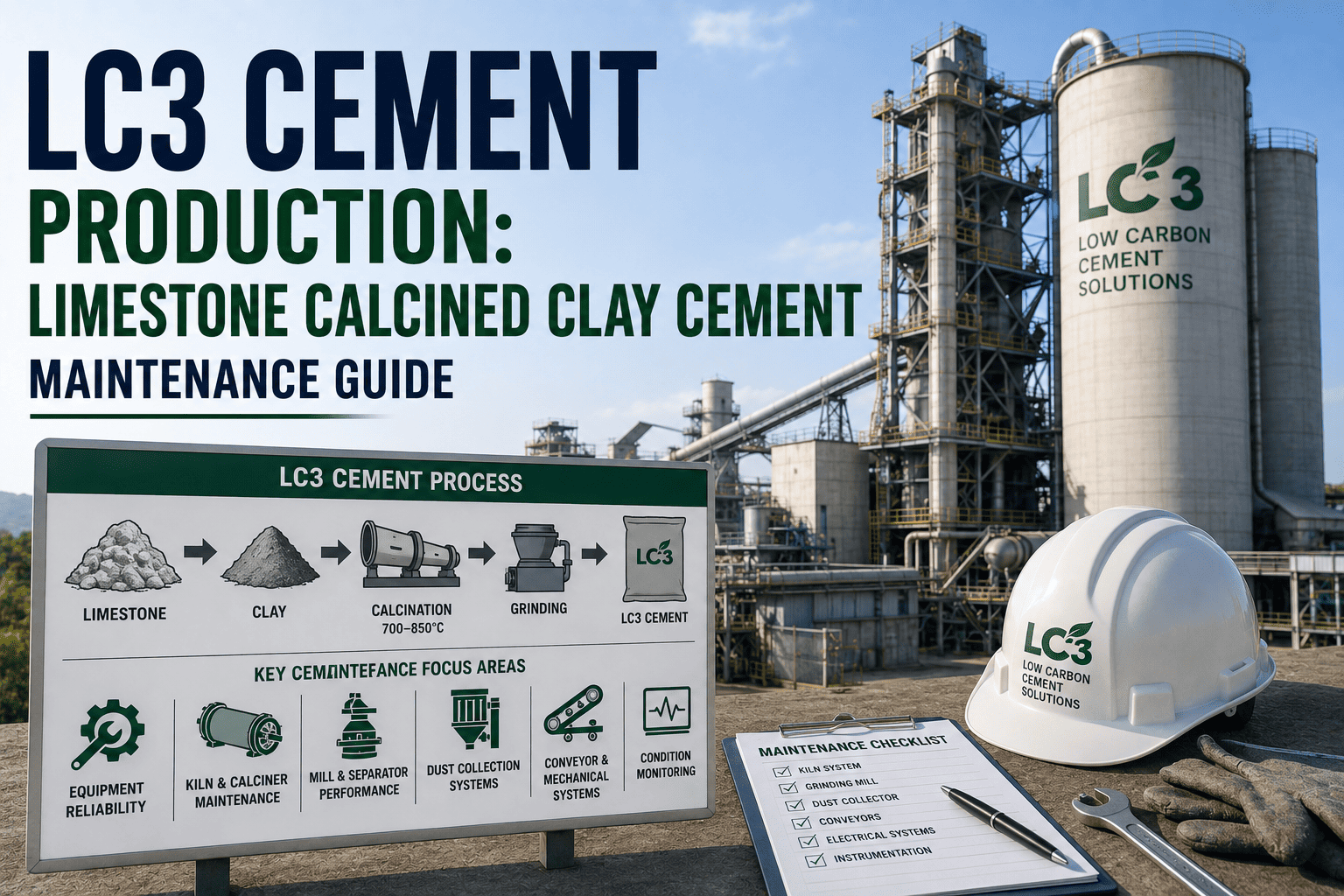
A clinker kiln runs at 1400-1600°C. An LC3 flash calciner runs at roughly half that. Lower heat sounds like an easier maintenance job, but it actually shifts the failure points somewhere new: feed consistency, refractory cycling, and grinding time become the variables that decide whether the cement performs. Sign up to see how Oxmaint tracks calciner performance and clay grinding data alongside the rest of your plant.
The precise calcination temperature a batch needs depends on kaolinite content, particle size, and moisture level in that specific clay source. High-kaolinite clay activates fully at a lower temperature than a mixed or impure clay, which means a maintenance team is really managing a moving target, not a fixed setpoint, every time the clay source shifts.
Three Calcination Technologies, Three Maintenance Profiles
Oxmaint tracks calciner temperature trends, refractory condition, and incoming clay kaolinite content on one asset record, so a strength or color inconsistency in the finished LC3 can be traced back to the exact calcination run. Sign up for a free trial to see it against your own calciner data, or book a demo and we'll map it to your production line.
Soak Calcination vs Flash Calcination
Runs in static furnaces or adapted rotary kilns at around 800°C
Longer residence time gives more tolerance for feed rate variation
Rapid cooling immediately follows the short high-temperature exposure
Uniform, efficient treatment well-suited to large-scale, centralized production
Oxmaint keeps calciner maintenance schedules, refractory inspection history, and clay grinding time logged against the same asset record used for temperature and quality data, so a compressive strength issue can be traced to its root cause instead of a guess. Preventive maintenance intervals adjust automatically as clay source or calcination method changes. Book a demo to see it built around your own LC3 line.
Frequently Asked Questions
Keep Your LC3 Line as Reliable as Your Clinker Line
Oxmaint gives cement plant teams calciner maintenance tracking, clay batch traceability, grinding circuit records, and quality-linked asset history in one platform. Sign up for a free trial to explore it yourself, or book a demo and we'll walk through it against your own LC3 production line.