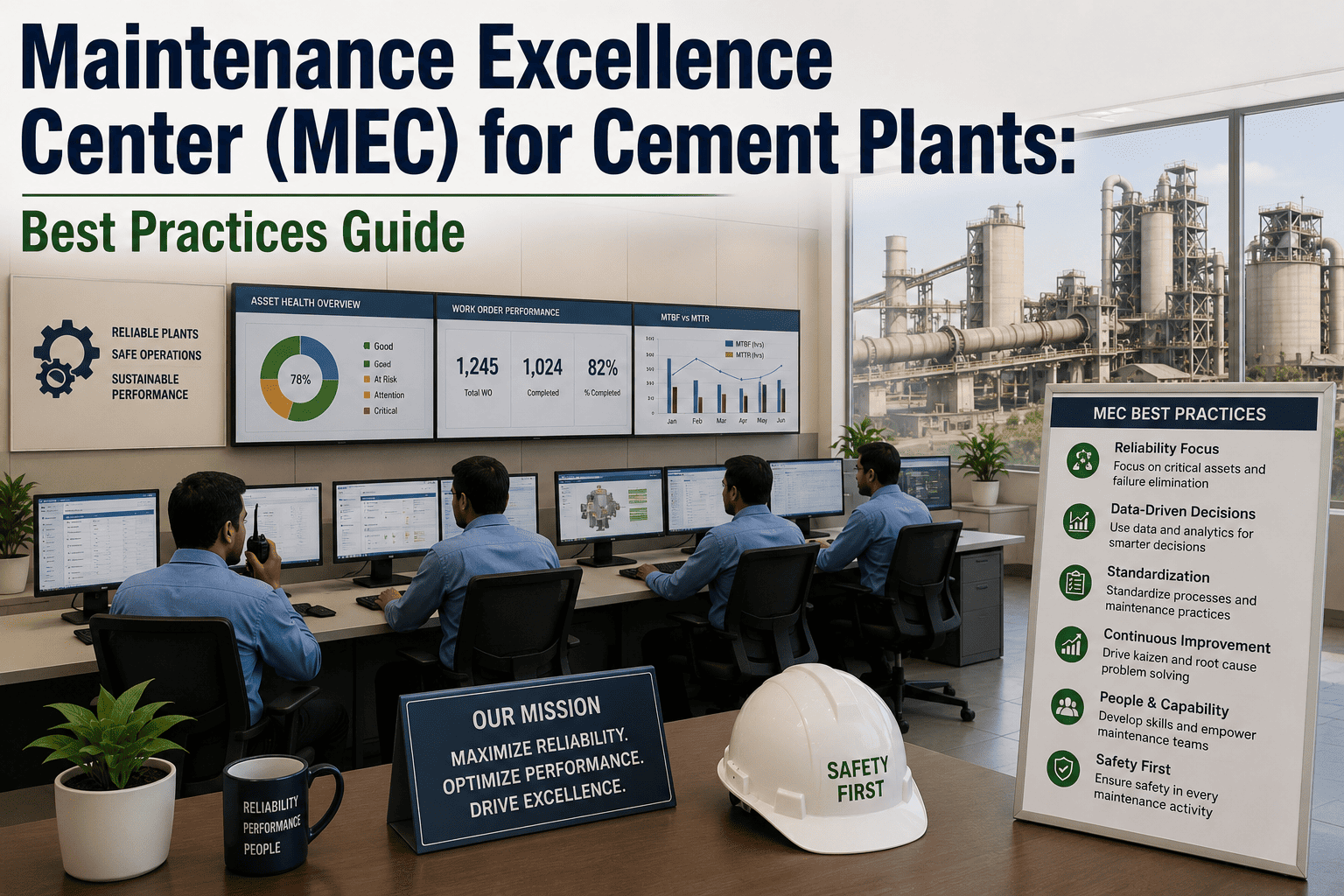
A cement group with five plants often ends up with five different ways of scheduling a bearing replacement, five different definitions of "critical asset," and five sets of numbers that don't add up when corporate asks for a single reliability report. A Maintenance Excellence Center exists to fix that by giving every plant the same playbook. Sign up to see how Oxmaint standardizes maintenance data across every plant in a group.
5 Pillars
Core pillars that make up a functioning Maintenance Excellence Center
6-8 KPIs
Core reliability metrics tracked consistently across every plant in the group
4 Levels
Maturity stages plants typically move through on the way to full standardization
1 Playbook
Single set of standards every plant follows instead of its own local practice
The Cost of Five Plants, Five Playbooks
When each plant sets its own PM intervals, names its own criticality tiers, and tracks downtime in its own spreadsheet, corporate reliability reporting becomes a translation exercise instead of an analysis. A Maintenance Excellence Center replaces that patchwork with one governance structure, one set of KPIs, and one CMMS configuration every plant reports into the same way.
The 5 Pillars of a Maintenance Excellence Center
| Pillar |
What It Covers |
| Governance |
A defined decision structure for who owns PM standards, criticality ranking, and escalation |
| Standard processes |
One work order lifecycle, one failure coding scheme, and one PM template library |
| KPI framework |
A shared set of reliability metrics every plant reports the same way, every period |
| Skills and training |
A common competency framework so a technician's certification travels between plants |
| Technology backbone |
A single CMMS configuration that enforces the standard instead of leaving it optional |
One CMMS Configuration, Every Plant in the Group
Oxmaint lets a Maintenance Excellence Center push one PM template library, one failure coding scheme, and one KPI dashboard to every plant, while still letting each site manage its own daily work orders. Sign up for a free trial and roll out your first standard template, or book a demo to see multi-plant reporting in action.
Core KPIs Every MEC Should Track
| KPI |
Why It's Tracked Group-Wide |
| PM compliance |
Shows whether scheduled work is actually being completed on time at every plant |
| MTBF and MTTR |
Lets corporate compare failure frequency and repair speed across similar equipment |
| Planned vs unplanned work ratio |
A rising unplanned share is an early warning sign before downtime spikes appear |
| Maintenance cost per ton |
Normalizes maintenance spend so plants of different sizes can be compared fairly |
| Backlog in weeks |
Flags whether a plant's maintenance team is keeping pace with demand or falling behind |
Siloed Plants vs a Centralized MEC
Siloed, Plant-by-Plant
Each plant defines its own PM intervals and criticality tiers independently
Corporate reports require manually reconciling five different spreadsheets
A best practice discovered at one plant rarely reaches the other four
Centralized MEC
A shared PM template library and criticality standard applies to every plant
Group-wide KPIs roll up automatically from a single CMMS configuration
A proven fix at one plant becomes the standard at every other site
Where to Start Building an MEC
Pick one plant as the pilot site, standardize its PM templates, failure codes, and KPI definitions first, then use that configuration as the template every other plant is migrated onto rather than trying to standardize all sites simultaneously.
Frequently Asked Questions
Q
Is an MEC only relevant for multi-plant groups?
It delivers the most obvious value across multiple plants, but a single large plant with several process areas benefits from the same governance, KPI, and standardization principles applied at the department level.
Q
Does an MEC take away a plant manager's autonomy?
No. It standardizes definitions, templates, and reporting, not day-to-day decisions. Plant managers still decide daily priorities and staffing, but they now do it against the same PM standards and KPI definitions as every other site.
Q
How long does it take to stand up an MEC across a group?
A pilot plant can be standardized in a few months, but rolling the same templates and KPIs across a full multi-plant group typically takes six to twelve months depending on how many sites and legacy systems are involved.
Give Every Plant in Your Group the Same Playbook
Oxmaint standardizes PM templates, failure codes, and KPI dashboards across every plant in a Maintenance Excellence Center, while keeping day-to-day work orders local to each site. Sign up for a free trial and roll out your first standard template, or book a demo to see group-wide reporting in action.