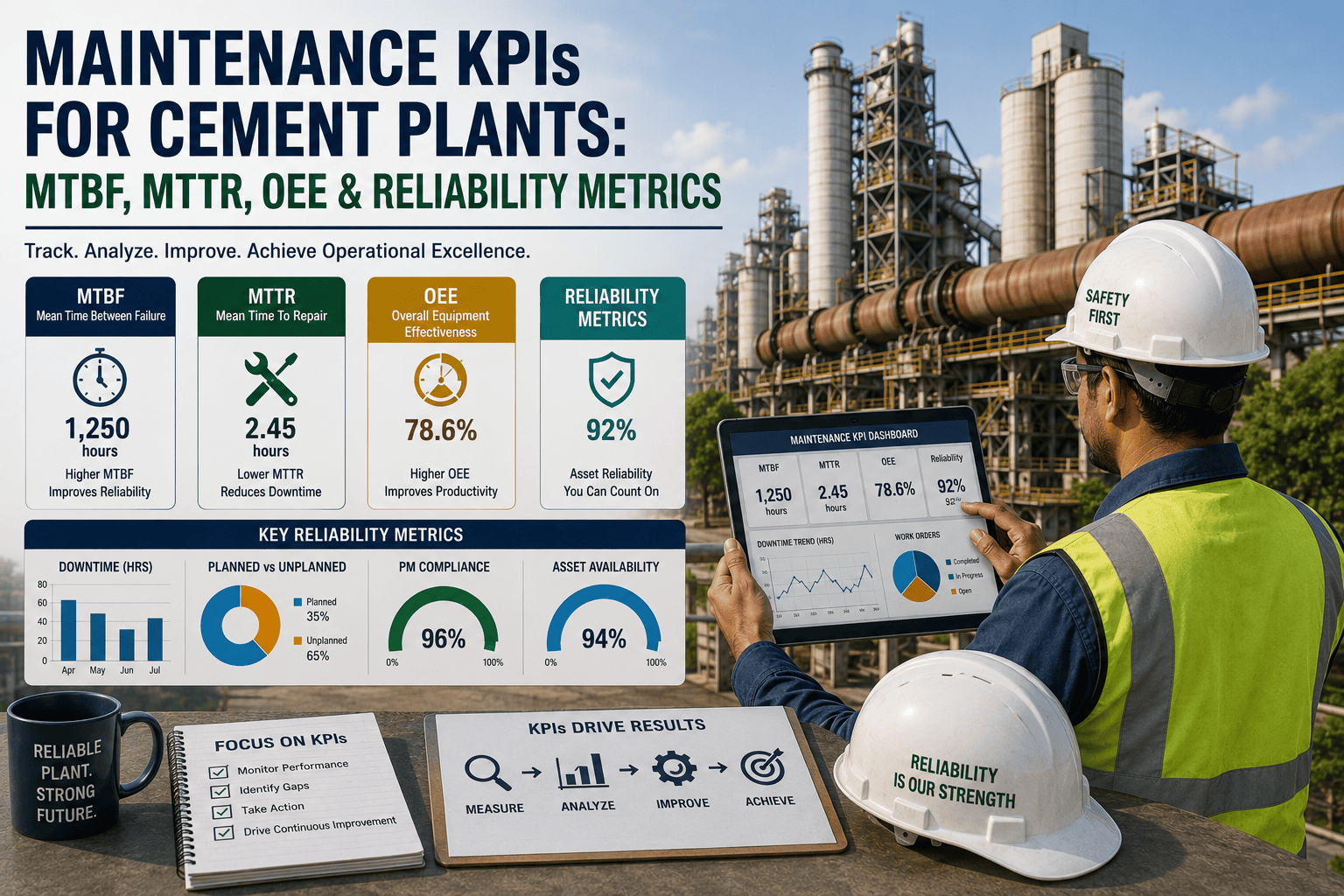
Ask a maintenance manager how the plant is really performing, and the honest answer should come from a dashboard, not a gut feeling. MTBF, MTTR, and OEE turn scattered breakdown records into numbers that show exactly where reliability is slipping. Sign up to see how Oxmaint calculates these metrics automatically from your existing work order history.
85%+
OEE score considered world-class for a cement production line
3 Factors
Availability, performance, and quality that together make up OEE
10-20%
Typical MTBF improvement once root causes are tracked and closed
90%+
PM compliance target most reliability-focused plants aim for
Why Plants Track the Wrong Numbers
It's common to measure how many work orders got closed this month and call that reliability. But a high close-out count means nothing if the same kiln fan keeps failing every six weeks. The metrics that actually matter connect back to a simple question: is equipment breaking down less often, and getting fixed faster when it does.
The Four Metrics Every Cement Plant Should Track
| Metric |
What It Measures |
What a Bad Number Tells You |
| MTBF |
Average time an asset like the raw mill runs between failures |
A recurring fault that preventive work isn't actually catching |
| MTTR |
Average time to repair a failed asset and get it back online |
Slow parts availability or an unclear repair procedure |
| OEE |
Combined availability, performance, and quality of a production line |
Losses hiding in slow cycles or rework, not just stoppages |
| PM Compliance |
Share of scheduled preventive tasks completed on time |
Skipped inspections quietly building up into future breakdowns |
Stop Calculating KPIs in a Spreadsheet
Oxmaint pulls MTBF, MTTR, OEE, and PM compliance directly from your work order history, updated automatically as technicians close jobs. Sign up for a free trial to see your current numbers, or book a demo and we'll build your first reliability dashboard together.
Breaking Down OEE Into Its Three Parts
| Component |
On the Cement Plant Floor |
Common Loss |
| Availability |
Time the kiln or mill is actually running versus scheduled to run |
Unplanned stops from equipment failure |
| Performance |
Actual output speed compared to the line's designed capacity |
Running slower than rated due to worn components |
| Quality |
Share of output meeting spec on the first pass, no rework |
Off-spec clinker or cement from equipment drift |
Gut-Feel Reliability vs KPI-Driven Reliability
Without KPI Tracking
"The mill breaks down a lot" stays a feeling, not a number
Repair time gets judged by memory instead of records
PM compliance is assumed to be fine until a failure proves otherwise
With KPI Tracking
MTBF shows exactly which asset is failing more than it should
MTTR highlights where repair delays are actually happening
PM compliance is visible weekly, not discovered after a breakdown
How Oxmaint Supports Reliability Reporting
Oxmaint calculates MTBF, MTTR, OEE, and PM compliance automatically from the work orders your team already closes, so there's no separate spreadsheet to maintain. Dashboards break the numbers down by asset, line, or shift, making it easy to spot which kiln zone or mill is dragging the plant's reliability down. Book a demo to see your own historical data turned into a live dashboard.
Frequently Asked Questions
Q
What's a realistic MTBF target for cement plant equipment?
It varies heavily by asset type and duty, so the useful benchmark isn't an industry average, it's your own asset's trend. A steadily rising MTBF over several quarters is the real sign reliability work is paying off.
Q
Why track MTTR separately if MTBF already covers failures?
MTBF tells you how often something breaks, MTTR tells you how long it stays broken. A plant can have infrequent failures but still lose huge amounts of output if repairs consistently drag on.
Q
Does low PM compliance always mean poor reliability?
Not immediately, but it's a leading indicator. Skipped inspections don't cause a failure the same week, they build up quietly until a fault that should have been caught early turns into an unplanned stop.
Q
What's the simplest way to start tracking these KPIs?
Start with your three most critical assets, log every failure and repair time consistently for a quarter, and calculate MTBF and MTTR from that data before expanding the tracking plant-wide.
See Your Real Reliability Numbers, Not Estimates
Oxmaint automatically calculates MTBF, MTTR, OEE, and PM compliance from your existing maintenance data, broken down by asset, line, and shift. Sign up for a free trial to see your current numbers, or book a demo and we'll build your first reliability dashboard together.
MTBF