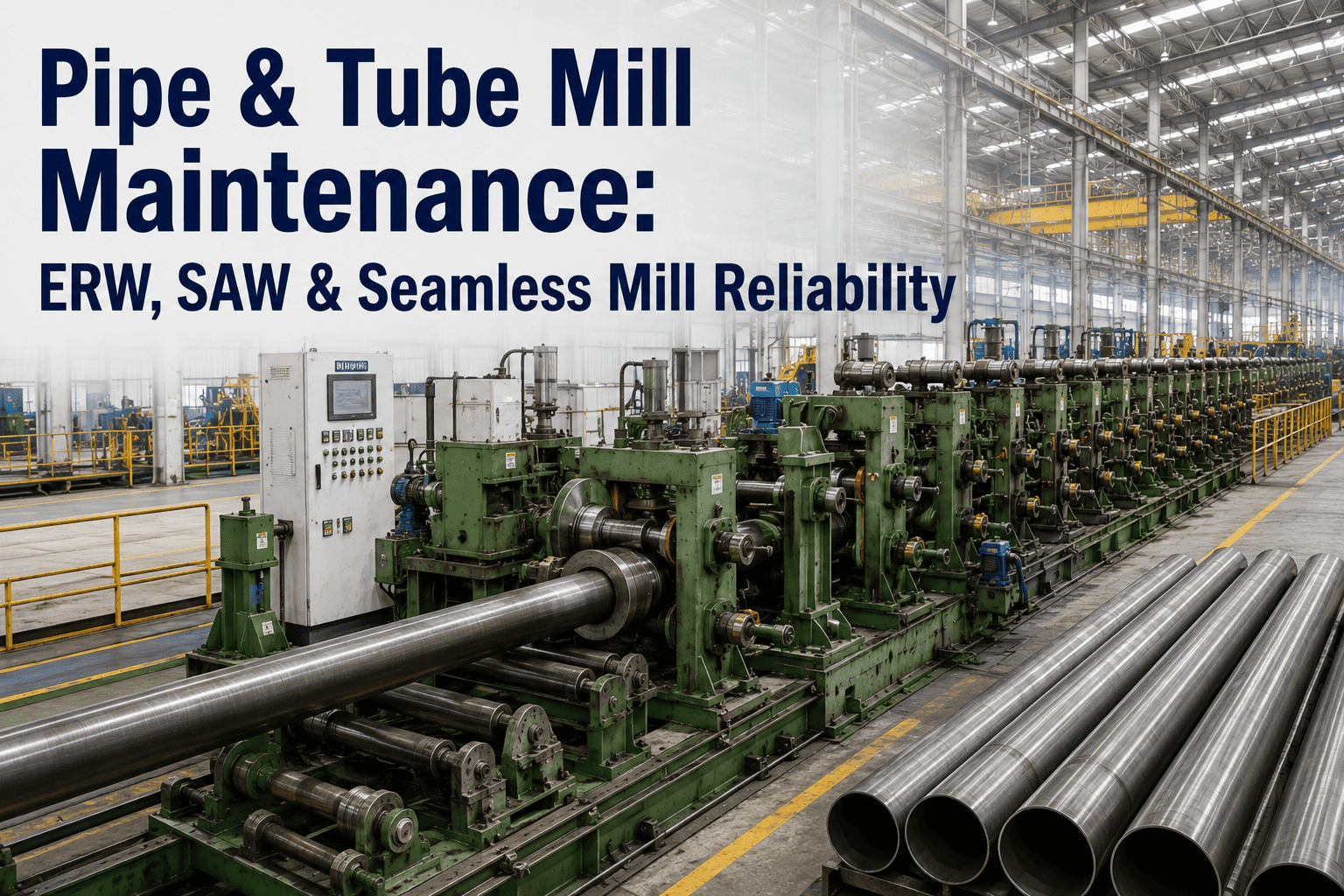
A pipe or tube mill fails differently than a bar or plate mill. There is almost no re-rolling a mistake away, a misaligned forming roll, a flux feed problem on a SAW weld, or a worn piercing plug on a seamless mill does not create a size error that gets corrected downstream, it creates a reject. That is what makes ERW, SAW and seamless mill maintenance a first-time-quality problem as much as an uptime problem. Sign up to see how Oxmaint tracks forming rolls, weld systems and sizing stands across your pipe and tube mill in one place.
3 Mill Types
ERW, SAW and seamless mills each carry a completely different failure signature
0 Rework
A weld or forming defect on pipe is almost always cut out and scrapped, not corrected
Final Test
Is often where an upstream tooling defect is discovered, far from where it began
1 Worn Plug
On a seamless mill is enough to fail an entire run at hydrostatic test
Why Pipe Mill Maintenance Is a Quality Problem First
In flat and long product rolling, a worn roll usually shows up as a size drift that a downstream stand can still correct. In a pipe or tube mill, the forming, welding and sizing sequence has almost no room for that kind of correction. A forming roll out of alignment shows up as a seam offset, a flux feed issue on a SAW weld shows up as a subsurface inclusion, and both are usually caught only at inspection or hydrostatic test, long after the defect was created.
Where Each Mill Type Actually Breaks Down
ERW Mills
Forming roll misalignment shifts the strip edges out of register before the weld point, producing a seam offset that only appears as a weld defect further down the line.
SAW Mills
Flux feed inconsistency or wire alignment drift on the submerged arc weld head creates subsurface inclusions that demand cut-out and re-inspection rather than a simple adjustment.
Seamless Mills
A piercing plug worn past tolerance leaves wall thickness variation that will not fail visually, it fails later at hydrostatic testing where the cause is much harder to trace.
Component-Level Checks Across the Line
| Component |
Common Wear or Failure Mode |
Preventive Task |
| Forming rolls & fin pass |
Edge misalignment causing improper strip closure before the weld point |
Strip edge alignment check against setup drawing per campaign |
| ERW weld electrodes |
Copper disc electrode wear reducing consistent current contact along the seam |
Electrode condition and contact pressure inspection on schedule |
| SAW flux & wire feed |
Feed rate drift or nozzle wear producing inconsistent flux coverage |
Flux feed rate and wire alignment calibration before each run |
| Piercing plug & mandrel |
Plug wear introducing wall thickness eccentricity on seamless tube |
Plug diameter measurement and wear-limit tracking per run |
| Sizing & stretch reducing mill |
Roll groove wear affecting final outside diameter and wall consistency |
OD and wall thickness sampling at fixed production intervals |
Every Weld Head, Every Plug, One Reliability Record
Oxmaint registers forming rolls, weld electrodes, flux feed systems, piercing plugs and sizing stands as tracked assets with their own inspection history, so a scrap event can be traced back to the exact tool that caused it. Sign up for a free trial to see it against your own pipe or tube mill, or book a demo and we will walk through your line.
Reactive Repairs vs Condition-Based Maintenance
| Approach |
How It Plays Out |
Result on Pipe Quality |
| Reactive repair |
Weld or forming issue is caught at final inspection or hydrostatic test |
Full run scrap risk and lost traceability of the original cause |
| Fixed schedule PM |
Electrodes and plugs replaced at set intervals regardless of actual wear |
Some tooling changed too early, some changed too late |
| Condition-based maintenance |
Forming, weld and sizing wear measured and trended against real tolerance data |
Defects flagged at the source, before they reach test or inspection |
How Oxmaint Supports Pipe & Tube Mill Reliability
Oxmaint tracks forming rolls, ERW electrodes, SAW flux and wire systems, seamless piercing plugs and sizing stands as individual assets, logging inspection readings and wear trends against each one. A drifting electrode contact reading or a piercing plug nearing its wear limit triggers a work order early, before the defect ever reaches final inspection. Book a demo to see it mapped against your own pipe or tube mill.
Frequently Asked Questions
Q
Why is pipe mill maintenance treated differently from bar or plate mill maintenance?
Because a forming or welding defect on pipe usually cannot be corrected at a later stand the way a size error can in flat or long product rolling, so the defect turns into scrap rather than a rework opportunity.
Q
What is the most common cause of weld seam offset on an ERW mill?
It is usually a forming roll or fin pass misalignment that lets the strip edges close out of register before they reach the weld point, so the offset is created upstream and only found at the weld inspection stage.
Q
Why do seamless mill defects show up so late in production?
A worn piercing plug creates wall thickness variation that is not visible on the outside of the tube, so it is typically only found at hydrostatic testing, far downstream from the plug that actually caused it.
Q
How can a pipe mill shift from reactive repair to condition-based maintenance?
Register each critical tool, forming rolls, weld electrodes, flux and wire systems, piercing plugs and sizing stands, as a tracked asset, then log wear readings against it so a drift is caught before it becomes a rejected run.
Catch Forming and Weld Defects Before They Reach Final Inspection
Oxmaint gives steel plant teams forming roll tracking, weld system condition monitoring, piercing plug wear alerts and predictive maintenance across the entire pipe and tube mill. Sign up for a free trial to explore it yourself, or book a demo and we will walk through it against your own mill.