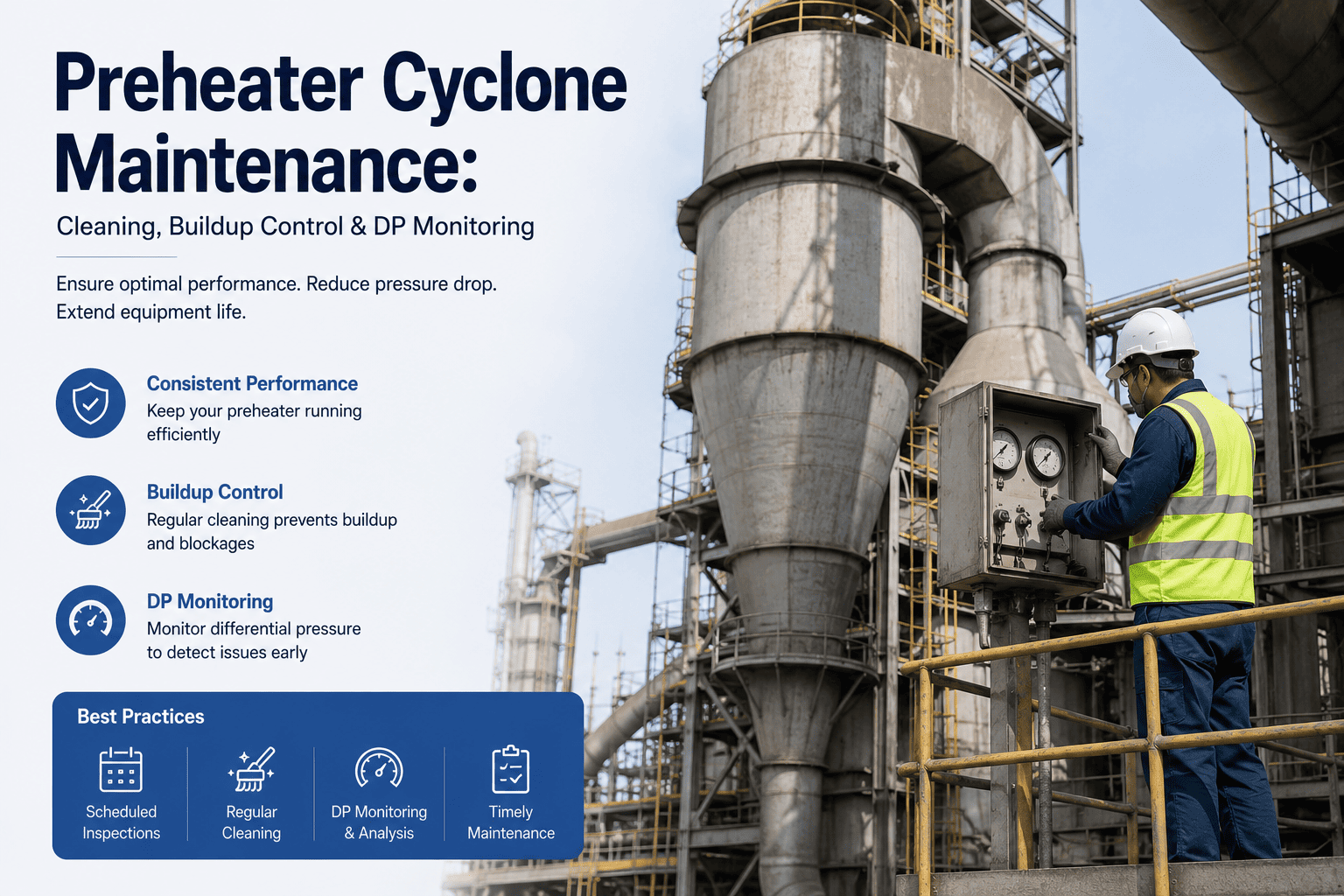
A single preheater cyclone blockage can shut down clinker production for 8 to 36 hours, and the pressure drop that gives it away is usually visible days before anyone reaches for a poke rod. Coating buildup, sometimes called a snowman when it forms at the kiln inlet or cooler connection, rarely announces itself until the differential pressure trend has already been climbing for a while. Start a free trial to see how Oxmaint trends cyclone DP across every stage before it forces a stop.
$180-650K
Typical cost of one unplanned preheater blockage event, including clearing and lost output
8-36 Hrs
Production lost to a single blockage event before clinker output returns to spec
60%+
Of preheater shutdowns originate from buildup in cyclone stages 4 and 5 specifically
8-12 Wks
Time for buildup to reach critical levels in high-alkali raw mixes without intervention
What's Actually Causing the Buildup
Alkali chlorides and sulfates in the raw meal condense and stick as gas cools moving up the tower, and cyclone stages 4 and 5 sit right in the temperature window where that condensation is worst. The same chemistry forms the buildup nicknamed a snowman at the connection between kiln and cooler, and it rarely gives clear warning of exactly why it started forming.
Where Buildup Forms and What It Looks Like First
| Location |
Typical Cause |
First Indicator |
| Cyclone stages 4 & 5 |
Alkali condensation in the 800-900°C temperature window |
Gradual rise in differential pressure across the affected stage |
| Kiln inlet & riser duct |
Salt compounds carried up from the kiln combining with cooling gas |
Rising pressure loss and shifting intermediate product chemistry |
| Cooler inlet (snowman) |
Buildup at the discontinuous kiln-to-cooler connection |
Visual growth pattern, often unpredictable until well advanced |
Every Cyclone Stage, One DP Trend Line
Oxmaint trends differential pressure and buildup rate per cyclone stage, projects days to critical restriction, and triggers a cleaning work order before flow gets choked off. Sign up for a free trial to see it against your own preheater tower, or book a demo and we'll walk through your buildup history stage by stage.
Fixed Cleaning Schedules vs Trend-Based Cleaning
| Approach |
How It Works |
Main Drawback |
| Fixed interval cleaning |
Every stage cleaned on the same shutdown schedule, typically every 6 months |
Wastes hours on stages that don't need it, misses stages that build up faster |
| DP trend-based cleaning |
Each stage's pressure differential trended individually against its own baseline |
Needs consistent logging discipline to build a reliable trend |
| Manual poke-hole clearing |
Reactive clearing once a blockage has already formed |
Puts crews near hot, pressurized ductwork and only happens after the fact |
Daily DP Watch vs Shutdown Cleaning Routine
Daily DP Watch
Log pressure differential across every cyclone stage each shift
Compare against the stage's own trend line, not a plant-wide average
Flag any stage rising faster than its historical pattern
Shutdown Cleaning
Physical inspection and cleaning of stages flagged by trend data
Air cannon and cleaning system function check before restart
Photo documentation of coating thickness for the next campaign's baseline
How Oxmaint Supports Preheater Reliability
Oxmaint captures pressure differential readings per cyclone stage, calculates buildup rate against each stage's own baseline, and auto-generates a cleaning work order when the projected days-to-restriction crosses your threshold. Shutdown findings and photo evidence stay linked to the exact stage, so a recurring buildup pattern is visible across campaigns instead of buried in paper forms. Book a demo to see your tower's buildup trend mapped stage by stage.
Frequently Asked Questions
Q
What exactly is a snowman in a preheater system?
A snowman is buildup that forms at the discontinuous connection between the kiln and cooler, named for its rounded shape. It's caused by the same alkali chloride and sulfate chemistry that builds up in cyclone stages, but its exact formation timing is notoriously hard to predict from process data alone.
Q
Why do cyclone stages 4 and 5 block up more than the others?
Those stages sit in the temperature range where alkali compounds in the raw meal condense most readily, roughly 800 to 900°C. That's why over 60% of preheater shutdowns caused by coating trace back specifically to buildup at stage 4 or 5.
Q
Is differential pressure really enough to catch a blockage early?
Yes, a gradually rising differential pressure across a specific stage is typically the first measurable sign of restricted gas flow, showing up well before the blockage becomes severe. The key is trending each stage against its own baseline rather than relying on a single plant-wide threshold.
Q
Why do fixed cleaning intervals still result in blockages?
A fixed schedule, like cleaning every stage every six months, treats every stage the same regardless of how fast it actually builds up. High-alkali raw mixes can push a stage to critical buildup in as little as 8 to 12 weeks, well before the next scheduled cleaning arrives.
Catch Buildup on the Trend Line, Not the Poke Rod
Oxmaint gives cement plant reliability teams stage-by-stage DP trending, projected days-to-restriction, and automated cleaning work orders across the entire preheater tower. Sign up for a free trial to explore it yourself, or book a demo and we'll walk through it against your own cyclone data.