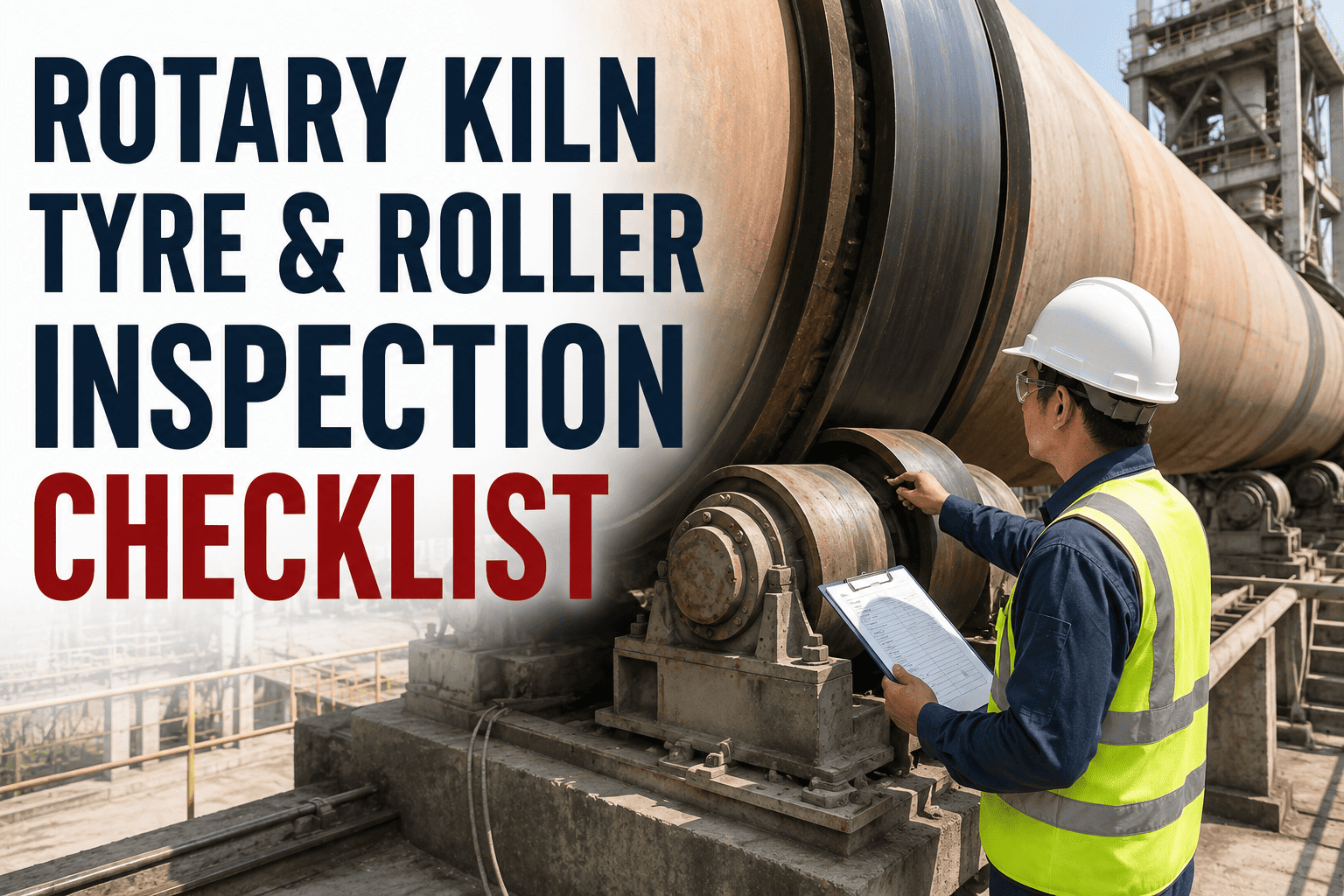
A kiln's tyres and support rollers carry the entire weight of the shell while it turns, day after day, for years without stopping. Small problems here rarely announce themselves loudly, a slight wobble or a few degrees of skew builds slowly until it shows up as uneven wear or a shell that's harder to keep aligned. This checklist covers what to check on tyres and rollers during every inspection round. Sign up to track tyre and roller readings against the kiln asset over time.
2-3 Tyres
Typical number of riding rings supporting a rotary kiln shell
Monthly
Recommended frequency for a full tyre migration and skew check
1-2mm
Typical wobble tolerance before it's flagged as abnormal
Continuous
How often lubrication film should be present between tyre and roller
Why Tyres And Rollers Deserve Close Attention
Tyre and roller wear rarely causes a sudden stoppage, but left unchecked it drives shell misalignment, uneven refractory wear, and higher power draw. Catching migration or skew early keeps the whole kiln running true instead of fighting itself.
Tyre Condition Checks
Tyre Migration Check
Mark the tyre's axial position and compare it against the last reading to track movement along the shell
Surface Wear & Scoring
Look for grooves, flat spots, or uneven wear across the tyre's riding surface
Tyre-To-Shell Clearance
Check the gap between tyre and shell pads at multiple points to confirm the tyre is riding evenly
Catch Tyre Migration Before It Becomes Misalignment
Oxmaint logs every tyre and roller reading against the kiln asset, so slow migration or skew shows up as a clear trend instead of a surprise. Sign up for a free trial to build your tyre and roller inspection route, or book a demo to see it in action.
Roller & Alignment Checks
Roller Skew Angle
Measure each roller's skew against the kiln axis, since skew is what drives tyre migration in the first place
Roller Bearing Temperature
Record temperature at each support bearing and compare against the established baseline
Lubrication Film Between Tyre & Roller
Confirm graphite or oil film is present and evenly applied to reduce friction and surface wear
What A Reading Might Be Telling You
| What You Notice |
Possible Cause |
| Tyre migrating axially |
Roller skew pushing the tyre in one direction along the shell |
| Uneven surface wear on tyre |
Inconsistent lubrication film or a roller running slightly out of alignment |
| Rising roller bearing temperature |
Lubrication breakdown or early bearing wear that hasn't reached alarm thresholds yet |
| Growing tyre wobble |
Loosening tyre pads or a support roller starting to wear unevenly underneath |
Where A CMMS Fits Into Tyre & Roller Inspections
Oxmaint turns this checklist into a recurring digital route, logging tyre position, skew angle, and bearing readings against the kiln asset so slow drift is visible long before it turns into a misalignment problem.
Frequently Asked Questions
Q
How often should tyre migration be checked?
A monthly check is generally enough to catch migration early, though kilns with a known skew issue may need a closer weekly watch until it's corrected.
Q
What causes a kiln tyre to migrate?
Migration is almost always driven by roller skew, where a support roller sits slightly off the kiln's true axis and gradually pushes the tyre along the shell.
Q
Can a CMMS track tyre and roller readings over time?
Yes, a CMMS can log tyre position, wobble, skew angle, and bearing temperature against the kiln asset, building a trend that flags drift before it becomes a bigger problem.
Keep Every Tyre And Roller Running True
Oxmaint keeps tyre position, roller skew, and bearing readings logged against your kiln asset, so drift gets caught while it's still cheap to fix. Sign up for a free trial to build your tyre and roller inspection route, or book a demo to see it in action.