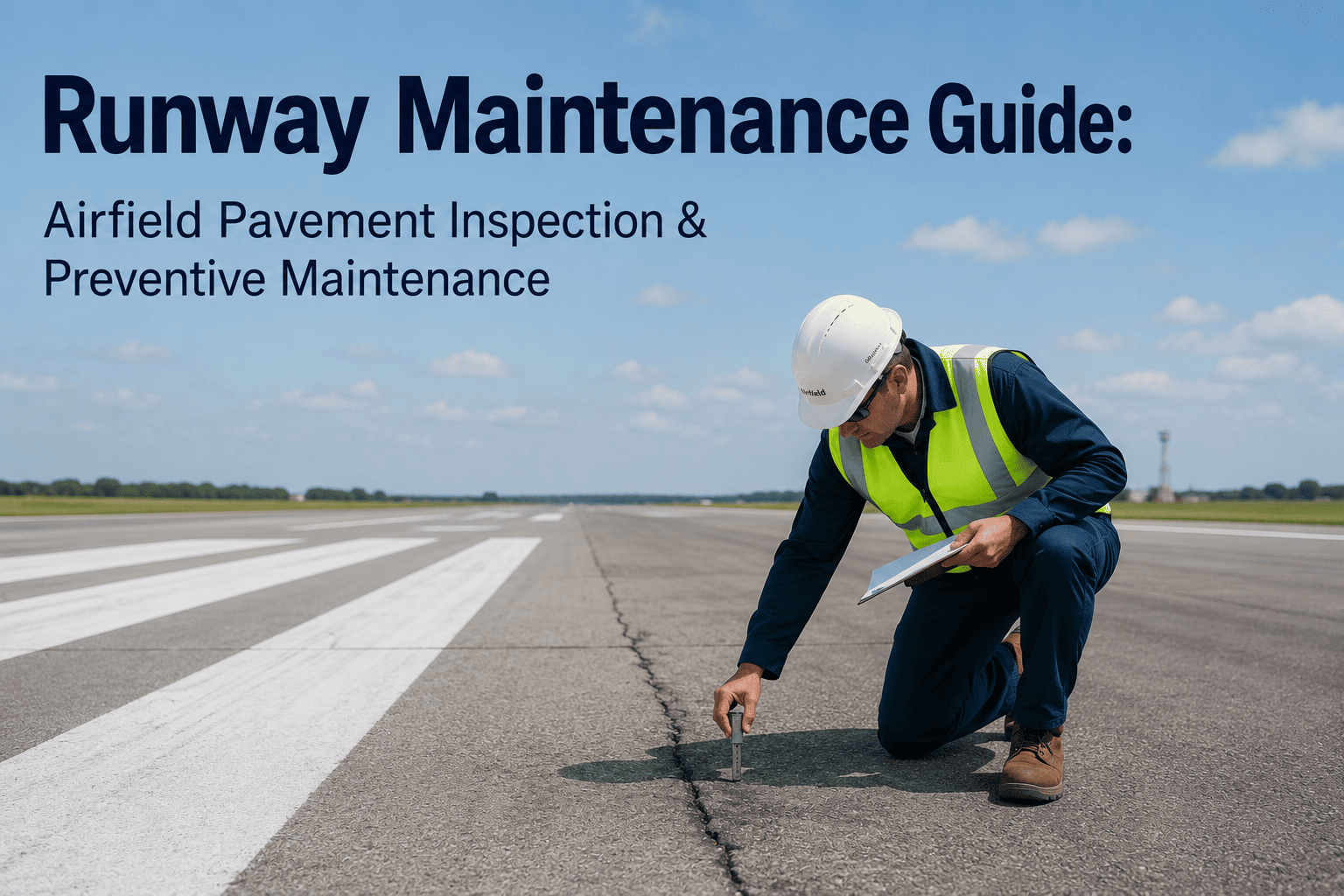
A runway doesn't fail all at once. Friction drops a fraction of a point per landing as rubber builds up in the touchdown zone, a hairline crack widens one freeze-thaw cycle at a time, and a stray bolt sits unnoticed until it's ingested by an engine. Foreign object debris alone is linked to over 400 aircraft incidents a year globally, and under CAP 683 and ICAO Annex 14, UK aerodrome licence holders carry a direct obligation to keep friction, texture and surface condition within defined limits. Start a free trial to see how Oxmaint tracks every runway, taxiway and apron section as a managed asset.
70
Pavement Condition Index score below which a runway requires prioritised maintenance planning
400+
Aircraft incidents a year globally linked to foreign object debris on airfield surfaces
0.05-0.15
Typical friction coefficient loss in touchdown zones from progressive rubber accumulation
61%
Average inspection completion verification on paper-based airfield programmes, versus near-complete on digital ones
Why Runway Maintenance Can't Be a Budget-Driven Exercise
Left to a fixed annual budget, pavement teams end up treating whichever section has the loudest complaint, not the one with the fastest-deteriorating condition data. Sections treated too late need far more expensive rehabilitation; sections treated too early consume budget that could have extended life somewhere else on the field. Condition data, not the calendar, should decide what gets fixed first.
The Four Disciplines of a Runway Maintenance Programme
Stage 1
Pavement Condition Inspection
Structured PCI checklists logged on a scheduled cycle, capturing distress type, severity and extent at the pavement section level.
Stage 2
Friction Testing
CFME survey runs measured against Design Objective, Maintenance Planning and Minimum Friction Levels set by CAP 683 and ICAO Annex 14.
Stage 3
Rubber Removal
Scheduled removal in touchdown zones, timed against aircraft movement data before rubber build-up drags friction below action levels.
Stage 4
FOD Management
Daily walkdown work orders with photo evidence, plus pavement repair timed before spalling generates loose debris in the first place.
Every Runway Section, One Condition Record
Oxmaint links PCI history, friction test results and FOD incidents to every runway, taxiway and apron section, so intervention decisions are backed by data instead of the loudest complaint. Sign up for a free trial to see it against your own airfield, or book a demo and we'll walk through your pavement portfolio.
Friction Thresholds Every Airfield Team Should Know
| Friction Level |
What It Means |
Required Action |
| Design Objective Level (DOL) |
Target friction on new or resurfaced pavement |
Baseline for ongoing condition comparison |
| Maintenance Planning Level (MPL) |
Alert threshold indicating corrective maintenance should begin |
Extended evaluation once breached over a continuous 305m section |
| Minimum Friction Level (MFL) |
Floor below which the runway may be slippery when wet |
Immediate corrective action and NOTAM notification |
Runway Maintenance Tasks by Frequency
| Frequency |
Task |
| Daily |
FOD walkdown with photo evidence logged against location and origin |
| Weekly |
Visual pavement inspection for new cracking, spalling or marking wear |
| Monthly to Quarterly |
Friction survey frequency scaling with daily turbojet landings, plus rubber removal review |
| Annual |
Full PCI survey, drainage clearance and marking retroreflectivity testing |
How Oxmaint Supports Airfield Teams
Oxmaint registers every runway, taxiway and apron section as a managed asset, with PCI history, FOD incident records, friction test results and rehabilitation forecasts linked to each one. Mobile checklists replace paper inspection sheets, and every completed task carries a timestamp and inspector sign-off. Book a demo to see the airfield pavement management workflow mapped against your own runway layout.
Frequently Asked Questions
Q
What is a Pavement Condition Index and why does it matter?
PCI is an internationally standardised 0 to 100 scale measuring a pavement's structural health based on visible distress type, severity and extent. Runways scoring below 70 require prioritised maintenance planning rather than routine monitoring.
Q
How often does UK CAA guidance require friction testing?
CAP 683 ties survey frequency to traffic volume, with high-turbojet-movement runways requiring far more frequent testing than lightly used ones. Testing is also required after resurfacing, following rubber contamination events, and when pilots report reduced friction.
Q
Why does rubber removal matter so much for runway safety?
Rubber deposits from landing aircraft build up in the touchdown zone and progressively reduce friction, sometimes covering surface texture entirely on heavily used runways. Left untreated, it directly affects braking distance and directional control on wet surfaces.
Q
Can proactive pavement repair actually reduce FOD incidents?
Yes. Treating surface distress like joint spalling and aggregate loss before it worsens can cut FOD generation on treated sections substantially, since a large share of debris originates from the pavement itself rather than external sources.
Turn Runway Condition Data Into a Safer, Cheaper Maintenance Plan
Oxmaint links PCI history, friction results and FOD records to every pavement section, so intervention decisions are driven by condition data instead of budget guesswork. Sign up for a free trial to explore it yourself, or book a demo and we'll walk through it against your own airfield.