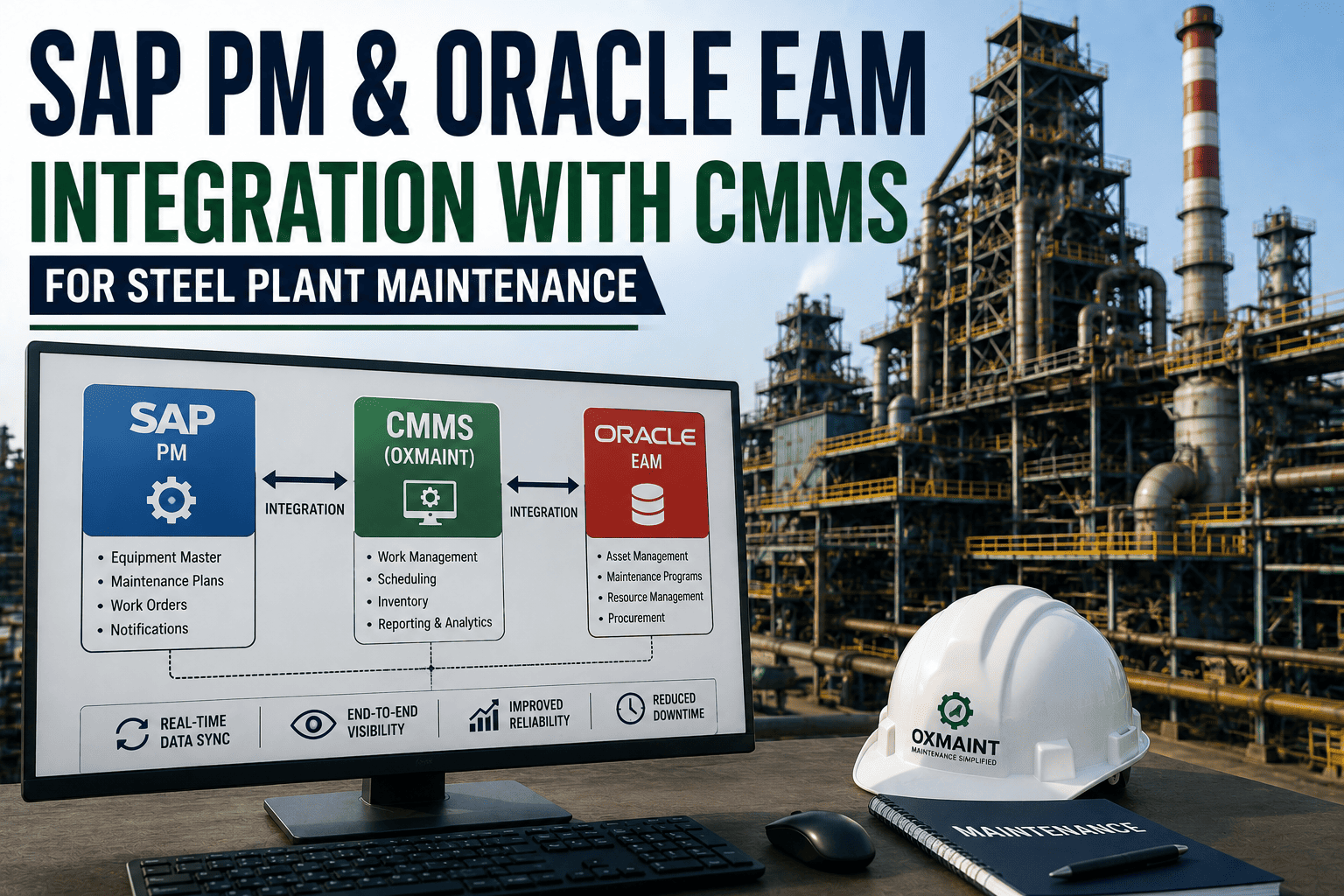
SAP PM knows exactly what every asset cost and where the budget went. What it doesn't know is what's happening on the mill floor right now, because it was built for desktop planners, not technicians standing next to a failed bearing. Sign up to see how Oxmaint runs alongside SAP PM or Oracle EAM as a mobile execution layer, no rip-and-replace required.
20-30%
Productive capacity typically lost to slow work orders and mismatched data on ERP-only plants
Under 4 wks
Time many teams reach real-time SAP-CMMS synchronization piloting on a single line
2.8 to 2.1 hrs
Typical drop in defect-to-work-order time once mobile execution runs alongside SAP
24 hrs
How fast a daily field reconciliation catches sync drift, instead of finding it at quarter close
Record System and Execution Layer Are Two Different Jobs
SAP PM and Oracle EAM excel at financial accuracy, master data integrity, and multi-site procurement governance. Neither was designed for a technician working offline in a taphouse with gloves on. Integration keeps the ERP as the system of record while a CMMS becomes the mobile execution layer, syncing bidirectionally instead of replacing anything.
What Actually Syncs Between CMMS and ERP
| Data Element |
Flows From |
Flows To |
| Equipment master data |
SAP PM or Oracle EAM |
CMMS mobile interface |
| Work order confirmations |
CMMS field execution |
ERP cost settlement |
| Parts and inventory |
CMMS parts consumption |
ERP procurement and reorder |
| Failure and cause codes |
CMMS technician entry |
ERP reliability reporting fields |
Keep SAP or Oracle EAM, Add Mobile Execution
Oxmaint connects to SAP PM and Oracle EAM through pre-built connectors, syncing assets, work orders, parts, and labor bidirectionally with no custom development for standard data flows. Sign up for a free trial and connect your sandbox in under a day, or book a demo with a solutions engineer who has run this integration in steel plants before.
A Phased Rollout, Not a Big-Bang Cutover
| Phase |
What Happens |
| 1. Audit and clean |
Review the existing SAP PM or Oracle EAM setup and clean up master data before connecting anything |
| 2. Pilot one line |
Configure bidirectional sync for one production line or asset group first |
| 3. Validate sync points |
Confirm confirmations, parts consumption, and cost settlements flow correctly both ways |
| 4. Extend plant-wide |
Roll the validated integration out across the rest of the plant, with daily reconciliation checks in place |
ERP-Only Execution vs ERP Plus CMMS Layer
ERP-Only Execution
Technicians log confirmations back at a desktop terminal, hours after the repair
Complex menus push field data entry toward paper notes and memory
Connectivity loss in a taphouse or basement means the record simply doesn't happen
ERP Plus CMMS Layer
Work orders closed on mobile at the asset, with data flowing to the ERP in real time
Offline mode caches repair data and syncs automatically once connectivity returns
Failure and cause codes map straight into ERP reliability reporting fields
How Oxmaint Supports SAP and Oracle EAM Integration
Oxmaint's mobile app runs offline in a taphouse or basement, caching every repair and syncing automatically once connectivity returns, so no maintenance log is ever lost. Part requests raised inside a work order route straight to your ERP's procurement module, and failure codes map to the fields your reliability reports already use. Book a demo to see the connector running against your own SAP PM or Oracle EAM environment.
Frequently Asked Questions
Q
Does adding a CMMS mean replacing SAP PM or Oracle EAM?
No. A modern CMMS integrates alongside the existing ERP configuration with no changes to the core system. SAP or Oracle stays the financial and master data system of record, while the CMMS becomes the mobile execution layer technicians actually use.
Q
Why do nightly batch syncs cause problems?
Overnight syncs mean inventory counts and work order confirmations sit stale for hours, which defeats the purpose of integration. Real-time, event-based sync is what keeps parts availability and cost data trustworthy on the floor.
Q
What happens if a technician works without a network connection?
A properly built CMMS caches work order data locally and automatically syncs it with the ERP once connectivity is restored, so a dead zone in a basement or taphouse doesn't cost a maintenance record.
Close the Gap Between the ERP and the Mill Floor
Oxmaint gives steel plant teams a mobile execution layer that syncs bidirectionally with SAP PM and Oracle EAM, covering assets, work orders, parts, and labor without replacing your ERP investment. Sign up for a free trial and connect your sandbox, or book a demo and we'll walk through your current integration gaps.