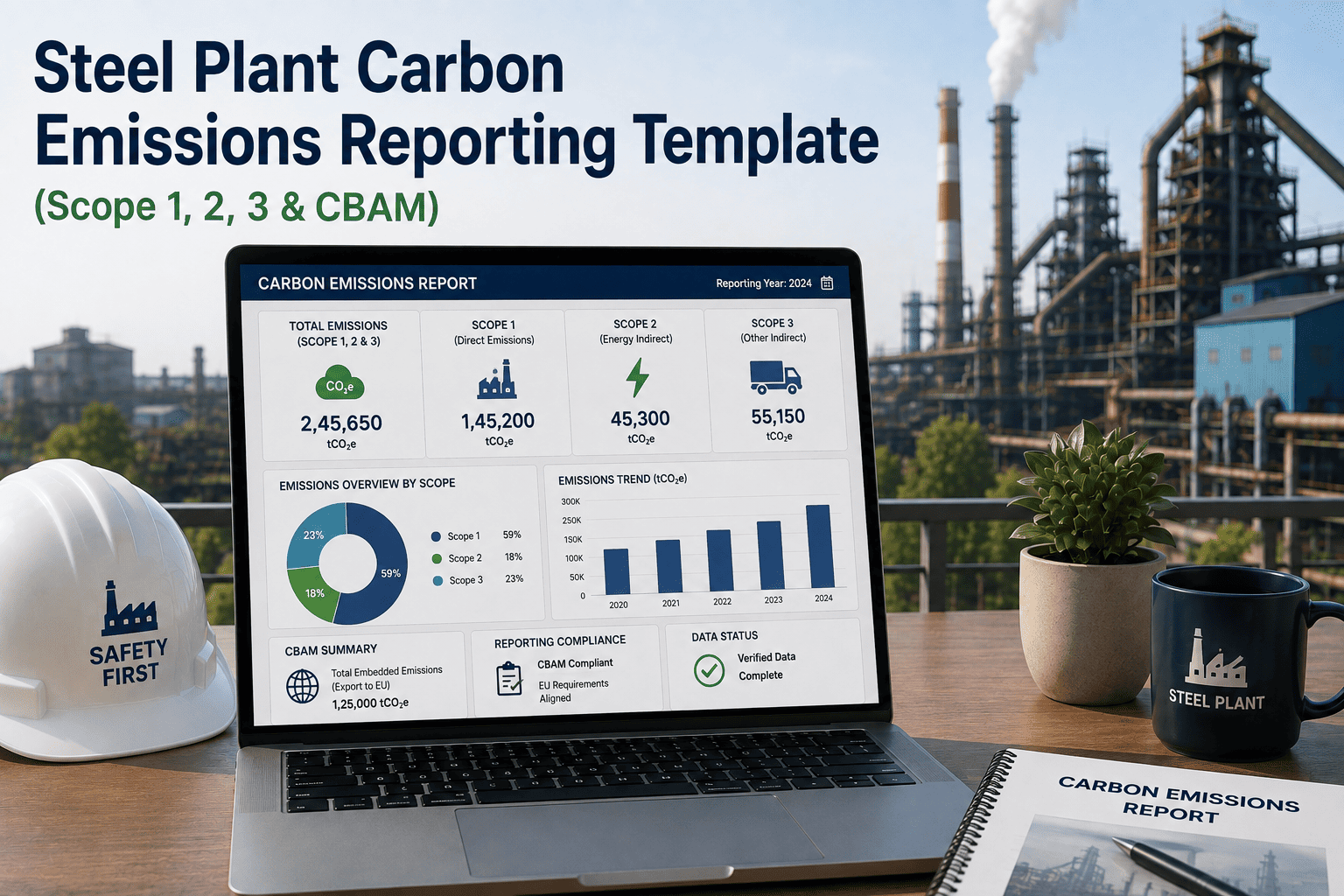
A steel mill's carbon report and its actual furnace fuel logs rarely agree. Manual spreadsheets combine quarterly fuel invoices with estimated electricity draw, and the gap between reported and real emissions often runs 15 to 25 percent, enough to trigger a CBAM certificate shortfall or a failed verification audit. This template lays out exactly what a Scope 1, 2, and 3 emissions record needs to hold up under GHG Protocol, ISO 14064, EU ETS, and CBAM review. Sign up to build an audit-ready carbon record directly from your plant's own operating data.
Why It Matters
CBAM's compliance phase now requires at least 80 percent of reported embedded emissions to come from verified actual data, not defaults. A mill relying on paper fuel logs and quarterly estimates cannot meet that bar, and default values are set well above industry average, which raises certificate costs, not lowers them.
The Three Scopes, Broken Down For Steel
Scope 1
Direct furnace and process emissions, typically 70-85% of a mill's total footprint
Scope 2
Purchased electricity, dominant in EAF mills, minor in most BF-BOF operations
Scope 3
Precursor carbon in scrap, DRI, and alloys, the hardest to trace and verify
Carbon Intensity Benchmarks By Production Route
BF-BOF Integrated Route
1.8-2.1 tCO2/t
DRI-EAF Route
0.5-1.2 tCO2/t
Scrap-Based EAF
0.3-1.2 tCO2/t
EU CBAM Default Benchmark
Set above average
Turn Fuel Logs Into Verified Data
Oxmaint pulls fuel consumption, electricity draw, and production data straight from plant operations into a Scope 1/2/3 record ready for CBAM declaration. Sign up for a free trial to see your first carbon record, or book a demo to walk through CBAM readiness with our team.
What An Audit-Ready Record Needs
Time-stamped meter readings and fuel deliveries, not monthly totals reconstructed from memory
Scope 1 and Scope 2 separated by production route, not blended into one plant-wide figure
Supplier-verified precursor carbon for scrap, DRI, and alloys, flagged wherever data is missing
Chain-of-custody documentation a third-party verifier can trace back to the original record
Emissions intensity calculated per product line, aligned to GHG Protocol and ISO 14064 boundaries
Manual Spreadsheets vs Live Carbon Tracking
| Factor |
Manual Spreadsheet |
Live Tracking |
| Data source |
Fuel invoices and estimates, updated quarterly |
Meter and production data captured continuously |
| Reporting accuracy |
Often 15-25% off actual consumption |
Traced directly to source records, minimal variance |
| Verification readiness |
Verifier defaults to conservative estimates on gaps |
Full audit trail ready for third-party review |
| CBAM certificate cost |
Higher, defaults penalize unverified data |
Lower, actuals reported below benchmark where earned |
The Takeaway
Under CBAM, carbon intensity is a cost variable, not just a disclosure. A mill that can prove its actual Scope 1, 2, and 3 numbers pays certificates on what it actually emits, while a mill stuck on estimates pays the penalty for not knowing.
Frequently Asked Questions
Q
Does CBAM apply to mills outside the EU?
Yes. CBAM applies to the product, not the mill's location. A mill exporting coil to an EU customer, or supplying an OEM that exports finished goods to the EU, falls within scope unless it stays under the 50 tonne annual threshold.
Q
What is the difference between GHG Protocol and ISO 14064 reporting?
GHG Protocol organizes emissions into Scope 1, 2, and 3. ISO 14064 uses direct and indirect emissions categories instead. Most mills report under both, since ISO 14064 supports third-party verification requirements that CBAM and EU ETS depend on.
Q
How long does third-party CBAM verification take?
A first-time mill audit typically takes 4 to 8 weeks and requires 2 to 3 person-weeks of verifier effort on-site. Incomplete or untimestamped data extends this timeline and pushes mills toward default emission values.
Stop Estimating Your Carbon Footprint
Oxmaint builds your Scope 1, 2, and 3 emissions record from live plant data, mapped to GHG Protocol, ISO 14064, EU ETS, and CBAM requirements. Sign up for a free trial to see your first carbon record, or book a demo to walk through CBAM readiness live.