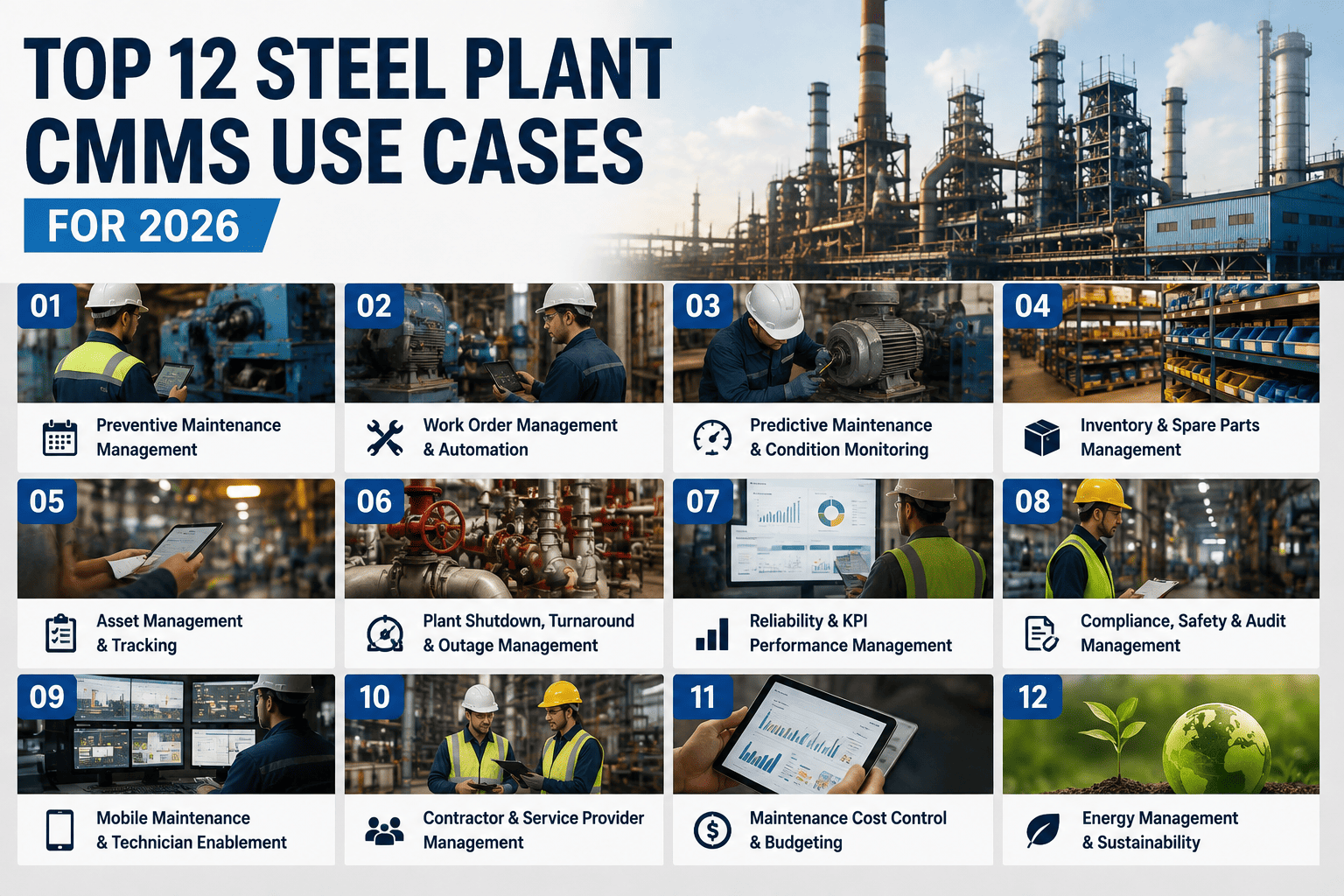
Twelve steel plants can buy the same CMMS and get twelve different results, because the value isn't in the software, it's in which workflows actually get configured. A generic work order tool left as-is manages a warehouse conveyor fine and misses a tuyere trending toward failure entirely. These are the 12 use cases separating plants that cut breakdown costs from plants still running blast furnace maintenance out of shift binders. Sign up to configure these use cases against your own asset hierarchy.
Why It Matters
The average North American steel plant still runs 55 to 65 percent of its maintenance reactively, unplanned work triggered after something has already failed. Every use case below exists to move a specific workflow, from tuyere replacement to electrode tracking, out of that reactive cycle and onto a planned schedule.
The 12 Use Cases At A Glance
1. Blast Furnace Campaign
Heat-count tracking for tuyeres, staves, and hearth refractory life
2. BOF Vessel Lining
Gunning cycles and thickness trending to forecast reline dates
3. EAF Electrode Tracking
Per-heat electrode length and tip condition logged automatically
4. Caster Segment PM
Mold and segment maintenance tied to casting sequence counts
5. Rolling Mill Roll Changes
Vibration-based scheduling instead of fixed calendar intervals
6. Refractory Lifecycle
Full lining history from install to relining across every vessel
7. Predictive Sensor Alerts
Thermal and vibration data auto-generates work orders on drift
8. Ladle Fleet Records
Shell thermal scans tied to individual ladle IDs and relining history
9. Meter-Based PM
Heat-count and run-hour triggers replace blanket calendar PMs
10. Critical Spares Inventory
Refractory brick, bearings, and electrodes tracked by min stock level
11. Mobile Hot-End Work Orders
Offline-capable work orders for technicians near furnaces and mills
12. Permit & LOTO Compliance
Isolation and gas-test records attached to every hazardous work order
What These Use Cases Are Worth
Unplanned Downtime Cost, 2024
$4.2 billion
Downtime Reduction With Predictive PM
Up to 30%
Planned Maintenance Achieved In Year 1
70-80%
MTTR Reduction With Parts Availability
30-50%
See These Use Cases On Your Own Assets
Oxmaint ships with pre-built templates for blast furnace, BOF, EAF, caster, and rolling mill maintenance, so these 12 use cases are configured in days, not months. Sign up for a free trial to load your asset hierarchy, or book a demo and we'll map it with you.
A Use Case Only Works If It Includes
A trigger tied to heat count or run hours, not a fixed calendar date that ignores actual asset load
An individual asset record, so a tuyere or ladle is tracked on its own history, not blended plant-wide
A mobile path for technicians to log readings and close work orders at the point of work
A permanent audit trail linking permits, sensor data, and repair history back to the asset
Shift Binder vs Structured CMMS
| Factor |
Shift Binders & Spreadsheets |
Structured CMMS |
| Tuyere or electrode data |
Recorded, rarely trended, lost across shift handovers |
Trended continuously against per-unit baselines |
| PM scheduling basis |
Fixed calendar dates regardless of actual heat count |
Triggered by heat count, run hours, or sensor threshold |
| Spare parts response |
Searched for during the emergency itself |
Stocked and reserved ahead of the scheduled work order |
| Compliance evidence |
Paper permits, difficult to produce during audits |
Digital permit record attached permanently to the asset |
The Takeaway
None of these 12 use cases require new hardware to start. They require the CMMS to model your actual assets, blast furnace tuyeres, BOF linings, EAF electrodes, so the data you already generate every heat gets captured instead of lost at shift change.
Frequently Asked Questions
Q
Which use case should a steel plant start with?
Start with the asset that drives the most downtime cost, usually blast furnace refractory or BOF vessel lining tracking. Getting one high-consequence asset onto a structured heat-count schedule proves the value before rolling out across the plant.
Q
Do these use cases require new sensors on the furnace?
Not always. Meter-based PM, spares tracking, mobile work orders, and permit compliance run on data your plant already generates. Predictive sensor alerts benefit from existing thermal and vibration instrumentation but do not require a full sensor buildout to start.
Q
How fast can a steel plant deploy these workflows?
Basic asset hierarchies, PM schedules, and mobile work orders are typically live within the first week using pre-built steel templates, with full deployment across all 12 use cases completed in 2 to 4 weeks.
Move All 12 Use Cases Off The Shift Binder
Oxmaint's pre-built templates for blast furnace, BOF, EAF, caster, and rolling mill maintenance get every one of these use cases running against your actual assets. Sign up for a free trial to start today, or book a demo and we'll map your specific asset structure.