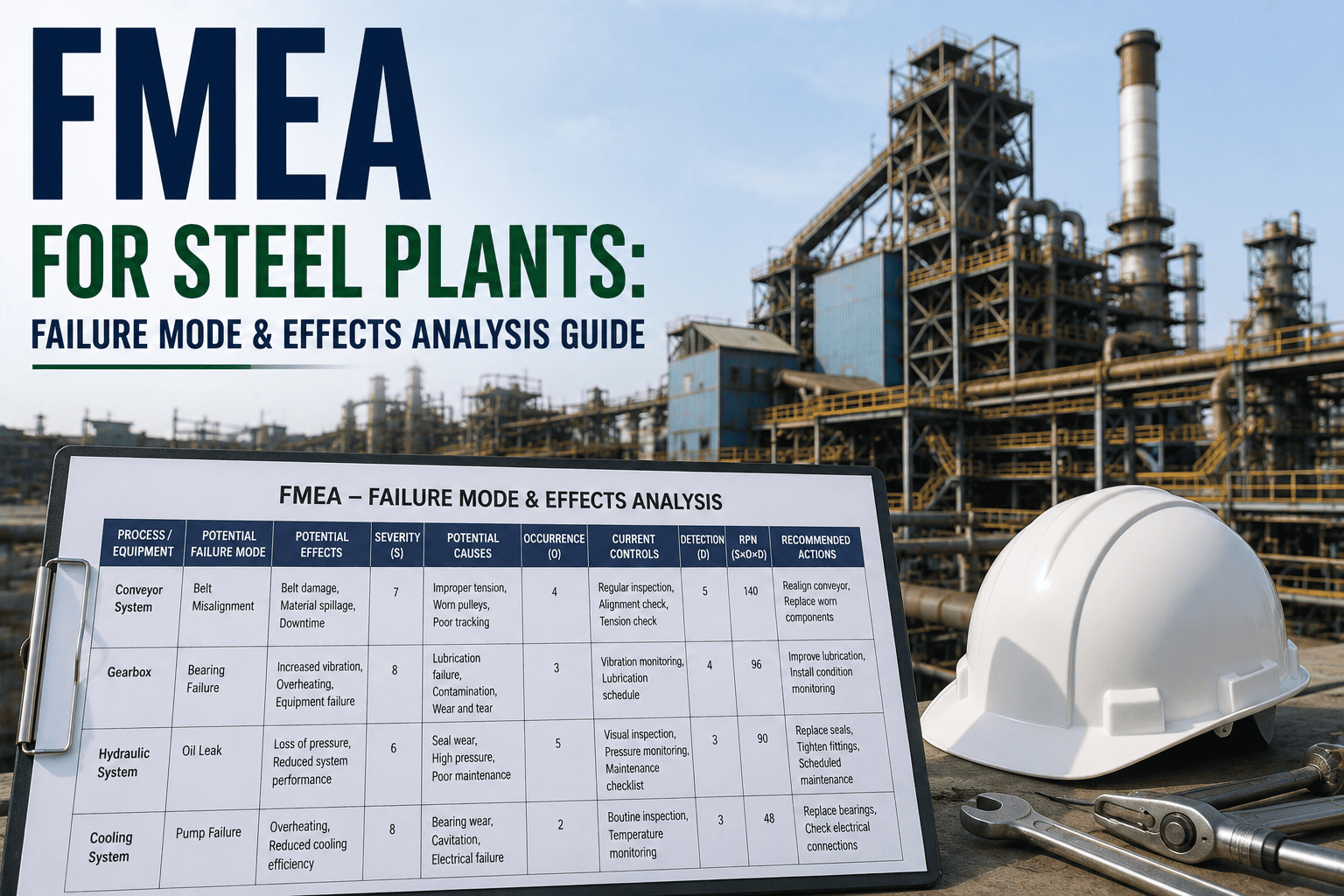
Every unplanned failure on a steel line had a precursor, a weak point that existed long before the line actually stopped. Failure Mode and Effects Analysis finds that weak point on paper, scores its risk, and tells a reliability team exactly where to spend the next maintenance dollar. Sign up to see how Oxmaint turns FMEA findings into live PM schedules instead of a document that sits on a shelf.
S x O x D
The Risk Priority Number formula: Severity times Occurrence times Detection
1-10
Rating scale used for each of the three RPN factors, giving a maximum score of 1000
100-150
Typical RPN threshold steel plants use to trigger priority corrective action
Why RPN Alone Isn't the Whole Story
A failure mode scored at 8 severity, 1 occurrence, and 3 detection carries the same RPN as one scored 1, 8, and 3, yet the two risks are nothing alike. That's why any failure mode with a severity of 9 or 10 demands action regardless of its overall RPN. Numbers guide the conversation, they don't replace engineering judgment.
The Three Scores Behind Every Failure Mode
| Factor |
Question It Answers |
Steel Plant Example |
| Severity |
How bad is the effect if the failure occurs |
A shorted EAF transformer versus a scratched belt guard |
| Occurrence |
How often does the underlying cause actually happen |
Bearing seizures under cooling water tuyere conditions |
| Detection |
How likely current controls catch it before failure |
Vibration sensors on a mill drive versus a purely visual walkdown |
Turn Your FMEA Register Into Live PM Tasks
Oxmaint links every failure mode's RPN directly to a PM schedule, inspection checklist, or condition monitoring alert, so the analysis drives real work instead of sitting in a spreadsheet. Sign up for a free trial to build your first FMEA register, or book a demo and we'll walk through your critical assets.
Six Steps From Blank Form to Corrective Action
| Step |
What Happens |
| 1. Define scope and team |
Pick the critical asset and bring in operators, mechanics, and process engineers together |
| 2. List failure modes |
Walk the process flow chart and list every realistic way each component can fail |
| 3. Identify effects and causes |
Trace what happens downstream and what actually triggers each failure mode |
| 4. Score S, O, D |
Rate each failure mode 1 to 10 using past accident and breakdown records |
| 5. Calculate and rank RPN |
Multiply the three scores and sort the register from highest risk down |
| 6. Assign corrective action |
Give every high-RPN item an owner, a target date, and a follow-up check |
Static FMEA Document vs Living FMEA Register
Static FMEA Document
Completed once during a workshop, then filed away and rarely reopened
Occurrence scores stay frozen even as failure history keeps accumulating
Corrective actions get listed but never linked to an actual work order
Living FMEA Register
Occurrence and detection scores update automatically from CMMS failure history
High-RPN failure modes convert directly into PM tasks and inspection checklists
Reviewed annually or whenever equipment, process, or supplier conditions change
How Oxmaint Supports FMEA in Steel Plants
Oxmaint keeps the FMEA register connected to live maintenance data, so RPN scores reflect what's actually happening on the floor rather than a workshop held years ago. High-risk failure modes map straight to PM schedules, inspection routes, and spare parts pre-positioning. Book a demo to see it built around your own critical assets.
Frequently Asked Questions
Q
What RPN score should trigger action in a steel plant?
Many steel plants focus corrective effort on failure modes with an RPN above roughly 100 to 150, though any failure mode with a severity rating of 9 or 10 warrants action regardless of the total score.
Q
Why can two very different risks share the same RPN?
RPN is a product, so a high-severity, low-occurrence failure can score identically to a low-severity, high-occurrence one. That's why teams review the individual S, O, and D scores alongside the final number, not the number alone.
Q
How often should a steel plant FMEA be revisited?
Revisit it whenever equipment, process conditions, or suppliers change, and at minimum once a year using real failure and maintenance history rather than the original workshop estimates.
Make Your FMEA a Living Reliability Tool
Oxmaint gives steel plant reliability teams RPN scoring, failure mode registers, PM task generation, and inspection checklists linked to one CMMS platform. Sign up for a free trial to build your first register, or book a demo and we'll walk through it against your own critical assets.
RPN Scoring
Failure Mode Register
PM Task Automation
Root Cause Tracking
Reliability Engineering