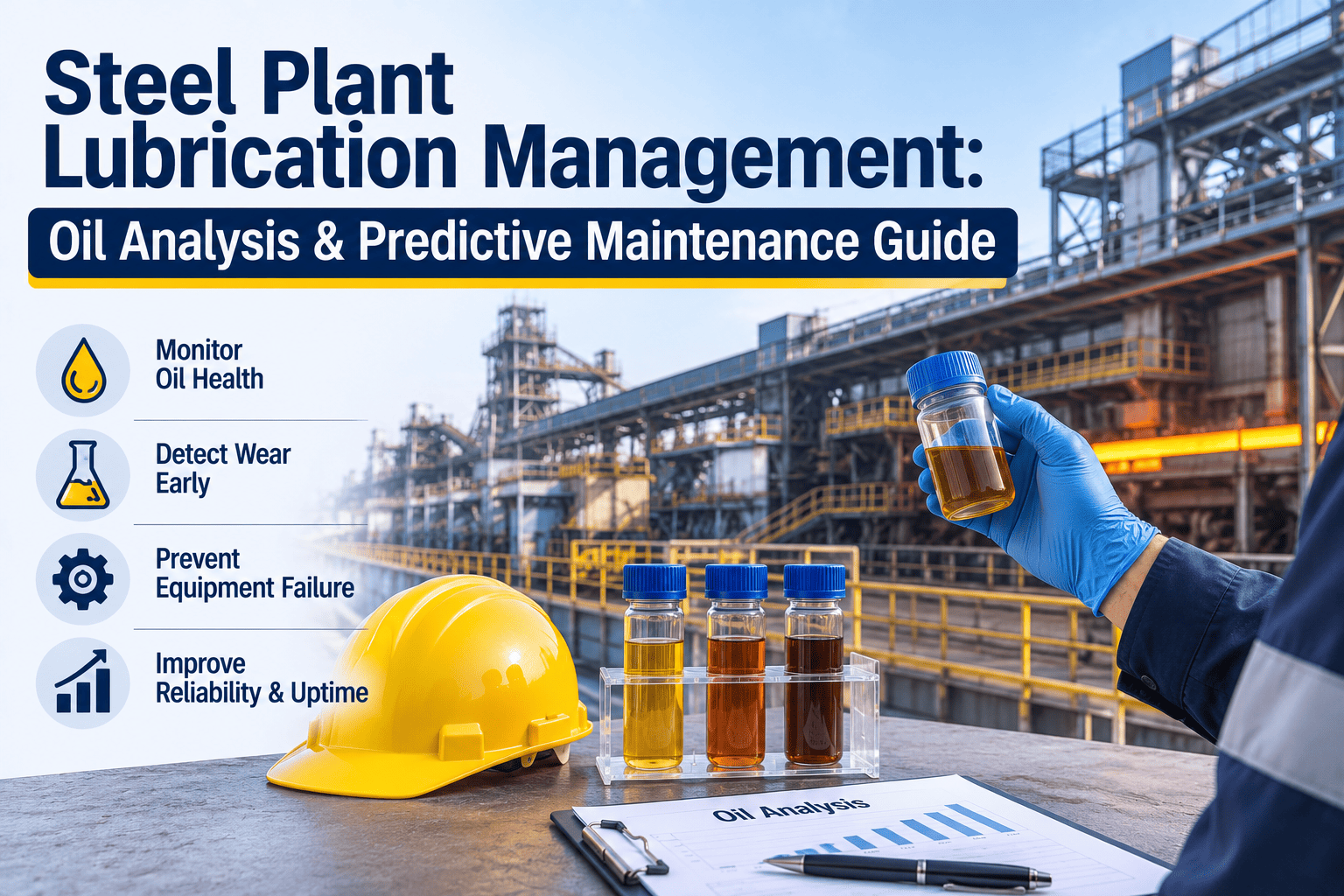
Most bearing and gearbox failures in a steel plant don't start with a broken part — they start with the wrong oil, a contaminated sample, or a relubrication interval nobody tracked. Lubrication is often treated as routine housekeeping, but the data says otherwise: a meaningful share of mechanical failures trace back to lubrication issues that oil analysis would have caught months earlier. A CMMS like OxMaint turns lubrication schedules and oil analysis results into one tracked system — sign up free and your first lubrication checklist is running today.
What Lubrication Management Actually Covers
Oil Analysis
Lab testing for viscosity, particle count, water content, and wear metals to catch degradation before it damages equipment.
Lubricant Selection
Matching the correct grease or oil grade to each machine's load, speed, and temperature conditions, per manufacturer specification.
Contamination Control
Filtration, breather management, and sealed storage practices that keep dust, water, and debris out of lubrication systems.
Relubrication Scheduling
Timed greasing and oil top-up intervals per asset, calibrated to duty cycle rather than a generic calendar date.
Storage and Handling
Labeled, sealed storage and dedicated transfer equipment per lubricant type to prevent cross-contamination before oil even reaches the machine.
Condition Monitoring Integration
Linking oil analysis trends with vibration data to build a complete picture of bearing and gearbox health over time.
Equipment That Needs Close Lubrication Management
Lubrication Checklist by Frequency
OxMaint auto-assigns these tasks to your team, with lubricant type and quantity logged per asset.
Common Lubrication Failures and CMMS Prevention
| Failure | Risk | Root Cause | OxMaint Prevention |
|---|---|---|---|
| Wrong lubricant used | Premature bearing or gear wear | No documented lubricant spec per asset | Asset record linking correct lubricant to each machine |
| Missed relubrication interval | Dry running, accelerated wear | Manual, inconsistent scheduling | Weekly greasing route checklist with reminders |
| Contaminated oil sample | Inaccurate analysis results | Poor sampling technique or storage | Standardized sampling checklist with technique guidance |
| Cross-contaminated lubricants | Chemical incompatibility damage | Shared containers or transfer equipment | Monthly storage audit with labeling verification |
| Ignored oil analysis results | Failures despite having the data | No follow-up process on lab reports | Digital result tracking with flagged action items |
| Water ingress in gearbox oil | Rust and additive breakdown | Failed seals or breathers unnoticed | Weekly seal and breather inspection checklist |
OxMaint vs. Competitors
| Capability | OxMaint | MaintainX | UpKeep | Fiix | Limble | IBM Maximo |
|---|---|---|---|---|---|---|
| Lubrication route templates | Yes | Limited | Limited | No | Limited | Custom |
| Oil analysis result tracking | Yes | No | No | Limited | No | Custom |
| Asset-specific lubricant records | Yes | No | Limited | Limited | No | Yes |
| Contamination audit checklists | Yes | No | No | No | No | Custom |
| Multi-site fleet view | Yes | Limited | Limited | Yes | Limited | Yes |
| Setup | Minutes | Hours | Hours | Days | Hours | Months |
Implementation Roadmap
Results
Data Security
Frequently Asked Questions
How often should oil samples be taken for analysis?
Monthly sampling is typical for critical gearboxes and hydraulic systems, though high-duty equipment may warrant more frequent checks.
What does oil analysis actually detect?
It measures viscosity, particle count, water content, and wear metals, which together indicate contamination, degradation, or developing mechanical wear.
Why does using the wrong lubricant matter so much?
Incorrect viscosity or additive package can accelerate wear or cause chemical incompatibility, often failing equipment faster than running with no lubricant maintenance at all.
Can OxMaint manage lubrication schedules across multiple plants?
Yes. OxMaint provides one dashboard across every plant with asset-specific lubrication routes, oil analysis tracking, and portfolio-wide reporting.