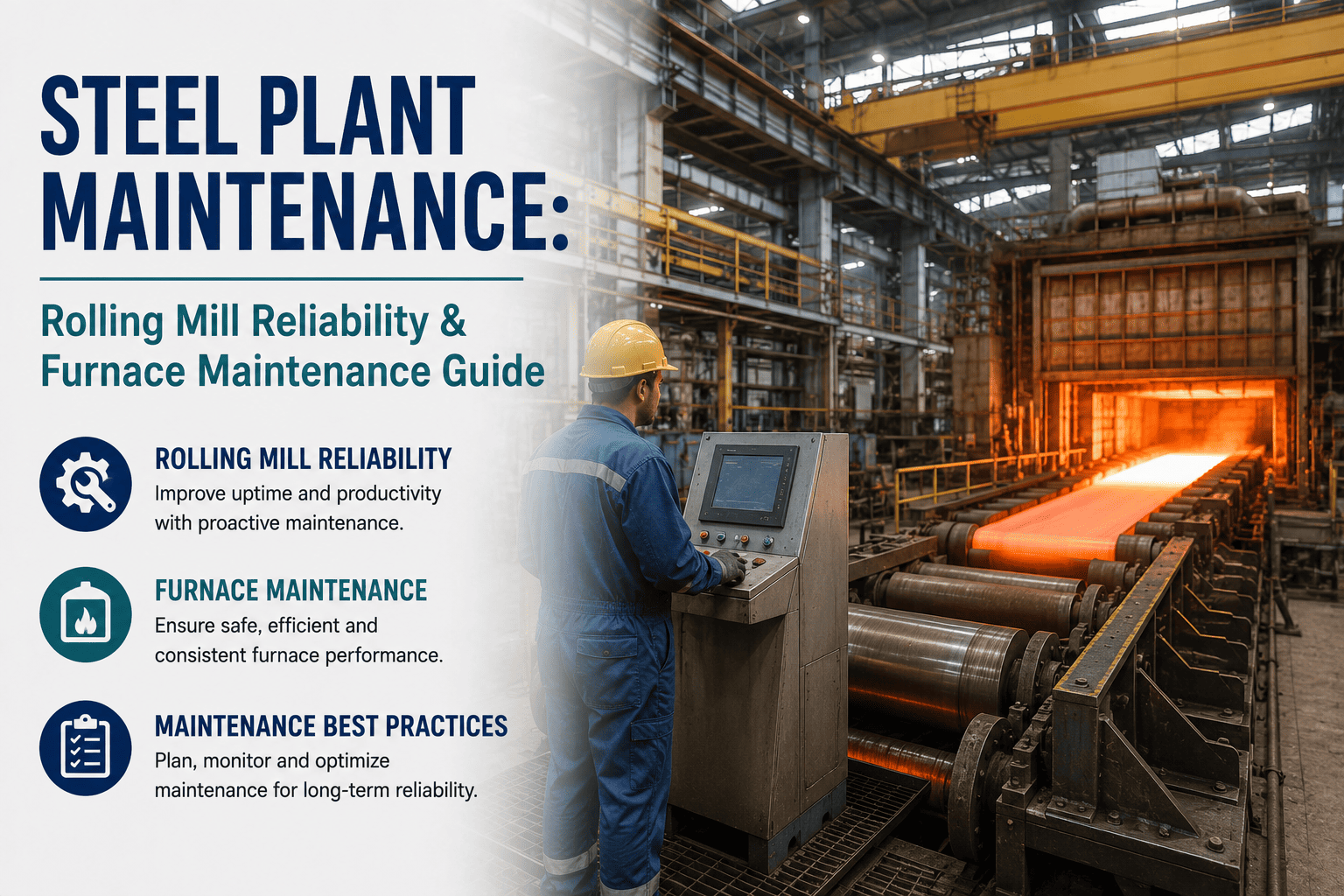
A reheat furnace pushing slabs past 1,200°C, a rolling mill stand running at speeds over 100 km/h, and a finishing line coiling steel to exact tolerance — three stages, and a failure on any one of them stops the whole line. Unplanned downtime in steel rolling operations runs $50,000 to $200,000 an hour, and the industry burned an estimated $4.2 billion on unplanned downtime in a single recent year, roughly 5-8% of total operating costs. Sign up free to see how Oxmaint keeps furnaces, mill stands and finishing lines running on one connected maintenance record.
$4.2B
Spent industry-wide on unplanned downtime in a single recent year
4-7
Unplanned furnace outages the average integrated steel mill experiences per year
60%
Of early-stage failures missed by fixed-schedule inspections and manual rounds
40-55%
Fewer unplanned furnace stops plants typically report after moving to condition-based maintenance
One Line, Three Points of Failure
A reheat furnace, a rolling mill and a finishing line are managed as separate departments in most steel plants, but they behave as one production line. A furnace running uneven temperature sends inconsistent slabs into the mill, accelerating roll wear. A mill stand vibrating out of tolerance produces gauge variation the finishing line then has to reject. Treat them as three isolated maintenance problems and the plant misses exactly where the next stoppage is coming from.
Where Reliability Actually Breaks Down
Each stage of the line has its own failure signature, and each one gives warning long before it forces a stop.
01
Reheat Furnace: Skid Pipes, Walking Beams and Burners
Sets the quality ceiling for everything downstream
Skid pipe sag and walking beam mechanism wear cause discharge delays and chill marks that show up as quality defects two stages later. Thermocouple, hydraulic pressure and burner flame pattern data all trend before the furnace forces an unplanned stop.
02
Rolling Mill Stands: Bearings, Rolls and Drives
Where a $180,000 gearbox failure starts as a small vibration reading
Work roll bearing failure and gearbox degradation are the leading mechanical causes of finishing mill downtime. Caught early through vibration trending, a bearing swap is a planned job. Caught late, it's a full gearbox replacement running 24 to 36 hours of downtime.
03
Finishing Line: Coilers, Hydraulic AGC and Transformers
Invisible degradation until it's catastrophic
Hydraulic automatic gauge control degradation and main transformer insulation breakdown give almost no visual warning. Servo valve response time and dissolved gas analysis are the leading indicators that catch these faults thirty or more days out.
04
Calendar PM Compliance Hides Real Risk
95% PM completion, still high unplanned downtime
Plants routinely hit 95% PM compliance on paper while unplanned downtime stays high, because calendar schedules don't correlate with actual equipment condition under variable production loads. A completed PM checklist isn't the same thing as a healthy machine.
Connect Furnace, Mill and Finishing Line Data on One Platform
Oxmaint tracks condition trends, work orders and PM schedules for every critical asset across your production line. Sign up for a free trial to explore it on your own equipment list, or book a demo and we'll walk through your furnace, mill and finishing line configuration together.
Reactive Maintenance vs. Condition-Based Maintenance
| Reactive Approach |
What It Costs the Plant |
Condition-Based Fix |
| Furnace inspected on a fixed monthly rota |
Skid pipe and burner faults develop unseen between visits |
Continuous thermocouple and hydraulic pressure monitoring |
| Mill drive vibration checked by handheld route |
Bearing faults progress from minor to catastrophic between checks |
Wireless vibration sensors trending BPFO, BPFI and gear mesh frequency |
| Repairs planned only after equipment stops |
Reactive cost often runs 50-75% of total annual maintenance spend |
Work orders triggered by degradation trend, weeks before failure |
| Furnace, mill and finishing line tracked separately |
Downstream quality and wear impact from one stage is missed on another |
One shared asset register across the full production line |
Four Practices That Move a Steel Plant to Top-Quartile Reliability
Practice 01
Prioritise Monitoring by Downtime Cost, Not Convenience
Blast furnace and rolling mill drive failures cost far more per hour than most auxiliary equipment. Deploy condition monitoring on the highest-consequence assets first.
Practice 02
Convert Trend Alerts Into Scheduled Work, Not Just Notifications
An alert that sits in an inbox has the same effect as no alert at all. Route condition-based triggers straight into planner work orders with a defined intervention window.
Practice 03
Track Planned Work Ratio Per Asset, Not Just Plant-Wide
A plant averaging 80% planned work can still be hiding a rolling mill stand running mostly reactive. Break the ratio down by critical asset to find where it's still hiding.
Practice 04
Plan Long-Lead-Time Parts Around Detection Lead Time
Early detection on transformers and gearboxes gives weeks of notice — long enough to order critical parts on standard lead time instead of paying an expediting premium.
How Oxmaint Supports Steel Plant Reliability
Oxmaint gives steel plants one asset register covering the reheat furnace, rolling mill stands and finishing line, with condition trends, PM schedules and work orders linked to every critical asset. Field and maintenance teams log inspections and close work from a mobile device, so a vibration or thermal trend never sits unreviewed until the next scheduled route. Book a demo to see it mapped against your own furnace and mill configuration.
Frequently Asked Questions
Q
Why does a reheat furnace problem show up as a rolling mill problem?
Uneven furnace temperature or discharge delays send inconsistent slabs into the mill, which increases stand vibration and roll wear. The mill absorbs a problem that actually started upstream, which is why tracking equipment in isolation misses the real cause.
Q
How much warning does condition monitoring actually give before a failure?
It varies by asset. Transformer degradation can surface 30 to 45 days ahead through dissolved gas analysis, while rolling mill gearbox faults are commonly caught weeks before seizure through vibration trending on bearing defect frequencies.
Q
We already hit 95% PM compliance — isn't that enough?
High PM compliance on a fixed calendar doesn't guarantee equipment health under variable production loads. Plants regularly report strong PM completion alongside persistently high unplanned downtime, because the schedule wasn't built around actual condition data.
Q
Where should a steel plant start if maintenance is largely reactive today?
Start with condition monitoring on the highest-criticality assets — furnace burners, mill drives and main transformers — before expanding coverage. Prioritising by downtime cost gets the fastest return and builds the case for wider rollout.
Turn Furnace, Mill and Line Data Into Fewer Unplanned Stops
Oxmaint gives steel plant engineers one connected register for every critical asset across the production line, with trend-based condition monitoring, PM scheduling and mobile work orders built in. Sign up for a free trial to explore it yourself, or book a demo and we'll walk through it against your own furnace and mill setup.
Furnace Condition Monitoring
Rolling Mill Vibration Tracking
Predictive PM Scheduling
Mobile Work Orders
Audit-Ready Reporting