A blast furnace tuyere can cost half a million dollars an hour in lost production the moment it fails, while a spare conveyor idler sitting on the same shelf can wait a week for next-day delivery. Most steel plants still stock both the same way: reorder when low, hope for the best. Sign up to see how Oxmaint turns spare parts data into a criticality-driven stocking strategy.
98%
Service level achieved by plants using risk-segmented spare parts stocking
23%
Less inventory carried by the same plants, per Bain 2024 research
17-25%
Annual carrying cost of a typical MRO item as a share of its purchase price
761
Machines analyzed in a Brazilian steel plant study that found many "non-critical" parts were misclassified
The Paradox Every Steel Storeroom Faces
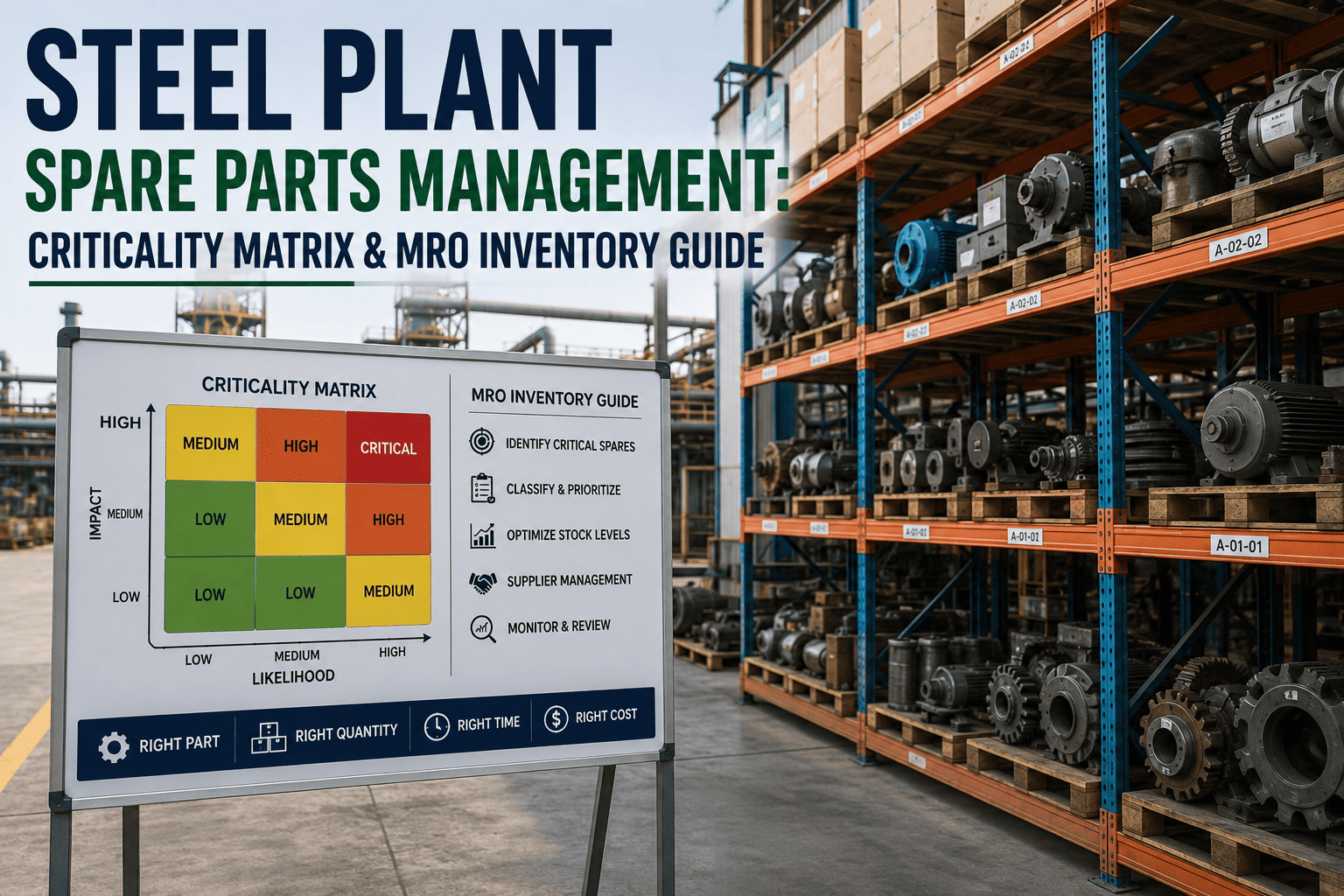
Critical parts run out while shelves overflow with slow-moving stock nobody has touched in years. Flat reorder-point logic treats a mill roll bearing the same as a shop rag. A criticality matrix fixes this by scoring every SKU on two axes: how badly production suffers if it fails, and how hard it is to replace.
Building the Criticality Matrix: Impact vs Supply Risk
| Matrix Quadrant |
Example Steel Plant Part |
Stocking Policy |
| High impact, high supply risk |
EAF transformer, custom-forged mill roll, blast furnace tuyere |
Insurance stock, held at near 100% availability regardless of carrying cost |
| High impact, low supply risk |
Precision mill stand bearings from a regional distributor |
Moderate min/max levels with a certified backup supplier |
| Low impact, high supply risk |
Specialty refractory grade used on one furnace only |
Light buffer stock, reviewed against actual consumption |
| Low impact, low supply risk |
Conveyor idler rollers, general fasteners, shop consumables |
Order-on-demand, no dedicated shelf space required |
Link Every Spare Part to the Asset It Protects
Oxmaint connects equipment criticality directly to parts stocking policy, so min/max levels are set by risk, not guesswork. Sign up for a free trial to score your own storeroom, or book a demo and we'll walk through your plant's SKU list together.
ABC Classification: Where the Capital Actually Sits
| Class |
Typical Share of SKUs |
Review Cadence |
| A - High value |
Roughly 10-20% of SKUs, majority of inventory value |
Monthly stock count and demand review |
| B - Moderate value |
Around 30% of SKUs, moderate share of value |
Quarterly review against consumption trend |
| C - Low value |
Remaining bulk of SKUs, small share of value |
Annual review, simple two-bin replenishment |
Flat Reorder Logic vs Criticality-Based Stocking
Flat Reorder Logic
Every part reordered at the same low-stock trigger, regardless of downtime cost
Slow-moving insurance spares get flagged for "cost cutting" during budget season
Emergency air-freight orders become routine for parts that should have been on the shelf
Criticality-Based Stocking
Reorder points set by downtime cost and lead time, not just shelf quantity
Insurance spares carry documented risk justification, protected from blanket cuts
Low-risk parts move to order-on-demand, freeing warehouse space and working capital
How Oxmaint Supports Steel Plant MRO Inventory
Oxmaint ties each spare part record to the specific asset and failure mode it protects, so criticality scores update automatically as equipment history grows. Min/max levels, supplier lead times, and reorder triggers live on one CMMS record instead of scattered spreadsheets. Book a demo to see it mapped against your own parts catalog.
Frequently Asked Questions
Q
Why does a low-cost part sometimes deserve insurance stocking?
Cost isn't the driver, downtime consequence is. A part worth a few thousand dollars that halts an entire rolling line still justifies dedicated shelf space if the lead time to replace it runs into months.
Q
How often should a criticality matrix be reassessed?
Reassess whenever equipment, suppliers, or production priorities change, and at minimum once a year. Studies of large steel plants have found that a meaningful share of parts originally marked non-critical were later reclassified after failure data came in.
Q
What's the fastest first step toward criticality-based stocking?
Start with the A-class SKUs from an ABC breakdown, score just those on impact and supply risk, and set documented min/max levels before expanding the exercise to the rest of the storeroom.
Turn Your Storeroom Into a Risk Mitigation Asset
Oxmaint gives steel plant teams criticality scoring, ABC classification, min/max stocking rules, and asset-linked parts records in one CMMS platform. Sign up for a free trial to explore it yourself, or book a demo and we'll walk through it against your own storeroom.