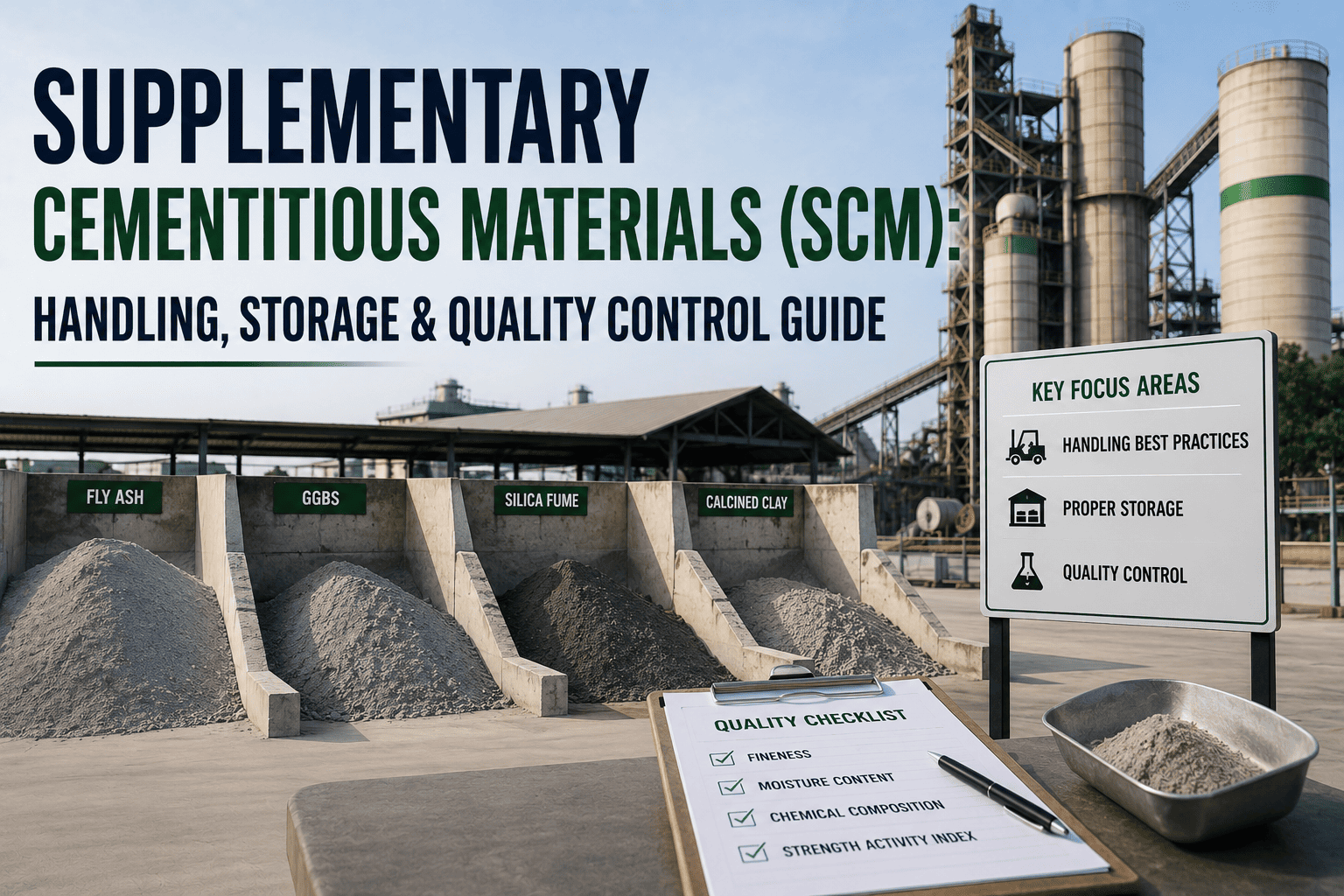
Supplementary Cementitious Materials (SCM): Handling, Storage & Quality Control Guide

By Mark strong on July 20, 2026

supplementary-cementitious-materials-scm-handling-quality-control

Clinker grinds easily, slag fights back, and fly ash reacts differently depending on which power plant it came from last month. Treat every supplementary cementitious material like clinker in storage and milling, and the blended cement that comes out the other end will quietly disappoint on strength or workability. Sign up to see how Oxmaint tracks SCM handling, moisture, and quality checkpoints as part of your plant's maintenance record.

Up to 50%
Clinker reduction achievable with Limestone Calcined Clay Cement (LC3)
~30%
Lower global warming potential when clinker is partially replaced with slag (CEM III)
Up to 55%
Lower global warming potential achievable with fly ash clinker replacement
28 days
Point at which most SCM blends match or exceed OPC compressive strength
Why SCMs Can't Be Handled Like Clinker

Most SCMs rely on pozzolanic reactions that develop after initial hydration, so a blended cement typically shows lower strength at one to seven days compared with ordinary Portland cement before catching up by 28 days. LC3 is the exception, often matching OPC early strength through its calcined clay and limestone synergy. That early-strength gap is exactly why storage moisture, fineness, and carbon content need tighter control on SCMs than on clinker.

Four SCMs, Four Very Different Handling Needs

Material Key Property to Watch Handling Consideration
Fly ash (Class C/F) Loss on Ignition (carbon content) High LOI interferes with air-entraining admixtures, so incoming loads need routine LOI checks
GGBFS (slag) Grindability and early strength Much harder to grind than clinker, so intergrinding risks over-ground clinker and under-ground slag
Silica fume Ultrafine particle handling and dust control Extremely fine particles increase water demand and need densified or slurry handling to control dust
Calcined clay (LC3) Kaolinite content and calcination consistency Reactivity depends on calcination quality, so incoming clay batches need kaolinite content verification
Log SCM Quality Checks Alongside Equipment Maintenance

Oxmaint keeps LOI results, fineness readings, and incoming batch quality checks on the same platform as mill and conveyor maintenance, so a raw material issue and a grinding circuit issue never get investigated in isolation. Sign up for a free trial to see it against your own SCM intake process, or book a demo and we'll walk through your plant's blending setup.

Intergrinding vs Separate Grinding for Blended Cement

Intergrinding Clinker and SCM
Single mill pass for clinker and slag or calcined clay together
Easier-to-grind clinker often becomes over-ground, raising water demand
Harder slag can remain too coarse, cutting its reactivity short
Separate Grinding, Then Blending
Each material ground to its own optimum fineness before blending
Clinker fineness and slag reactivity both controlled independently
More equipment complexity, but generally the recommended best practice for high-SCM blends
How Oxmaint Supports SCM Quality Control

Oxmaint links incoming SCM batch data, storage silo conditions, and mill grinding performance to one asset record, so a strength complaint can be traced back to the exact batch, silo, and grinding pass involved. Preventive maintenance schedules for storage silos and separate grinding circuits sit next to the quality data they affect. Book a demo to see it mapped against your own blended cement process.

Frequently Asked Questions

Q Why does fly ash quality vary between deliveries?
Fly ash composition depends on the coal source and combustion conditions at the power plant that produced it, so Class C and Class F ash can behave quite differently even from the same supplier over time. This is exactly why routine LOI and composition checks matter on every incoming load.
Q Does a low clinker factor mean weaker concrete?
Not by 28 days. Most SCM blends show lower strength in the first week because pozzolanic reactions take time to develop, but they typically match or exceed ordinary Portland cement strength by 28 days and keep gaining strength for years after.
Q Why is LC3 gaining attention over traditional SCMs?
LC3 can cut clinker content by up to half while still matching OPC early strength, largely because it doesn't depend solely on slow pozzolanic reaction. It also avoids the supply uncertainty now affecting fly ash as coal-fired power plants are decommissioned.

Give Every SCM Batch the Same Level of Scrutiny as Your Equipment

Oxmaint gives cement plant teams SCM batch quality tracking, storage silo condition monitoring, grinding circuit maintenance records, and traceability from intake to blended cement in one platform. Sign up for a free trial to explore it yourself, or book a demo and we'll walk through it against your own SCM process.


Share This Story, Choose Your Platform!