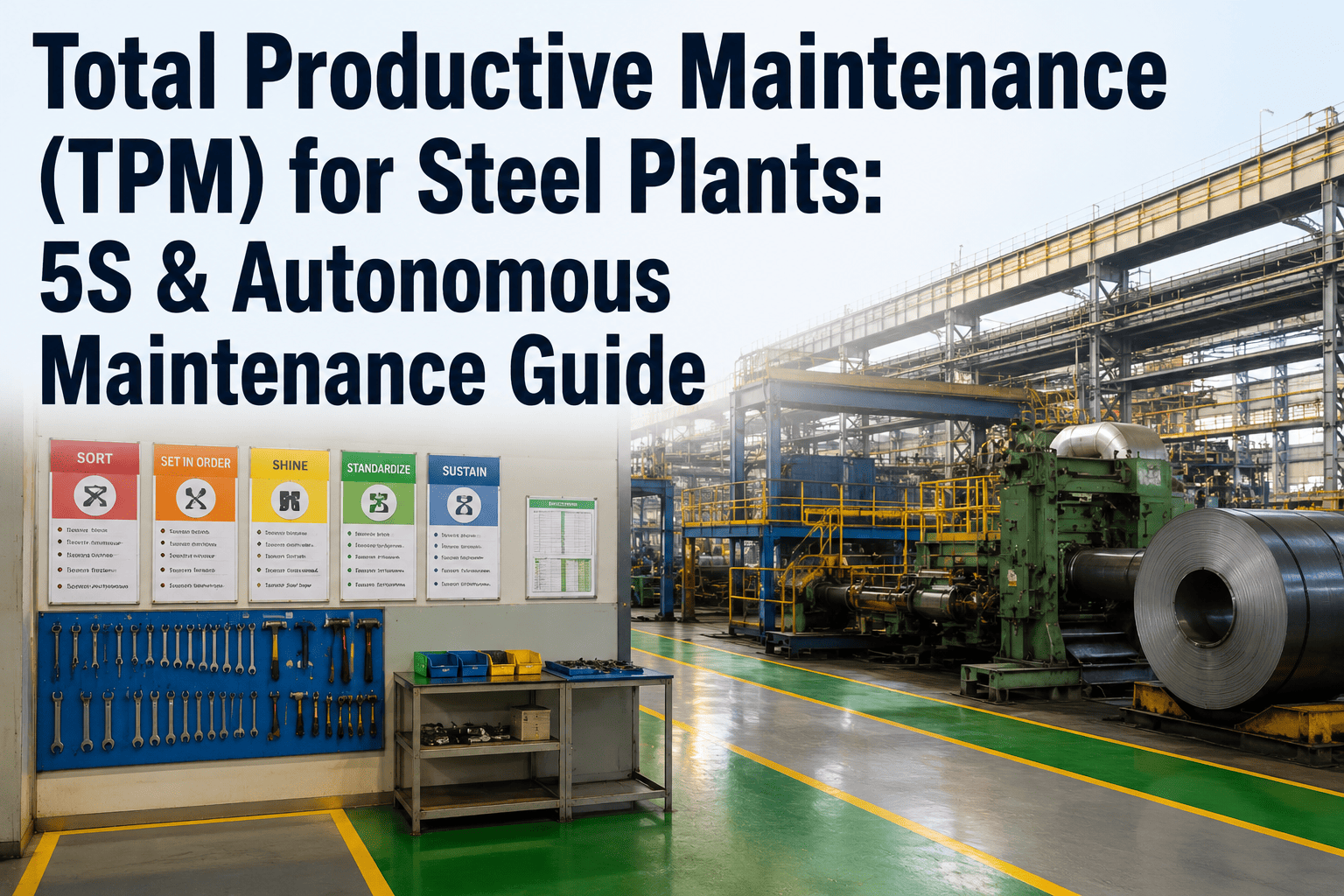
Most steel plants already have a maintenance schedule. What they don't have is operators who catch a loose bolt, a leaking hose, or a hairline crack before it becomes a breakdown. That gap is exactly what Total Productive Maintenance closes, by handing routine care of the equipment to the people standing next to it every shift. Sign up to see how Oxmaint turns 5S and CILT checklists into a live part of your daily floor routine.
15-25%
Typical OEE improvement reported after a full TPM rollout
50-70%
Reduction in breakdowns once autonomous maintenance is running properly
4 Steps
Clean, Inspect, Lubricate, Tighten — the CILT routine operators own daily
6-9 Months
Typical timeline to get 5S and autonomous maintenance fully adopted on the floor
Why TPM Stalls in Most Steel Plants
TPM programs usually launch with a big 5S cleanup and a poster on the wall, then quietly fade once the initial push wears off. The plants where it sticks treat 5S as the housekeeping layer and CILT as the daily habit layer, then track both against OEE so operators can see the direct link between a five-minute inspection and a shift that didn't lose two hours to a roll bearing failure.
5S on a Steel Plant Floor: What Each Step Actually Looks Like
| 5S Step |
On the Floor |
What It Prevents |
| Sort |
Clear scrap, unused tooling, and old spares off the roll shop and mill floor |
Wasted search time and tripping hazards near moving equipment |
| Set in Order |
Fixed, labeled spots for grease guns, gauges, lockout tags near each asset |
Skipped CILT steps because the tool wasn't within reach |
| Shine |
Cleaning that doubles as inspection — dust hides leaks, cracks, loose guards |
Early-stage faults going unnoticed until they escalate |
| Standardize |
Same CILT checklist and layout across every shift and every crew |
Good habits from one shift disappearing on the next |
| Sustain |
Supervisors auditing checklists and OEE trends, not just filing them |
The whole program quietly dying after the first few months |
Turn CILT Checklists Into Data, Not Paper
Oxmaint puts your 5S audits and CILT routines on a mobile checklist tied straight to each asset, so a flagged defect creates a work order automatically instead of sitting on a clipboard. Sign up for a free trial to build your first checklist, or book a demo and we'll set up your roll shop as an example.
Autonomous Maintenance: The CILT Routine That Does the Heavy Lifting
| CILT Step |
Operator Action |
Typical Catch |
| Clean |
Wipe down drives, bearings, and guards at shift start |
Oil seepage and coolant leaks before they pool |
| Inspect |
Quick visual and sound check against a fixed checklist |
Unusual vibration or noise in motors and gearboxes |
| Lubricate |
Top up grease points on a fixed frequency, not by memory |
Bearing wear from over-greasing or missed points |
| Tighten |
Check bolts, couplings, and fasteners flagged as loose last shift |
Misalignment that would otherwise snowball into downtime |
Reactive Maintenance vs a Working TPM Program
Without TPM
Maintenance crew finds out about a fault only when the line stops
Cleaning is a housekeeping task, disconnected from inspection
OEE gets reviewed monthly, after the losses are already locked in
With TPM
Operators catch and log faults during their own daily CILT round
5S and inspection happen together, so cleaning surfaces real defects
OEE is tracked per shift, so a slipping trend gets caught early
How Oxmaint Supports a TPM Rollout
Oxmaint digitizes the 5S audit and CILT checklist so every operator round is logged against the actual asset, not a paper form that gets lost. Flagged defects convert into work orders automatically, and OEE dashboards roll the data up so supervisors can see which line, shift, or asset is dragging the numbers down. Book a demo to see it mapped to your existing shift structure.
Frequently Asked Questions
Q
What's the actual difference between TPM and regular preventive maintenance?
Preventive maintenance is scheduled by the maintenance team on a calendar. TPM adds a daily layer run by operators themselves, so basic care and early fault detection happen every shift, not just when a technician's route comes around.
Q
Do operators need training before they can run CILT routines?
Yes, but it's usually short. A basic CILT round covers cleaning, a visual and sound inspection, lubrication points, and fastener checks — most crews are running it confidently within a few guided sessions.
Q
How does 5S connect to OEE improvement?
A clean, organized floor makes early-stage faults visible and cuts the time crews spend hunting for tools or parts during a changeover. Both effects show up directly in availability and performance, two of the three OEE components.
Q
What's the smallest way to pilot TPM without disrupting production?
Pick one line or one asset, roll out 5S and a basic CILT checklist there first, and track OEE before and after. Once the pattern holds for a few weeks, expand it line by line instead of plant-wide on day one.
Give Your Operators the Checklist, Give Yourself the Data
Oxmaint gives steel plant teams digital 5S audits, CILT checklists, automatic work order creation, and shift-level OEE tracking in one platform. Sign up for a free trial to build your first checklist, or book a demo and we'll walk through it against your own lines.