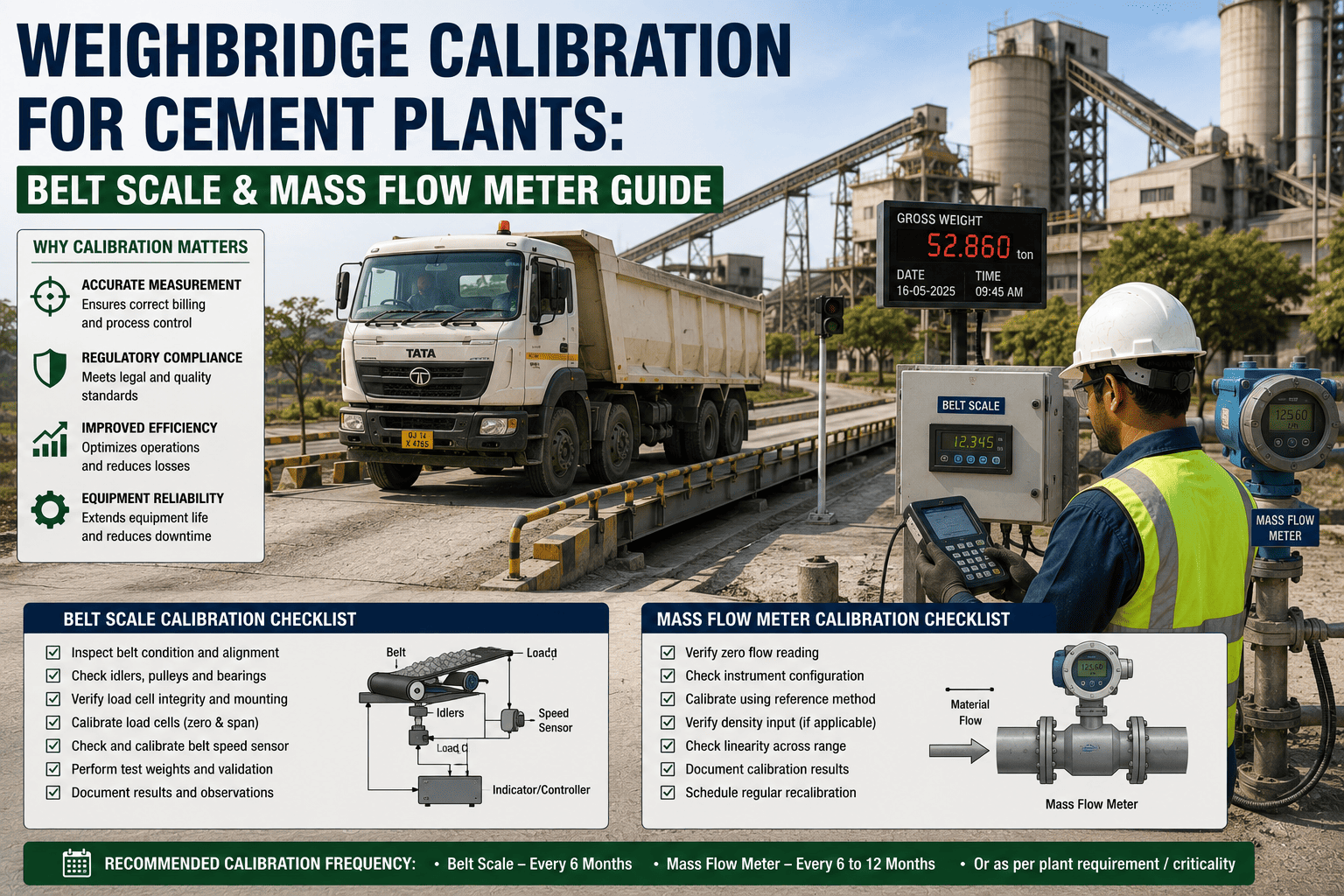
Every tonne of clinker, every batch of raw mix, and every truck leaving the gate depends on a number coming off a scale being right. In a cement plant, that number decides raw mix ratios, fuel dosing, dispatch billing, and yes, the Scope 1 and Scope 2 figures that eventually land on an ESG form. Sign up to see how Oxmaint keeps belt scales, mass flow meters, and weighbridges on a calibration schedule that never slips.
±0.25%
Typical accuracy tolerance expected from a well-calibrated belt weigher
4 Systems
Main weighing instruments a cement plant relies on daily
Quarterly
Common calibration cycle recommended for in-service belt scales
Daily
Recommended frequency for a quick zero-point check on active scales
Why A Drifting Scale Is An Expensive Problem
A belt weigher that drifts by even one percent changes the raw mix ratio going into the kiln, throws off fuel dosing, and quietly distorts every production and dispatch record downstream. Most plants only catch the drift after a customer disputes a delivery weight or a quality report stops adding up.
The Four Weighing Systems Every Cement Plant Runs
| Instrument |
What It Measures |
Calibration Method |
| Belt Weigher |
Continuous material flow on a conveyor |
Test chain run or material test against a known weight |
| Mass Flow Meter |
Rate of mass moving through a pipe or chute |
Reference flow comparison against a certified batch |
| Dosing Scale |
Precise batch weight for raw mix or additives |
Certified test weights applied at zero and span points |
| Truck Weighbridge |
Gross and net vehicle weight at dispatch |
Load cell verification with certified test weights or a test truck |
Never Miss A Calibration Date Again
Oxmaint schedules calibration for every belt weigher, mass flow meter, dosing scale, and weighbridge automatically, then logs the certificate against the asset the moment it's done. Sign up for a free trial to connect your first scale, or book a demo to see the calibration workflow.
A Calibration Run, Step By Step
| Step |
What Happens |
| Pre-Check |
Belt or chute inspected for buildup, alignment issues, or mechanical wear before any reading is trusted |
| Zero Calibration |
Scale set to read zero with no material present, correcting for any baseline drift |
| Span Calibration |
Known test weight or test chain applied to align the scale's upper reading range |
| Load Simulation |
A material or test run confirms accuracy holds across normal operating loads, not just at zero and span |
| Certification |
Results, tolerances, and technician sign-off recorded against the asset for the next audit |
Tracking Calibration On Paper vs On A CMMS
Paper-Based Tracking
Calibration due dates tracked in a logbook or spreadsheet that's easy to overlook
Certificates filed away, hard to pull up quickly during an audit
Overdue scales often only noticed after a dispute or a bad reading
CMMS-Backed Tracking
Calibration schedules trigger automatic work orders before a due date is missed
Certificates and results stored against the exact asset, ready for instant lookup
Drift patterns visible over time, so a slipping scale is flagged before it causes a problem
Where A CMMS Fits Into Calibration Work
Oxmaint turns every belt weigher, mass flow meter, dosing scale, and weighbridge into a tracked asset with its own calibration calendar, so technicians get the work order automatically and the certificate lands in the same place every time.
Frequently Asked Questions
Q
How often should a belt weigher be calibrated in a cement plant?
Most plants run a full calibration every quarter, with a quick zero-point check done daily or weekly to catch drift early between formal calibration runs.
Q
What's the real difference between a belt scale and a mass flow meter?
A belt weigher measures material sitting on a moving conveyor, while a mass flow meter measures material moving through an enclosed line, so their calibration references and typical placement in the plant differ.
Q
Can a CMMS actually manage calibration schedules and certificates?
Yes, a CMMS can trigger calibration work orders on a set cycle, capture technician sign-off, and store the resulting certificate against the asset so it's ready whenever an audit or customer dispute comes up.
Keep Every Scale In The Plant Accurate And Audit-Ready
Oxmaint tracks calibration due dates, certificates, and drift history for every belt weigher, mass flow meter, dosing scale, and weighbridge in one place. Sign up for a free trial to connect your first scale, or book a demo to see the calibration workflow in action.