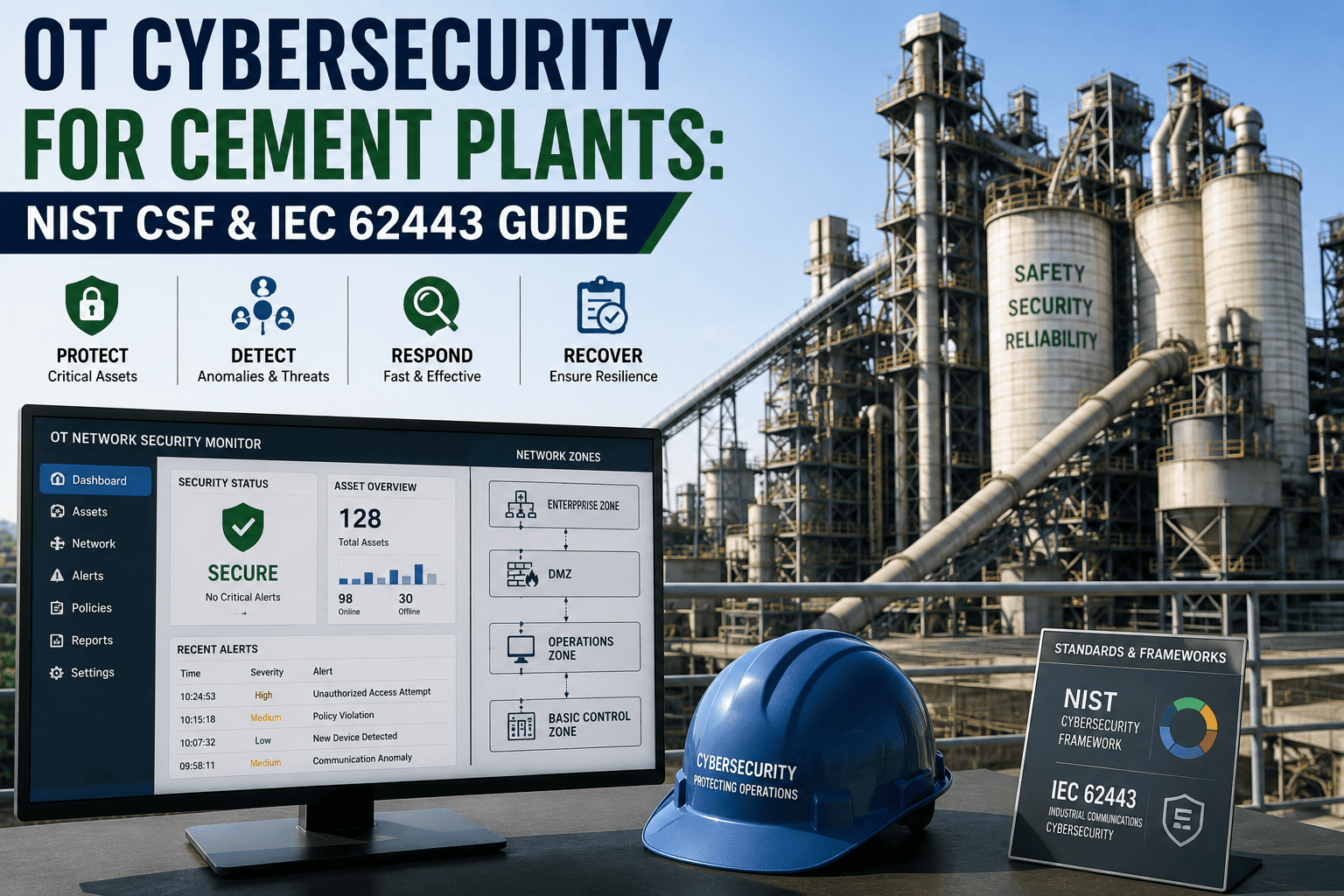
A cement plant's kiln PLC and a laptop in the front office were never meant to speak the same language, but on most industrial networks today they sit one hop apart. One infected USB drive or one unpatched remote access tool is all it takes to stop a kiln, and most plants only find out their OT network was exposed after the fact. Sign up to see how Oxmaint connects secured OT monitoring to CMMS work orders without opening new pathways into the control network.
5 Functions
NIST CSF core functions plants use to structure an OT security program
SL 0-4
IEC 62443 security levels used to rate each control zone's required defenses
Zero Trust
Read-only integration model that avoids writing anything back into the DCS or SCADA
4-6 wks
Typical time to segment, monitor, and connect a first control zone securely
The Blind Spot Most Cement Plants Are Carrying
Kiln PLCs, mill drives, and crusher controllers were designed for uptime, not for resisting an attacker. Once a vendor laptop, a remote support session, or a flat network puts those controllers within reach of IT systems, the plant inherits every IT-side risk without any of the OT-side visibility to catch it early. NIST CSF and IEC 62443 exist to close exactly that gap.
Mapping NIST CSF to a Cement Plant Floor
| NIST CSF Function |
What It Looks Like on the Plant Floor |
| Identify |
Inventory every PLC, HMI, VFD, and historian tag feeding the kiln, mill, and crusher lines |
| Protect |
Segment control zones, lock down remote access, and enforce least-privilege on engineering workstations |
| Detect |
Monitor OT network traffic and alarm patterns for anything outside normal process behavior |
| Respond |
Trigger a defined incident workflow the moment an anomaly is confirmed, not after production stops |
| Recover |
Restore controllers from known-good backups and reconcile equipment history once systems are clean |
See Asset Health Without Touching the Control Network
Oxmaint reads OT and historian data through a one-way integration layer, so nothing is ever written back into the PLC, DCS, or SCADA system your security team has already locked down. Sign up for a free trial to connect a monitored zone, or book a demo to walk through your plant's current segmentation.
IEC 62443 Security Levels for Each Control Zone
| Security Level |
Protection Against |
Typical Cement Plant Zone |
| SL 1 |
Casual or accidental exposure |
Non-critical utility monitoring |
| SL 2 |
Intentional violation with low resources |
Packing and dispatch systems |
| SL 3 |
Sophisticated attacker with moderate resources |
Mill and crusher control zones |
| SL 4 |
State-level attacker with extended resources |
Kiln DCS and safety instrumented systems |
Flat Network vs Zoned and Monitored Network
Flat, Unsegmented Network
IT and OT traffic share the same network, so one compromised laptop reaches the kiln controller
No baseline exists for normal PLC or SCADA behavior, so anomalies go unnoticed
A single vendor remote session can touch every zone in the plant at once
Zoned, Monitored Network
Zones and conduits per IEC 62443 keep kiln, mill, and crusher controllers isolated from the business network
Read-only monitoring flags abnormal tag values and routes them straight to a work order
Every remote session is scoped to a single zone with its own logging and time limits
Where CMMS Fits Into an OT Security Program
A secured OT network is only useful if the anomalies it detects turn into action. Oxmaint sits outside the control zone entirely, reading historian and alarm data through a one-way feed and converting confirmed anomalies into prioritized work orders, complete with the equipment history a technician needs before they ever log into a controller.
Frequently Asked Questions
Q
Do we need both NIST CSF and IEC 62443?
They work at different levels. NIST CSF structures the overall program across Identify, Protect, Detect, Respond, and Recover, while IEC 62443 provides the technical zone, conduit, and security-level detail for the control systems themselves.
Q
Where should a cement plant start if nothing is segmented yet?
Start with an asset inventory of every PLC, HMI, and historian tag, then draw zone boundaries around the kiln, mill, and crusher before adding monitoring, since segmentation without visibility still leaves the plant blind to what is happening inside each zone.
Q
Does connecting a CMMS to OT data increase the attack surface?
Not when the integration is one-way. A read-only historian feed exposes data outward without opening any inbound path back into the PLC, DCS, or SCADA system, so the security posture of the control zone stays unchanged.
Secure the Network, Then Act on What It Tells You
Oxmaint pairs with a segmented, IEC 62443-aligned OT network to turn monitored anomalies into structured, prioritized work orders, without ever writing back into the control system. Sign up for a free trial and connect your first monitored zone, or book a demo to review your plant's current segmentation.